
Tree Removal Cost: How Much You'll Pay by Size and Extras
Here is the short answer to how much is a tree removal cost : most homeowners pay between $200 and $2,000, with a national average near $750. Small trees under 30 feet can come down for $150 to $450, while tall trees close to a house or power lines can reach several thousand dollars. Stump grinding, cleanup, permits, and cranes are usually priced on top.
A tree removal quote is really a price for time and risk, not for the tree. A crew has to climb or rig, lower every piece under control, haul or chip the debris, and carry insurance for the day something goes wrong. That is why two quotes for the same tree can differ by hundreds of dollars, and why the lowest number is rarely the best one.
At Alexa's Tree Service, we have removed trees across Vancouver, Portland, and nearby Pacific Northwest towns since 2006. The examples below come from what we see on real jobs: tall Douglas firs, bigleaf maples, and storm-damaged trees on tight lots. This guide shows what drives the price, how to estimate your own number by height, which extras to budget for, and how to compare quotes line by line.
Why tree removal cost varies so much
Tree removal cost varies so much because you pay for labor, equipment, and risk, and every tree brings a different mix of the three. The wood has no value to the crew. Getting it down without damage is the product you are buying.
What the average price hides
National data puts the average tree removal cost near $750 , with most jobs landing between $200 and $2,000 . The extremes sit far apart. A small ornamental can come down for around $150, while a very large tree tangled with power lines can pass $10,000. Published state averages for Washington run roughly $550 to $800, but tall conifers push many Pacific Northwest tree removal prices above that.
Averages blend easy jobs with hard ones. Treat them as a sanity check, not a budget. Your tree's height, its distance from your house, and what surrounds it matter more than any statewide figure.
The average tells you what a typical tree costs, and your tree is rarely typical.
The three things inside every quote
Every price you receive breaks down into the same three parts:
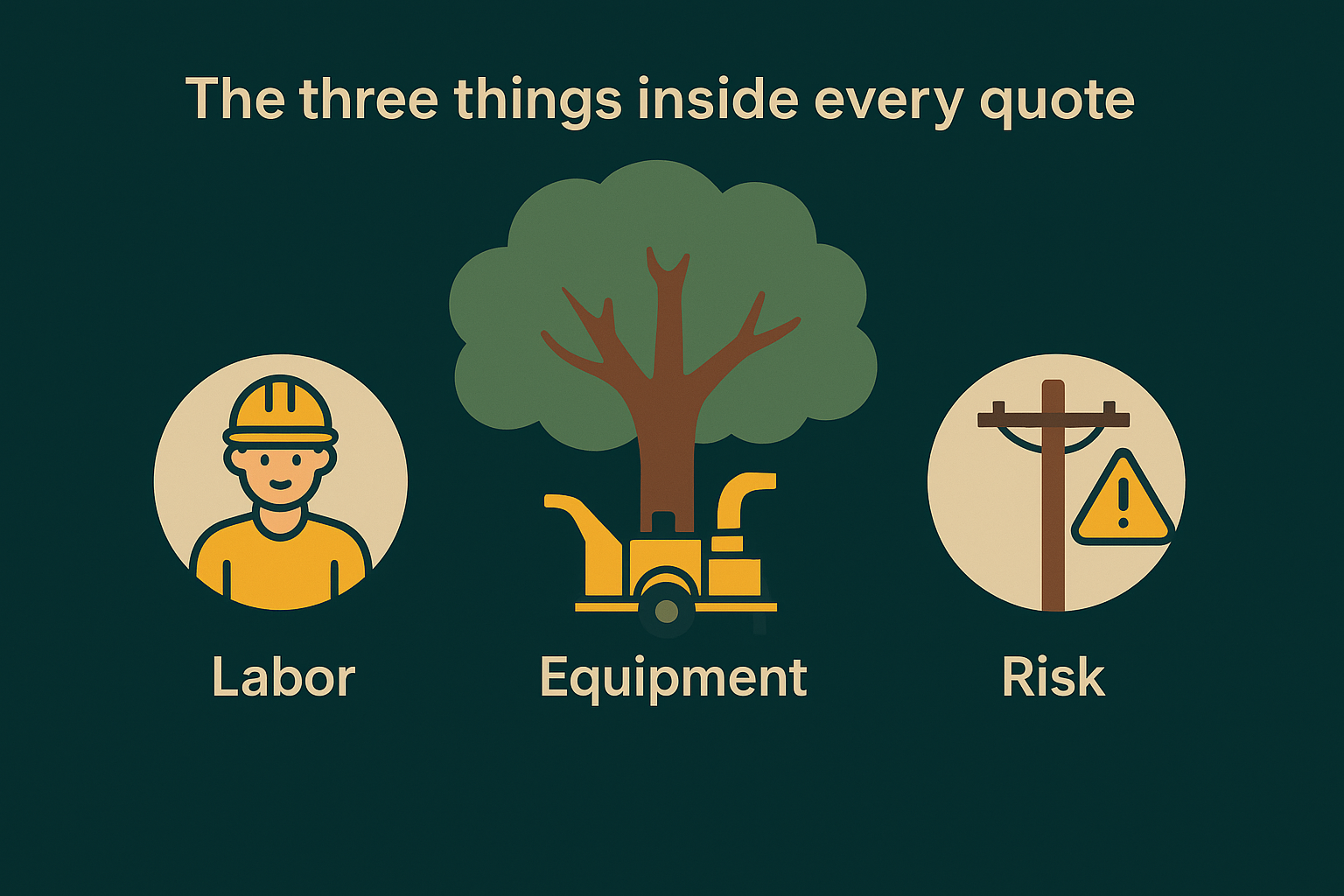
- Labor. Crew size multiplied by hours on site. Climbers, ground crew, and a truck driver all count.
- Equipment. Chippers, rigging gear, bucket trucks, and sometimes a crane. Each one adds to the cost of the day.
- Risk. Distance to roofs, fences, cars, and power lines, plus the insurance that covers a mistake.
A tree that is tall, close to a roof, and hard to reach scores high on all three. That is why the price climbs faster than height alone suggests.
Why the cheapest quote can cost the most
Low bids often leave something out. The crew may lack the rigging to lower heavy sections, skip cleanup, or leave stump grinding off the written price. Some general landscapers carry coverage that does not extend to work high in a tree, so ask for proof of liability insurance and workers' compensation before you sign anything.
Consider what happens when a limb lands on your roof or a worker gets hurt on your property. Without proper coverage, the bill can land on you. Saving $200 on the quote is a poor trade against a $5,000 repair. A fair price pays for trained climbers, the right equipment, and real coverage .
How to estimate your tree removal cost by height
Start with height. On open ground with easy access, expect $150 to $450 up to 30 feet , $450 to $1,200 from 30 to 60 feet, $800 to $1,500 from 60 to 80 feet, and $1,000 to $2,000 above 80 feet. Use those ranges as your baseline, then adjust for the factors in the later sections.
Price ranges by tree height
The table below combines national ranges with what we see on typical residential jobs. It also answers the common searches for a 30 foot, 40 foot, 50 foot, and 100 foot tree.
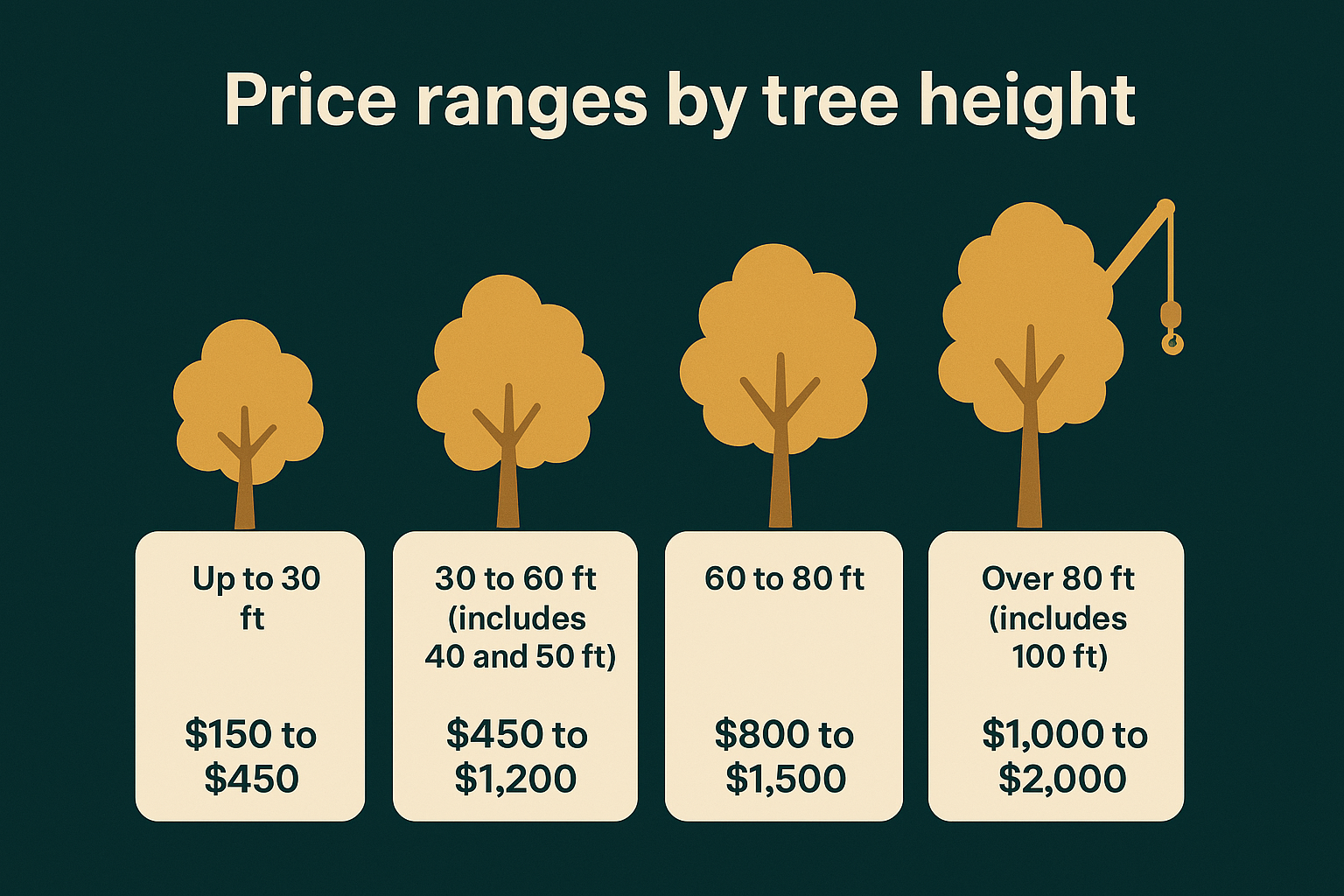
| Tree height | Typical range, easy access | What moves the price |
|---|---|---|
| Up to 30 ft | $150 to $450 | Small ornamentals and young trees. Often a half-day job for one crew. |
| 30 to 60 ft (includes 40 and 50 ft) | $450 to $1,200 | Most backyard trees. Trunk width and nearby structures matter most. |
| 60 to 80 ft | $800 to $1,500 | Climbing and rigging are needed to lower sections by rope. |
| Over 80 ft (includes 100 ft) | $1,000 to $2,000 | A crane is often needed, adding around $500 or more. |
Real local quotes for big trees often run higher than this table. A large tree in an ordinary front yard can cost about $2,500, and the same tree behind a house with a fence, shed, and power lines in the way can cost two to three times that.
You do not need a ladder to estimate height. On a sunny day, measure your own shadow and the tree's shadow at the same moment. Multiply the tree's shadow length by your height, then divide by your shadow length. The result is the tree's height, close enough to match it to a range.
Cost per foot and per hour
Some crews price by the foot. Working backward from the ranges above gives roughly $10 to $25 per foot on ordinary jobs, with the high end for wide trunks and cramped spots. A 40 foot tree at $15 a foot lands near $600. Treat the per-foot number as a sanity check , not a rate card.
Hourly pricing is less common, because hours depend on risk. Small trees take a couple of hours, mid-sized trees take four to eight, and large trees can take one or two full working days. If a company quotes hourly, ask how many crew members and which equipment the rate covers, then compare the estimated total across bids, not the rates.
Height sets the starting price, and access sets the final one.
Three worked examples
These examples add the extras from the next section to show how a total takes shape. They are illustrations built from national ranges, not quotes.
| Scenario | Removal | Extras | Rough total |
|---|---|---|---|
| 25 ft ornamental, open lawn | $150 to $450 | Hauling about $70, stump $100 to $150 | $320 to $670 |
| 55 ft tree, backyard, average access | $450 to $1,200 | Chipping about $95, stump $100 to $150 | $645 to $1,445 |
| 90 ft tree, near house and power lines | $1,000 to $2,000 | Crane from about $500, access surcharge of 25% to 50% | Often well into the thousands |
The third row shows why tall trees near structures are the hardest to budget. Several costs stack, and a site visit is the only way to price them honestly.
What stump grinding, cleanup, and other extras cost
Extras add roughly $100 to $400 to a simple job and thousands to a complex one. The base price usually covers cutting the tree down and little else, so ask what each add-on costs before you compare totals.
Stump grinding and debris
Stump grinding typically costs $100 to $150 for the first stump and about $50 for each additional one. A tree removal quote rarely includes it unless you ask. Bundling it into the original quote is usually cheaper than booking a second visit later, since the crew is already on site.
Cleanup varies by what you want done with the wood. Hauling a tree away runs about $70, chipping averages around $95, and splitting wood into firewood is about $70. If you can use wood chips as mulch or want firewood, say so, because you may be able to keep the material and shave the haul-away fee.
Permits, reports, and cranes
The table collects the other add-ons that appear on quotes.
| Extra | Typical cost | When it applies |
|---|---|---|
| Tree removal permit | $60 to $150 | Where local rules regulate larger or protected trees |
| Arborist report | About $860 on average | When a city requires a written assessment for the permit |
| Crane service | From about $500, up to several thousand | Tall trees, or trees that cannot be dropped safely |
| Pruning remaining trees | $75 to $1,500 | When you want the crew to trim other trees during the same visit |
Permit rules differ by city and county. Portland and many Clark County jurisdictions regulate some larger or protected trees, so check with your city before you book. We guide Vancouver customers through the permit process, and it is worth asking any company whether it will handle the paperwork.
A quote that does not name the stump, the cleanup, and the permit is only a partial price.
What pushes a tree removal quote up or down
Access, tree condition, and urgency move the tree removal cost more than species or brand of equipment. A hard-to-reach tree can cost 25% to 50% more, a dying tree can swing either direction, and an emergency call carries a premium.
Access and surroundings
Crews charge 25% to 50% more when the tree stands in a tight, sloped, or hard-to-reach spot. Power lines add more, because the crew must work around live wires or coordinate with the utility. Fences, sheds, gardens, and patios mean pieces must be lowered by rope instead of dropped, which takes longer.
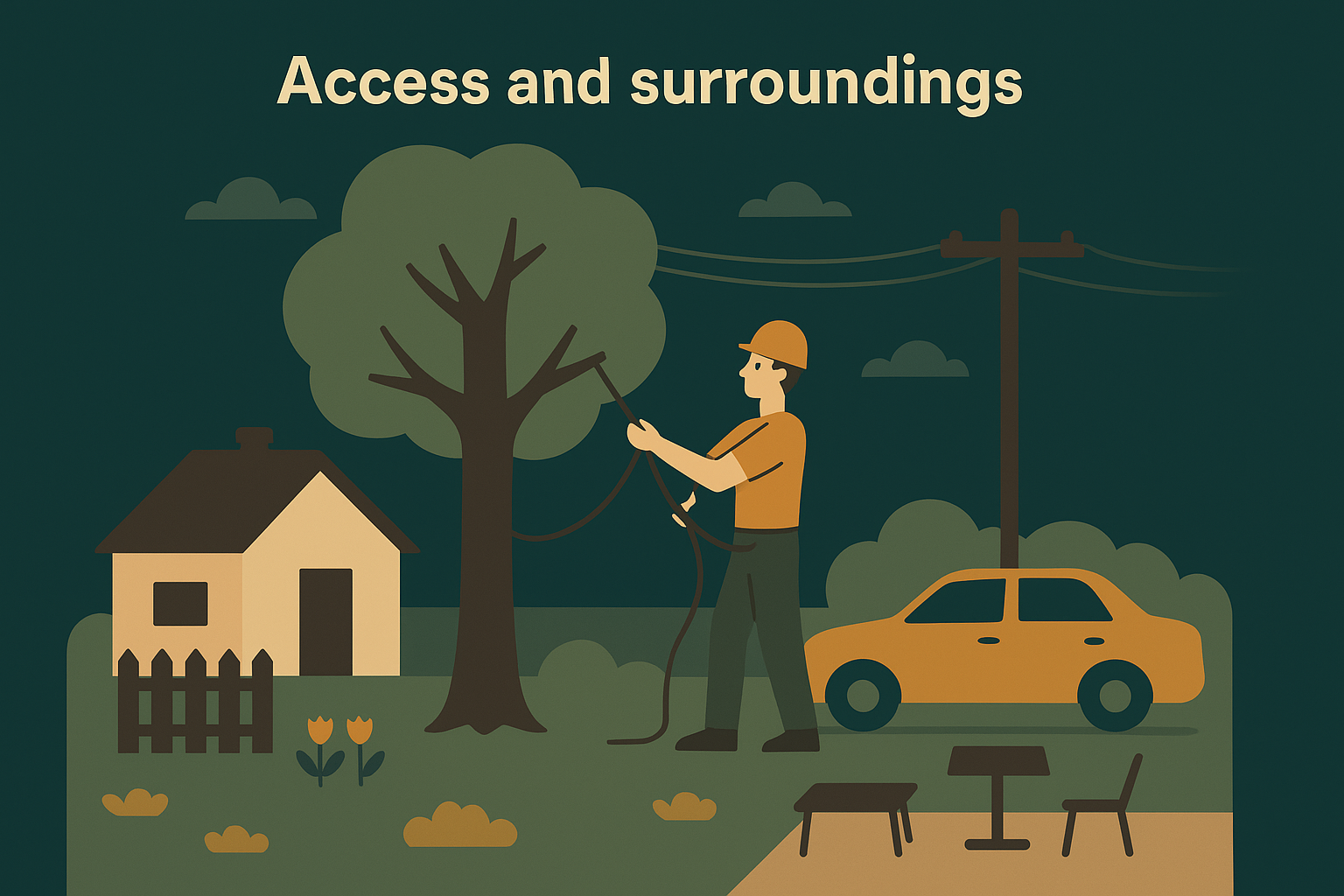
You can cut some of this cost. Move vehicles, patio furniture, and yard ornaments out of the way before the crew arrives. If a fence section needs to come down for access, agree on that during the estimate.
Tree condition and species
Dead trees do not always cost less. Soft or brittle wood can be quicker to cut, and diseased trees sometimes price from $400 to $900. But a dead tree can also fail without warning, so crews may need extra rigging or a crane to work safely, and that raises the price. Trees already on the ground are cheaper because there is nothing to climb, often a few hundred dollars.
Species matters in smaller ways. Big hardwoods with heavy limbs take longer to lower, and tall conifers need more rigging. Some cities also protect certain heritage trees, so a permit or arborist report may be part of the job.
Emergencies and timing
Emergency removal costs more because crews drop scheduled work to respond. After a storm, it is not unheard of to pay up to $5,000 when a tree is leaning on a home. We run storm cleanup around the clock because those jobs cannot wait.
Call your insurer before the tree is removed if it hit your house. Homeowners policies often cover storm damage, and coverage can depend on what the tree struck. Take photos first, since adjusters may want to see the damage. Outside of emergencies, winter is often a good time to book. Crews are typically less busy, and trees carry less foliage to deal with.
An emergency is the one situation where you pay for speed, so avoid creating one by acting on a dying tree early.
How to compare tree removal quotes
Compare tree removal quotes by asking each company to price the same scope in writing, then check what every line includes. The bottom number means little until you know what sits behind it.
What a complete quote spells out
A reliable estimate requires someone to see the tree and its surroundings, so be wary of firm prices given by phone. A complete written quote includes:
- The tree's species, approximate height, and location on your property
- How the crew will take it down, such as climbing, rigging, or crane
- What happens to the wood and debris
- Whether stump grinding is included, and how deep
- Who handles the permit, and what it costs
- Proof of liability insurance and workers' compensation
- The expected date, duration, and payment terms
Get at least three written quotes and lay them side by side. When one is much lower, find the line that is missing before you celebrate.
A message that gets comparable quotes
Sending the same request to every company keeps the comparison fair. Copy this and fill in the brackets:
 Hi, I'd like a written estimate to remove one [species] tree at [address].

Height: about [__] ft. Trunk diameter at chest height: about [__] inches.
Location: [front yard / backyard / near house / near power lines].
Access: [gate width, fences, slope].

Please itemize:
1. Tree removal (crew size and equipment)
2. Debris hauling or chipping
3. Stump grinding (depth and cleanup of grindings)
4. Permit or arborist report, if needed
5. Crane or bucket truck, if needed

Please also send proof of liability insurance and workers' compensation,
the expected start date, and how long the job will take.
Photos from two angles help the company give a closer first estimate, though a site visit still settles the final price.
Red flags worth walking away from
Some warning signs show up again and again after storms and on low bids:
- No proof of insurance, or a refusal to show it
- A large cash deposit demanded before any work
- A single lump price with no breakdown
- Pressure to decide on the spot
- A suggestion to top a healthy tree instead of removing or pruning it properly
Any one of these is enough to keep looking. A professional company welcomes questions about coverage and scope.
Compare scope first and price second, because a cheap quote with missing lines is a bigger bill waiting to happen.
How to pay less without cutting corners
You can lower your tree removal cost by bundling work, booking off-peak, and preparing the site, but never by dropping insurance or safety. The savings come from reducing the crew's time, not their protection.
Practical ways to lower the price
These steps work because they cut hours or avoid a second trip:
- Remove several trees in one visit instead of scheduling separate dates.
- Book in the quieter months, when crews have fewer jobs and trees carry less foliage.
- Clear the work area of vehicles, furniture, and obstacles beforehand.
- Keep the logs for firewood or the chips for mulch instead of paying to haul them.
- Skip stump grinding if you do not mind the stump, or ask for it in the same quote if you do.
- Ask an arborist whether the tree needs to come out at all.
Each of these is worth tens or hundreds of dollars on a typical job. Negotiating a lower hourly rate from an insured crew is rarely one of them.
When removal is worth paying for
Removal is justified when the tree is a hazard. Signs to act on include:
- The tree is dead, or more than 25% of its branches are dead
- The trunk is hollow or cracked
- Fungus or heavy pest damage is visible
- The tree leans 15 degrees or more, which suggests a root problem
- It stands too close to power lines or your home
If you are unsure, have a certified arborist inspect it. A dead tree left standing costs more in the long run, because it can fall on its own and some local authorities fine owners who ignore hazardous trees.
Why DIY rarely saves money
Cutting down a tree yourself looks cheap until you count the risk. A wrong cut can send a trunk through a roof or into a car, and your homeowners policy may not cover damage from unlicensed work. Renting a stump grinder is also harder and more dangerous than it looks.
If you want to do something yourself, stay on the ground. Clear the area, pick up debris afterward, and cut leftover logs into firewood. Leave the felling and rigging to licensed professionals who do it every week.
What to remember before you request quotes
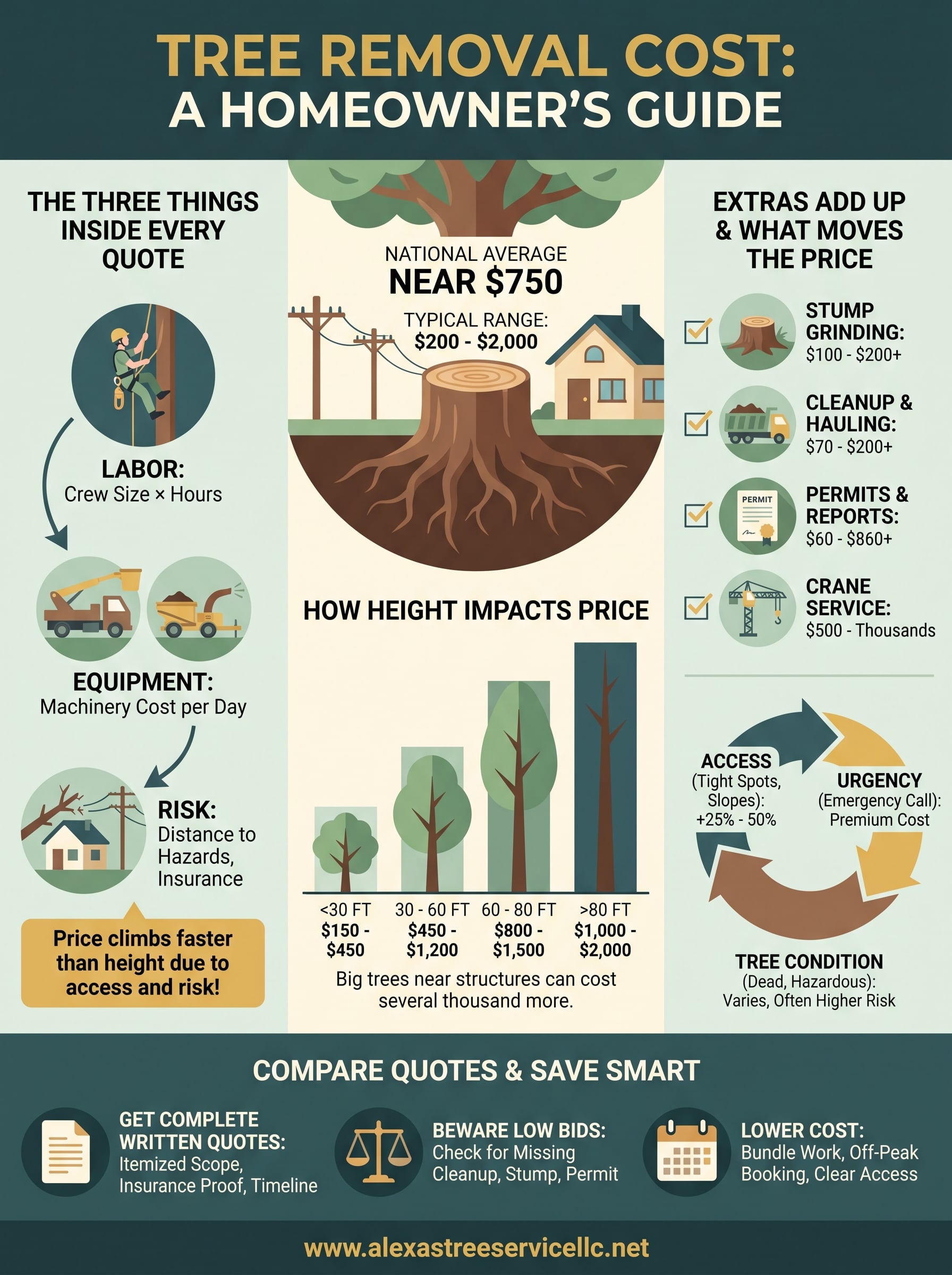
Tree removal cost comes down to height, access, and the extras you add. Expect about $200 to $2,000 for most jobs, more for tall trees near houses or power lines, and plan for stump grinding, cleanup, and permits as separate lines. Compare itemized written quotes, confirm insurance, and be suspicious of a price that is far below the rest.
If you are in Vancouver, Portland, or nearby, the fastest way to get a real number is a site visit. Request a free estimate from Alexa's Tree Service and we will price your tree line by line.