
Arborist for Tree Trimming: 5 Options Compared in Vancouver
The best arborist for tree trimming is a licensed, insured professional who prunes to industry standards and can explain why each cut matters. For most homeowners in Vancouver and Portland, that means an established local tree service. If a tree looks sick or you need a formal risk report, hire a consulting ISA Certified Arborist first. For routine work on a small ornamental tree, a trimming-only crew can be enough.
You probably searched because quotes vary wildly and job titles blur together. You also can't tell whether a certified arborist is worth paying more for. The stakes are real. A bad trim can't be undone, and topping a tree or stripping too much canopy weakens it for years. One bid can easily run double another.
This guide compares five types of providers you will meet in the Portland-Vancouver area. For each one you get who it suits, what it costs, and what to watch for. We list our own company, Alexa's Tree Service, first because we do this work every week. We also tell you plainly when someone else is the better call.
1. Alexa's Tree Service, local full-service crew
Alexa's Tree Service is a licensed and insured local company that has been trimming trees since 2006 in Vancouver, WA, Portland, OR, and the surrounding towns. It handles trimming, ornamental pruning, cabling, stump grinding, removal, and 24/7 storm cleanup under one roof.
Who it suits
This option fits homeowners and commercial property managers who want trimming done properly and the freedom to handle other tree work without calling a second company. We serve Vancouver, Portland, Camas, Battle Ground, Ridgefield, Gresham, Beaverton, and Lake Oswego. On the commercial side, our commercial trimming work covers parking lots, entrances, and signage at retail centers and office parks. We also offer seasonal maintenance plans that combine pruning and preventive health checks .
Our edge is track record. We have 180+ five-star Google reviews and a reputation for clean, damage-free work, with roughly 14 to 25 projects finished each month. One honest limit: if you need a formal diagnosis report for an insurance claim or a neighbor dispute, bring in a consulting arborist too (see option 2).
A good trimming crew protects your tree, your roof, and your lawn in the same visit.
Cost and trade-offs
Estimates are free by phone or online form, and we price by tree size, access, and cleanup needs. The table below shows rough U.S. ballparks for a single trimming job. They are not quotes. Tall Douglas firs and mature maples common in our area land at the top of each range or beyond.
| Tree size | Typical trimming range |
|---|---|
| Small ornamental, under 25 ft | $150 to $500 |
| Medium, 25 to 50 ft | $400 to $900 |
| Large, over 50 ft | $800 to $1,800+ |
The trade-off is timing. Storm season fills our schedule, so book seasonal pruning early . Our permit guidance for tree removal in Vancouver, WA also helps if a trim turns into a removal.
2. Independent consulting arborist
A consulting arborist is an ISA Certified Arborist who diagnoses trees and writes assessments, often without doing the cutting. The credential means they passed an exam from the International Society of Arboriculture and must keep earning continuing education credits to hold it.
Who it suits
Hire one when the decision is expensive or uncertain. That includes a sick or declining tree , a mature tree you want to save, a trunk leaning toward your house, or a risk report for a permit or dispute. Because consultants usually don't sell cutting, their advice is independent. They can write a pruning specification, and then any qualified crew can bid on the same scope.
If you wonder whether you need an arborist to trim trees, the answer for routine pruning is no. For high-stakes questions, yes.
Cost and trade-offs
Consultants typically bill hourly or charge a flat assessment fee, paid separately from the trimming. Expect to pay a few hundred dollars for a typical residential visit, though rates vary. Is hiring an arborist worth it? Yes, when the answer changes what you spend , such as saving a $5,000 removal.
Pay a consulting arborist to answer the question, not to do routine pruning.
For a healthy tree that just needs deadwood out, the fee adds cost without adding value. You also still need a second company to do the work.
3. Trimming-only crew
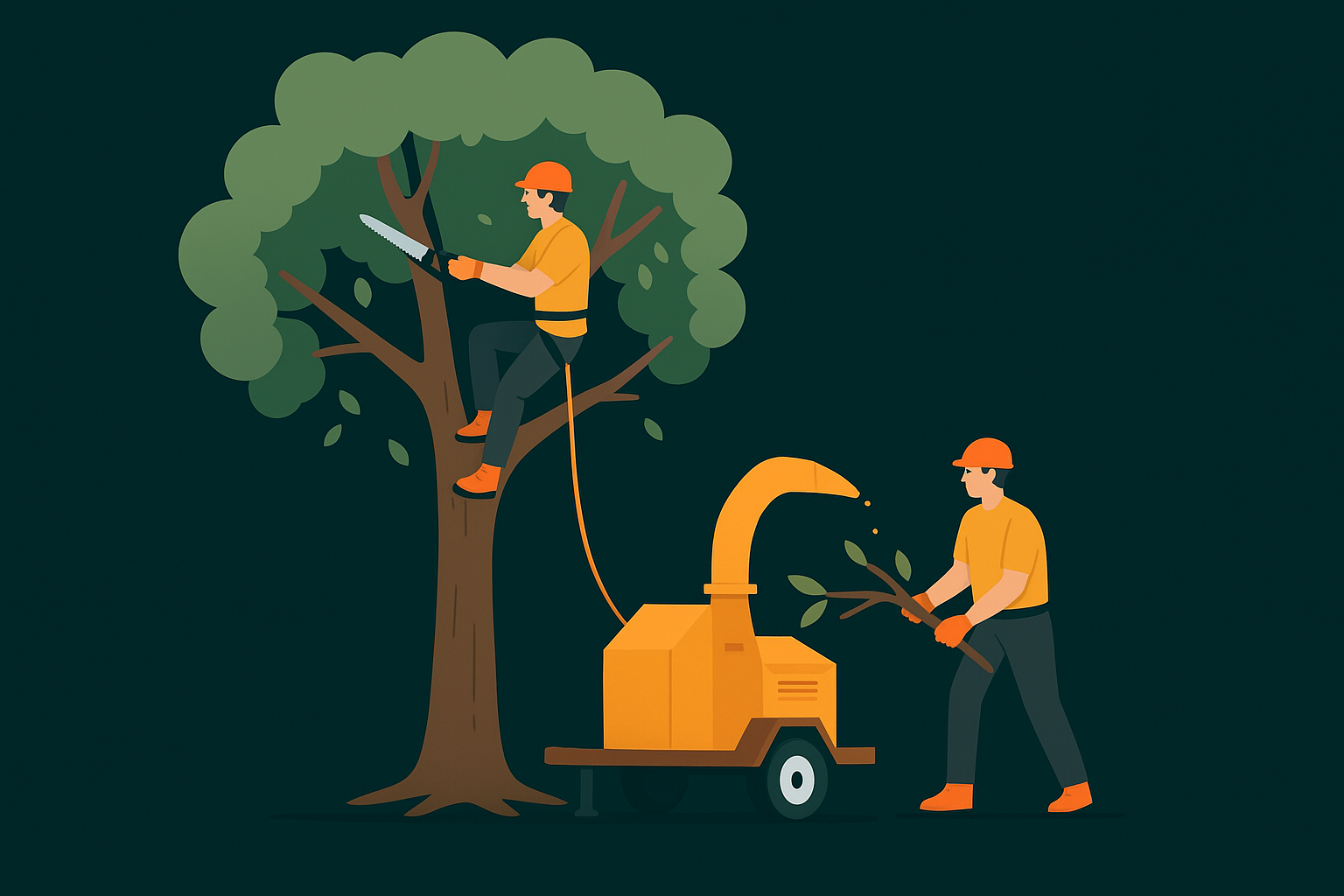
A regular tree trimmer is a small crew with saws, a chipper, and climbing gear that focuses on cutting. The difference between an arborist and a tree trimmer is training. An arborist studies tree biology and pruning standards, while a trimmer may only know how to cut. Some trimming crews are excellent, so judge the crew and not the label.
Who it suits
This option works for small ornamental trees , deadwood removal, and low branches that need clearance. You get the lowest bid and often fast scheduling. If you already know what you want cut, a skilled crew will do it efficiently.
Ask them to prune to ANSI A300 standards, the accepted U.S. pruning benchmark, and to explain which branches they will remove and why. A crew that can't answer that is guessing.
Cost and trade-offs
Prices run lowest here, but the risk of damage is highest. Watch for these warning signs before you sign:
- Offers to top the tree , meaning chopping the main leaders to stubs
- Plans to remove more than about a quarter of the canopy in one season
- No proof of liability insurance or workers' compensation
- A door-knocking pitch after a storm, with cash-only terms
- No written estimate listing the exact work
The cheapest bid costs the most when it leaves a tree that never recovers.
Verify contractor registration with Washington's Department of Labor & Industries, or your Oregon licensing board, before work starts.
4. National tree and lawn care company
A national tree-care company offers trimming as one service inside a larger plant health program that also covers fertilization, pest control, and lawn care. Many employ ISA Certified Arborists, so the arborist for tree trimming you meet is often credentialed.
Who it suits
These companies suit homeowners who want ongoing treatment plans with one invoice, and commercial owners who need the same vendor across several cities. If you have a collection of valuable ornamental trees and want regular monitoring, the program model works well.
The assigned arborist usually visits, writes the plan, and hands the work to a separate crew. That structure is efficient for programs but less personal for one-off jobs.
Cost and trade-offs
Pricing tends to run higher than local crews because it covers overhead, proprietary treatments, and program management. Treat that as a fair price if you want the program, and as overpaying if you only need a single trim.
Pay for a program only when you will actually use the program.
Check how much local knowledge the crew has. Pacific Northwest conifers, wet winters, and wind events call for regional experience. Also confirm how scheduling works, since call-center booking can slow emergency storm response compared with a local owner-operated company.
5. General landscaper or handyman
A landscaper or handyman offering tree trimming is a generalist who adds pruning to mowing, planting, or home repair. The short answer on whether to hire one is only for ground-level work : shrubs, hedges, and branches you could reach with a pole saw.
Who it suits
This option suits small jobs where nothing can fall on a structure and no one needs to climb. Shaping a laurel hedge or lifting the lowest branches of a young tree is reasonable. Anything that requires a ladder, a climbing line, or a bucket truck belongs to a tree specialist.
Never allow trimming near power lines. Call your utility instead, since only qualified line-clearance workers should touch branches near energized wires.
Cost and trade-offs
The hourly price is low and scheduling is easy. The cost shows up later if a heavy limb lands on your roof , or if an uninsured worker gets hurt on your property. Ask for proof of insurance and confirm registration like you would with any contractor.
If the work is above ladder height, it is not a handyman job.
Fruit and flowering trees also need specific timing and cuts. A generalist who prunes everything in one weekend can cut off next year's blooms and fruit.
Choosing who trims your trees
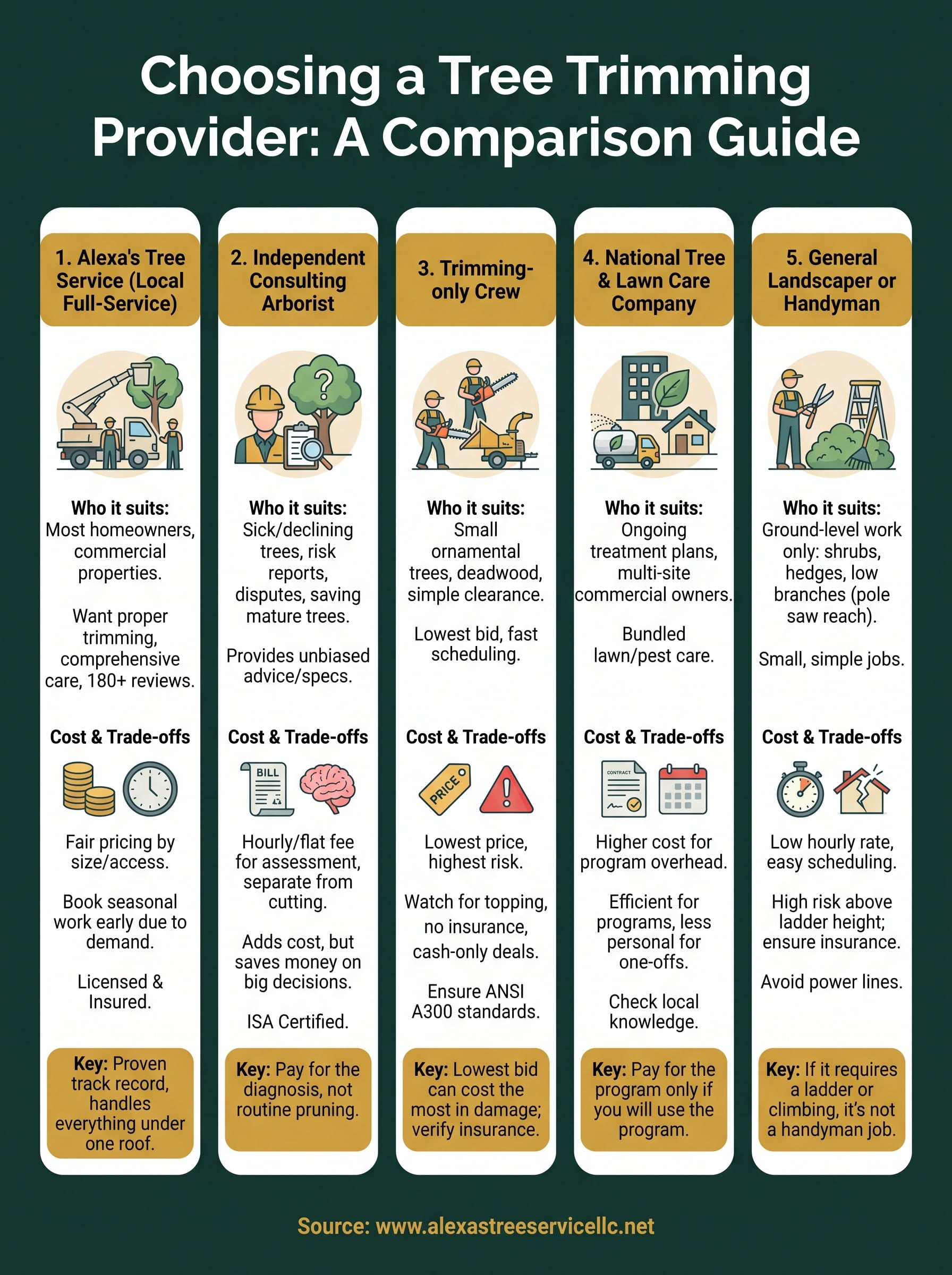
Match the provider to the job. A local full-service crew fits most trims, a consulting arborist answers the expensive questions, a trimming-only crew covers small simple work, a national program suits ongoing care, and a generalist stays on the ground. In every case, insist on proof of insurance, a written scope, and pruning that follows ANSI A300.
If you want an experienced local team to look at your trees, request a free estimate from Alexa's Tree Service. We will walk the property, explain what we would cut and what we would leave, and give you a clear written price.