
Pricing for Tree Removal: What You'll Pay and Why It Varies
Pricing for tree removal is what a tree service charges to cut down a tree and, depending on the quote, to clear away what is left. For an average residential tree, most homeowners pay roughly $400 to $1,100. Small trees can start near $150, while tall trees near houses or power lines often pass $2,000 and can run far higher. Height sets the starting number, and access, condition, and cleanup move it from there.
A quote pays for risk and crew time more than for the wood that ends up on the ground. That is why two trees of the same height can get bids hundreds of dollars apart. It is also why a single national average tells you very little about your own yard.
Alexa's Tree Service has removed trees around Vancouver, WA, and Portland, OR, since 2006, so we see how these numbers play out on real jobs. This guide covers typical ranges by height, the factors that raise or lower a bid, common add-on costs, and how to read a quote before you sign.
Why tree removal pricing matters and what to expect
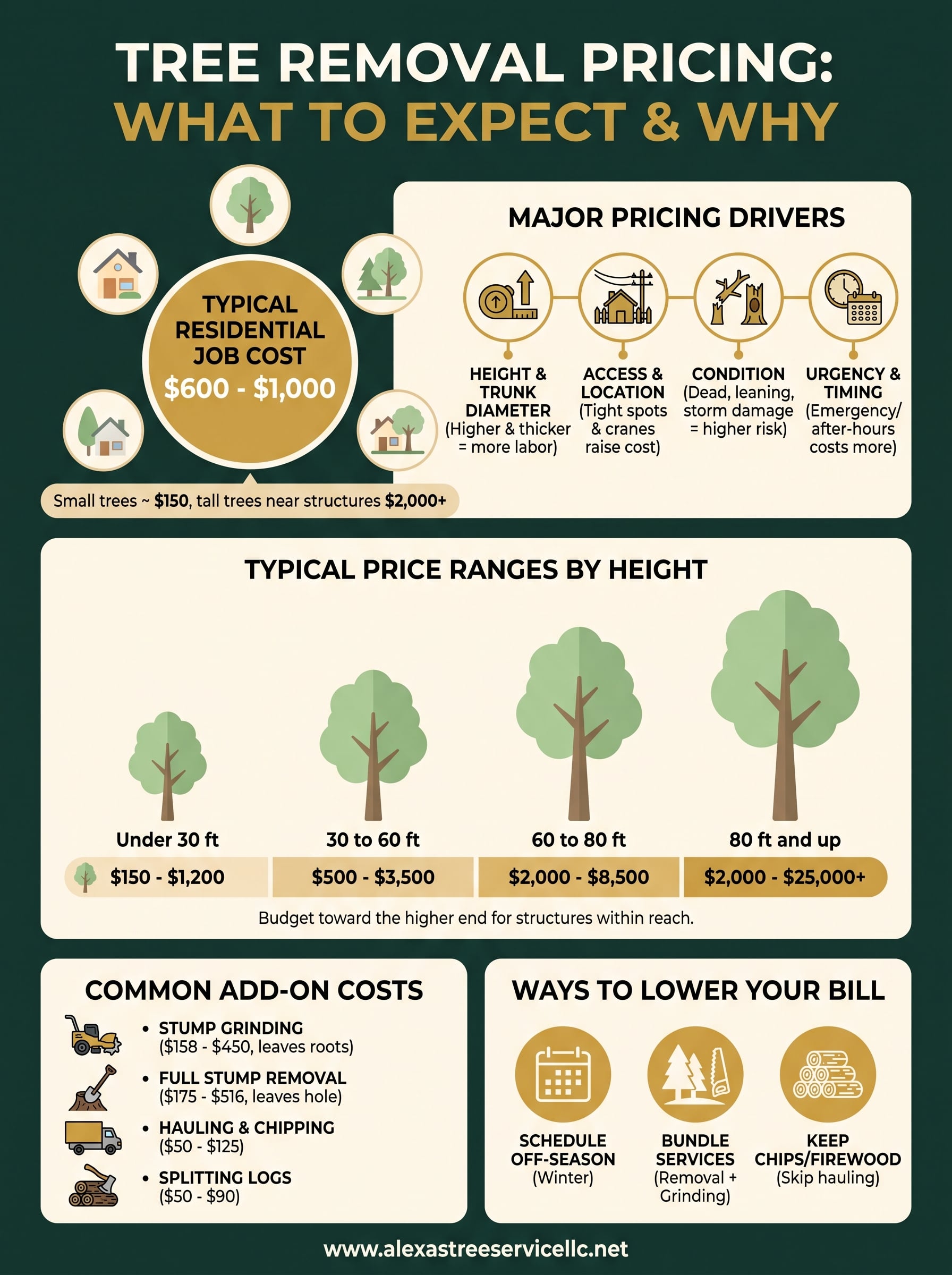
Knowing the going rate before you call keeps you from overpaying and from trusting a bid that is too good to be true. Published figures put the typical job between about $600 and $1,000 , but the full range runs from $150 to $25,000 for a very large, high-risk removal. Where your tree lands depends mostly on its height and its surroundings.
Typical price ranges by tree height
Height is the first number any estimator writes down, because taller trees need more crew time, more rigging, and often a lift or crane. Published figures vary because some describe a basic cut-and-drop and others describe a full job with cleanup. The table shows both ends.
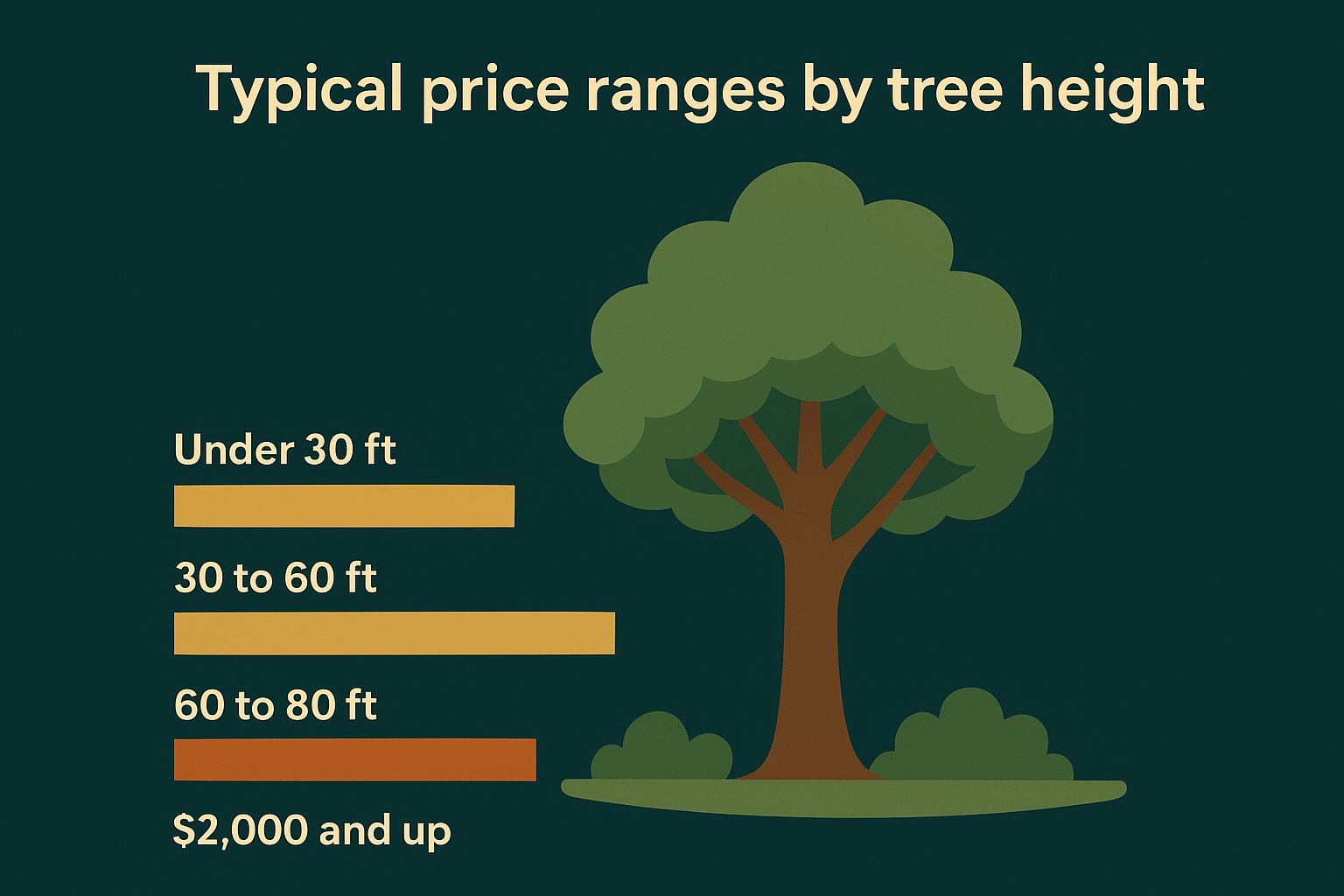
| Tree height | Lower published range | Higher published range |
|---|---|---|
| Under 30 ft | $150 to $500 | $425 to $1,200 |
| 30 to 60 ft | $500 to $1,000 | $1,200 to $3,500 |
| 60 to 80 ft | $2,000 and up | $3,500 to $8,500 |
| 80 ft and up | $2,000 and up | $8,500 to $25,000 |
The lower column fits simple jobs in open yards, and the higher column fits full-service work around structures. If your tree is a tall evergreen near a house, which describes many Douglas firs and cedars around Vancouver and Portland, budget toward the higher column . Plan for the upper half of the range whenever a structure sits within reach of the tree.
What per-foot rates tell you
Many companies quote by height, commonly $9 to $15 per foot , then add charges for trunk diameter, access, and cleanup. A 50-foot tree at $12 per foot comes to $600 before extras. Treat that as a quick sanity check for small and medium trees , not a formula.
Per-foot math breaks down on big trees, because risk grows faster than height. A 100-foot fir will not simply cost $1,200. The crew needs climbing or lift work, more rigging, and far more cleanup.
Why quotes for the same tree differ
Two honest bids can differ because they price different jobs. One includes hauling and a full cleanup, while the other leaves logs on your lawn. One company carries liability and workers' compensation coverage, which costs money, and another does not. A very low bid often means a missing insurance policy or a missing cleanup line, and either can leave you exposed to the cost if something goes wrong.
Most of a removal bill pays for risk and crew time, so a bid that ignores both is probably missing something.
What drives pricing for tree removal up or down
Five things do most of the work: height, access, condition, urgency, and your local market. Height gets the attention, but access and condition explain most of the surprises on a final bill. Once you know how each one works, you can predict whether your quote will land low or high in the ranges above.
Height, trunk diameter, and species
Height and trunk width usually rise together, so diameter rarely changes the price by itself. The exception is a short tree with a very thick trunk , or one that splits into several trunks near the base . Those need more cuts and more hauling than a single straight trunk of the same height.
Species matters mostly because it predicts mature size. A mature bigleaf maple or Douglas fir is a different job than an ornamental plum, even if both are "just one tree" on the estimate form.
Access, location, and local rates
A tree in an open backyard is a simple drop. A tree wedged between a house, a fence, and a power line has to come down in pieces, and that extra work can raise the bill by as much as 50% . If a crane is the only safe way in, the equipment cost goes on top. Tight suburban lots in the Portland-Vancouver area make these jobs common.
Local rates matter too. Labor, fuel, disposal fees, and travel distance all shift the number, so a price quoted in one metro area is a poor benchmark for another. Use national figures to learn the shape of the pricing for tree removal, then let local written quotes set your actual budget.
Access, more than height, is what most often turns an average quote into an expensive one.
Condition, lean, and timing
Dead trees can be cheaper to remove because nobody is protecting nearby plants, but they are unpredictable. Hollow trunks and rotted roots can fail mid-cut, so a good crew prices in caution. Leaning or storm-damaged trees usually cost more, since the crew has to plan around where the tree wants to fall. A tree already on the ground is the cheap case, often $85 to $300 to cut up and haul.
Urgency changes the price as well. One cost guide puts emergency removal at $500 to $2,500 , and after-hours calls carry a premium. If the tree is not an immediate hazard, scheduling ahead and choosing slower winter months can lower the bill. When a covered storm drops a tree on your home, call your insurance agent before work starts, because some policies help with removal.
Extra services that change your final bill
The base price covers cutting the tree down, and most extras are billed on top. Stump work and cleanup often add a few hundred dollars, so a quote for pricing for tree removal that leaves them out will look cheaper than the job really is. Ask what each quote includes before you compare totals.
Typical add-on prices
The figures below are national ranges for common extras. Your local rates may sit higher or lower, but the table shows which items usually matter most.
| Service | Typical add-on cost |
|---|---|
| Stump grinding | $158 to $450 |
| Full stump and root removal | $175 to $516 |
| Hauling debris off-site | $50 to $90 |
| Wood chipping | $65 to $125 |
| Splitting logs into firewood | $50 to $90 |
| Trimming nearby trees | $315 to $700 |
Stump grinding versus full removal
Stump grinding shaves the stump below ground level and leaves the roots to decay. It costs less and works well when you plan to lay sod or mulch over the spot. Alexa's Tree Service offers stump grinding as a standard part of tree removal jobs.
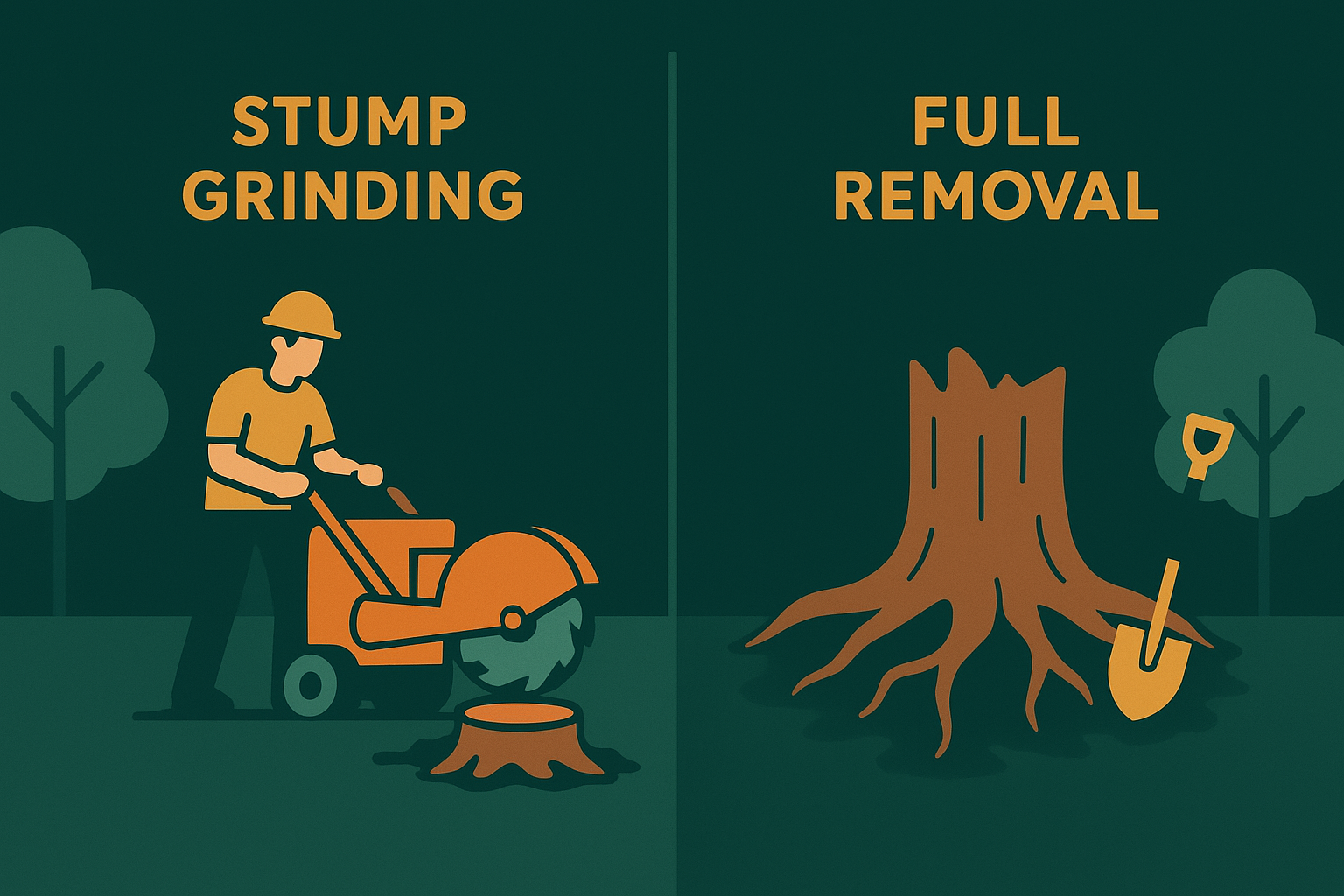
Full stump removal pulls out the stump and the root ball. It costs more and leaves a large hole to fill. Choose it only if you plan to build, regrade, or replant in the same spot.
Grind the stump unless you plan to build or replant in that exact spot, because full removal costs more for little visible gain.
What cleanup should include
Cleanup is the line item most likely to differ between bids. Some companies include hauling, chipping, and raking, while others bill each one separately. Ask for the answer in writing, not on the phone.
You can also trade work for savings . Keeping the wood chips as mulch or the logs as firewood means less hauling, and that can trim the final number.
How to evaluate a quote and keep costs down
Get at least three written quotes, compare scope and cleanup line by line, then check each against per-foot math before you choose. The lowest number only wins when it covers the same work as the others. A short checklist keeps the comparison honest.
Compare quotes line by line
A reliable estimate comes after someone walks your property, not from a photo or a phone guess. Check each bid for these items:
- Scope: Does it remove the whole tree, or only cut it down to the stump?
- Cleanup: Are hauling, chipping, and raking included or billed separately?
- Access notes: Did the estimator account for slopes, fences, and nearby structures?
- Timeline: When will the crew arrive, and how long will the job take?
If a quote is vague on two or more of these, ask for a revised version before you sign anything.
Confirm insurance and permits
Ask each company for proof of liability and workers' compensation coverage . An uninsured crew may quote less, but you carry the risk if a tree lands on your roof or a worker is hurt.
Check your city's rules before you book, too. Some cities regulate removal of larger or protected trees, and fines for unpermitted work can cost more than the removal. Vancouver and Portland both have tree rules, so ask the company whether it can walk you through the permit process.
Ways to lower the bill
Several choices can bring the number down without cutting corners:
- Schedule non-urgent removals in the slower winter months.
- Bundle removal, stump grinding, and trimming into one visit.
- Keep the chips or firewood instead of paying for hauling.
- Remove several trees in a single visit, so the crew's setup time is spread across them.
Doing it yourself rarely pays off. One cost guide puts the gear for a small tree around $425, which is more than the $150 to $385 a professional typically charges for the same tree, and you also take on the liability.
A cheaper bid is only a better deal when it covers the same work, the same cleanup, and the same insurance.
Budgeting for your tree removal
Pricing for tree removal comes down to height, access, condition, and cleanup. Expect roughly $600 to $1,000 for a typical tree, less for a small one, and well above that for a tall tree beside a house or power line. Compare written quotes line by line, and use per-foot math as a check rather than a rule.
If you have a tree in Vancouver, Portland, or the surrounding area, request a free estimate from Alexa's Tree Service by phone or online form. We will look at your tree in person and give you a written number that spells out exactly what is included.