
How to Hire Tree Stump Grinding Services (Costs & Tips)
That leftover stump in your yard isn't just an eyesore. It's a tripping hazard, a magnet for termites and carpenter ants, and it keeps you from actually using that patch of lawn. If you've started searching for tree stump grinding services, you're probably wondering what a fair price looks like and how to avoid hiring someone who leaves your yard torn up or your stump only half-ground.
Here's the short answer: stump grinding typically runs $100 to $400 per stump depending on diameter, root spread, and accessibility, and the right contractor will be licensed, insured, and willing to show you photos of recent local jobs before you sign anything. Skipping that vetting step is how homeowners end up with damaged irrigation lines or a driveway full of ruts.
We've ground stumps across Vancouver, Portland, and the surrounding Pacific Northwest since 2006, so we've seen every pricing trick and shortcut a company can pull. This guide walks you through what drives cost, the questions to ask before hiring, and how to spot a crew that will actually protect your property instead of leaving a mess behind.
What to know before hiring a stump grinding service
Before you call anyone, understand what you're actually paying for. Stump grinding shreds the wood below the surface with a specialized machine, leaving mulch and a hole where roots used to be. Stump removal digs out the entire root ball, which costs more to remove a stump completely and disturbs a much larger area of your yard. Most homeowners only need grinding since it clears the tripping hazard and stops regrowth without the extra digging.
Stump grinding solves the safety and eyesore problem for a fraction of what full removal costs.
Factors that drive your price
Several variables determine what a company quotes you, and knowing how grinding prices are calculated helps you spot a lowball estimate or an inflated one:
- Stump diameter (measured in inches across the top)
- Root spread and how far surface roots extend
- Accessibility for equipment, tight side yards cost more
- Number of stumps , since multi-stump jobs usually get a per-stump discount
- Wood species , as hardwoods like oak take longer to grind than pine
Timing matters more than people think
Fall and winter tend to bring lower rates because demand drops once storm season passes and companies aren't booked out for weeks. If you're dealing with a stump from a recent removal, grinding it while the wood is still fresh is easier on the equipment and often cheaper than waiting for it to harden. Scheduling around your local company's slow season, rather than right after a summer storm, can save you real money on the same job.
Step 1. Assess your stump and yard needs
Walk your property before you pick up the phone and take stock of what you're dealing with. Measure the stump's diameter across the top, since that single number drives most of the quote you'll get. Note whether the stump sits near a fence, septic line, sprinkler head, or underground utility, because tight access adds time and cost to the job.
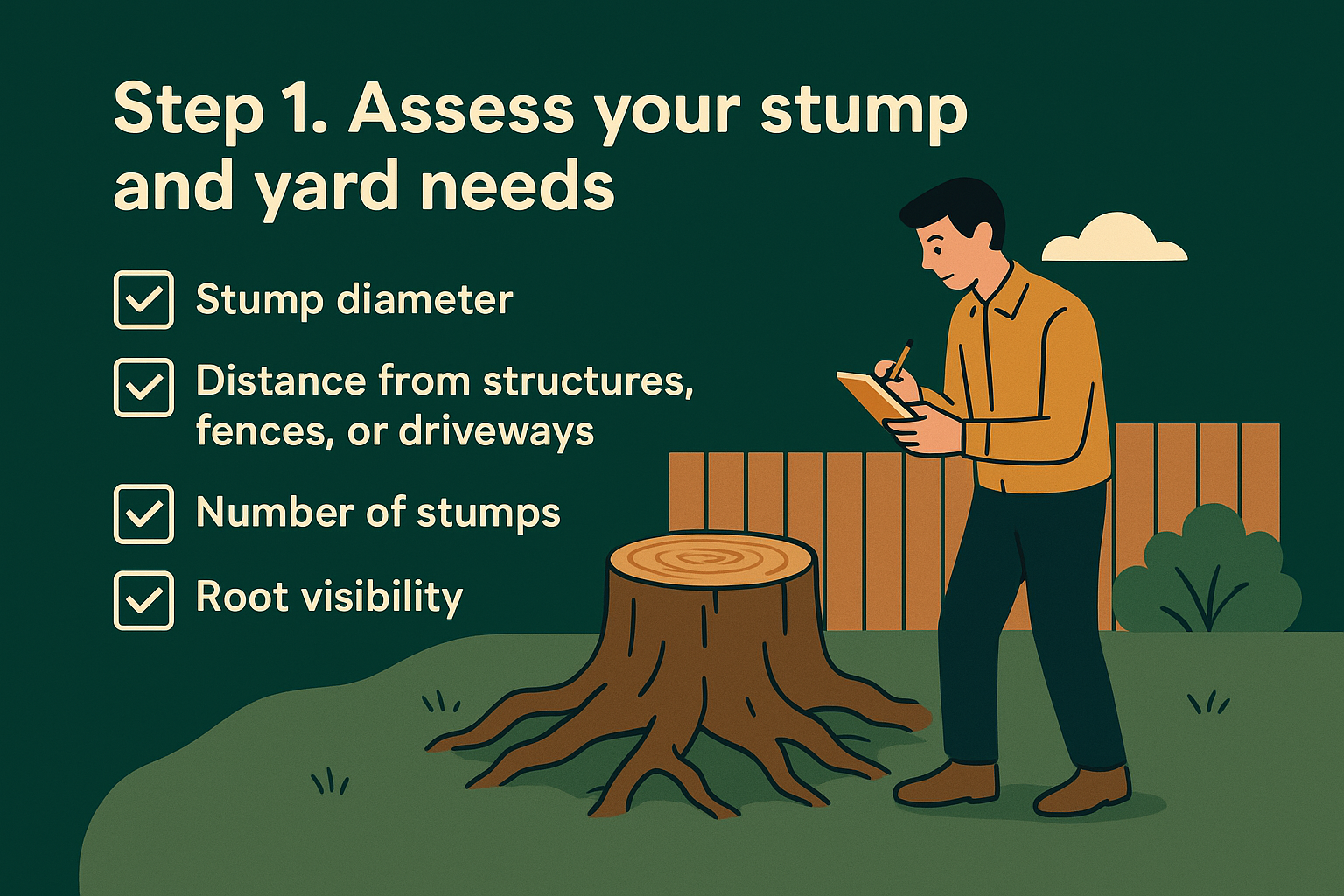
Knowing your stump's size and location before you call turns a vague estimate into an accurate one.
Check for these details and jot them down so you're ready when a company asks:
- Stump diameter in inches
- Distance from structures , fences, or driveways
- Number of stumps if you have more than one
- Root visibility , are large roots poking above ground
- Access path width for a grinder to reach the spot
Multi-stump properties are common in older Pacific Northwest neighborhoods where windstorms took down several trees over the years. If that's you, group the stumps into one job. Most local crews charge less per stump when they're already on-site with the equipment loaded and running.
Step 2. Request quotes from local stump grinding companies
Once you know your stump's size and location, call at least three local stump grinding companies near Vancouver, WA and ask for a written quote , not just a phone estimate. A crew that quotes sight-unseen off a photo alone is more likely to surprise you with add-on fees once the truck is parked in your driveway. Good outfits will either ask detailed questions about diameter and access or offer a quick on-site walkthrough before pricing anything.
A written quote protects you from surprise fees once the equipment shows up.
When you call, have your notes from Step 1 ready and ask each company the same set of questions so you can compare answers fairly:
- Do you charge a flat rate per stump or by diameter?
- Is debris and mulch cleanup included in the price?
- What's your minimum charge for a single small stump?
- Do you offer a discount for grinding multiple stumps in one visit?
- How soon can you schedule the job?
Most stump removal companies worth hiring, including our team at Alexa's Tree Service, offer free estimates with no obligation, so there's no reason to settle for a guess over the phone.
Step 3. Compare costs and what's included
Line up your quotes side by side once they come in, because the lowest number isn't always the best deal. Some companies bundle debris hauling and mulch removal into their price, while others tack it on as a separate charge that can add $50 to $100. Look past the total and check what each stump grinding cost actually covers before you decide.

The cheapest quote often costs more once you tally the fees it left out.
Here's a quick way to compare apples to apples:
| What to check | Why it matters |
|---|---|
| Price per diameter inch | Reveals hidden markups on larger stumps |
| Debris and mulch cleanup | Some quotes leave chips piled on your lawn |
| Backfill with topsoil | Needed if you plan to reseed the area |
| Minimum service fee | Small stumps sometimes cost more per inch |
| Multi-stump discount | Worth asking for if you have two or more |
Requesting this breakdown from each company keeps you from comparing a bare-bones price against a full-service one. Full-service pricing almost always wins out once you factor in the cleanup you'd otherwise do yourself.
Step 4. Verify credentials and schedule the job
Before any equipment touches your lawn, confirm the company is licensed and insured in Washington or Oregon, and ask for proof rather than taking their word for it. A legitimate outfit won't hesitate to email you a certificate of insurance, since it protects both of you if a grinder throws a rock through a window or nicks a buried line. Skipping this step is how homeowners end up covering repair bills a contractor should have carried.
Insurance paperwork takes five minutes to check and can save you thousands if something goes wrong.
Before you sign off on a date, confirm these details in writing:
- Proof of insurance and license number
- Start and completion date , especially if rain is in the forecast
- Payment terms , deposit required versus payment on completion
- Cleanup responsibility , who hauls the mulch away
- Point of contact if the crew runs late or hits an unexpected root
Once you've verified credentials, book the job during a week with a dry forecast. Wet ground slows the grinder and can leave ruts across your yard that take a season to fill back in.
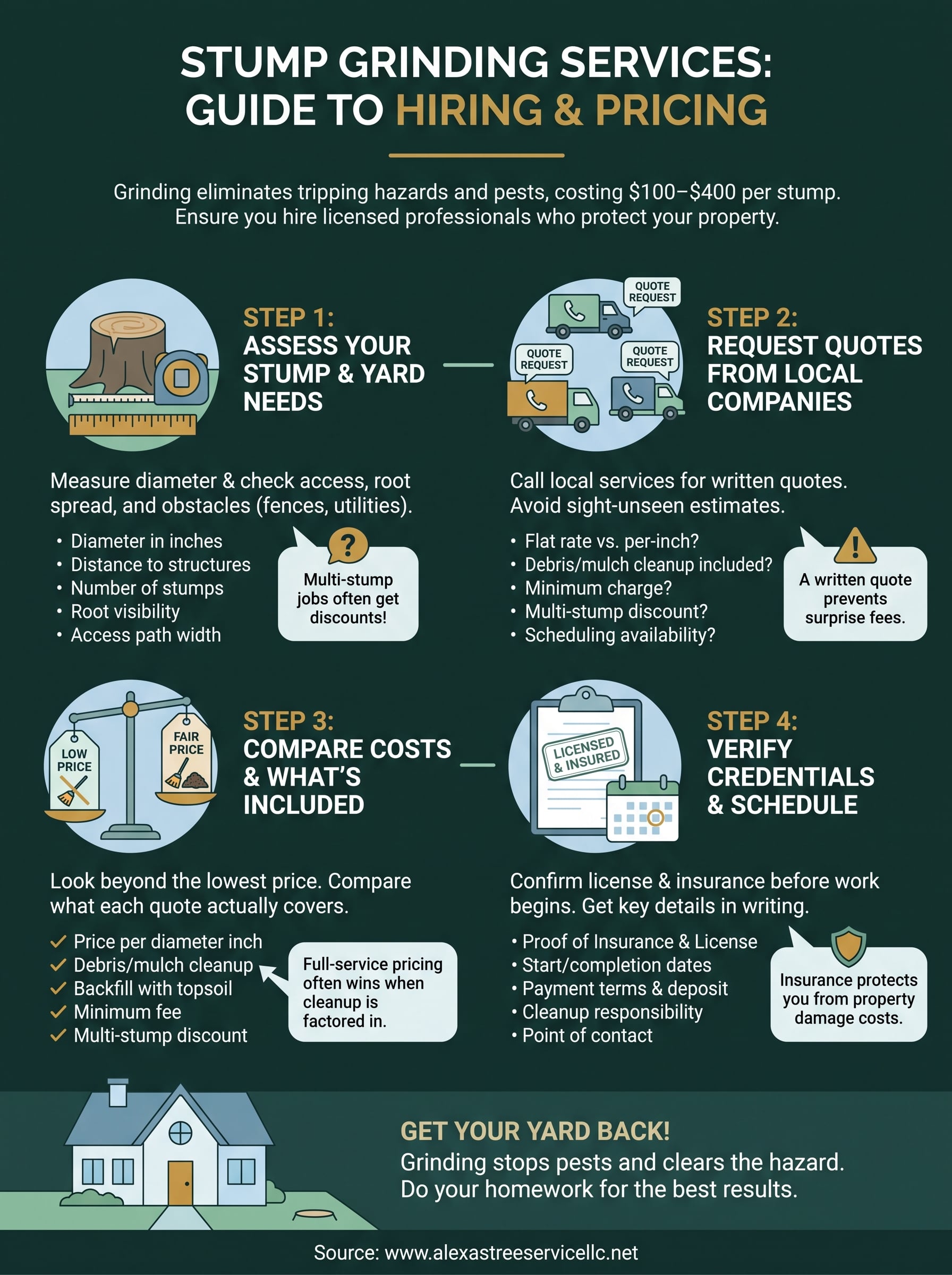
Getting your yard back
A stump doesn't have to sit in your yard for another season waiting on the right contractor. Grinding it out clears the tripping hazard, stops the termite invitation, and gives you back a patch of lawn you can actually use again. Follow the four steps above, measure your stump, gather quotes, compare what's included, and check credentials, and you'll land on a company that does the job right the first time.
Budget for $100 to $400 per stump depending on size and access, and don't let a low quote talk you out of asking what it leaves out. The homeowners who end up happy with the work are the ones who did their homework before the grinder showed up, not after.
If you're in Vancouver, Portland, or anywhere nearby in the Pacific Northwest, get your free stump grinding quote and let a crew that's been doing this since 2006 handle it.