
6 Tree and Stump Removal Options Near Me in Vancouver, WA
If you search tree and stump removal near me in the Vancouver, WA and Portland area, the best pick is a licensed, insured local crew that quotes in writing, grinds the stump in the same visit, and hauls away the mess. A full-service company like Alexa's Tree Service suits most homeowners and property managers. A stump-only specialist suits a job where the tree is already down. Renting a grinder suits one small stump and a tight budget.
The hard part is telling providers apart. Every listing promises free estimates and five-star service, yet a single stump can cost $120 while a large tree can pass $2,000. A listing will not tell you who carries insurance, who shows up on time, or who leaves wood chips across your lawn.
This article sorts six ways to get the work done, from full-service crews to doing it yourself. It then covers typical prices, a worked cost example, free and low-cost options, and the questions to ask before you accept a quote. We are Alexa's Tree Service, working in this region since 2006, so we list ourselves first and say plainly where another option fits better.
1. Alexa's Tree Service for full-service local jobs
Alexa's Tree Service removes the tree, grinds the stump, and cleans up in one coordinated job. That makes it the simplest choice when you have a tree to take down and a stump to deal with afterward.
How it works
You call (360) 723-6688 or use the online form for a free estimate . The crew then handles the removal, which takes 2 to 8 hours for most residential jobs, and hauls away debris. Stump grinding goes 6 to 12 inches below grade . A small softwood stump takes about 30 minutes, and a large hardwood takes 2 to 3 hours.
In Vancouver, WA, we also guide you through permit assistance . Permit processing takes 5 to 10 business days, and we have helped with permits for 31 Vancouver properties from 2024 to 2026. Storm cleanup is available 24/7. We work across Vancouver, Portland, Camas, Battle Ground, Ridgefield, Gresham, Beaverton, and Lake Oswego.
A crew that removes the tree and grinds the stump in one visit saves you a second appointment and a second bill.
Who it suits
This option fits homeowners with hazardous, diseased, or unwanted trees. It also fits commercial properties, where we schedule tree removal around business hours and grind stumps that trip up foot traffic and mowing crews.
- Storm damage that needs urgent cleanup
- A tree and stump you want gone in one visit
- Retail centers, office parks, and parking lots
Cost and trade-offs
Tree removal runs $300 to $2,000+ depending on size and access. Stump grinding runs $120 to $380 per stump , and bundling it with a removal saves $45 to $75 compared with booking separately. We are licensed and insured, with 180+ five-star Google reviews. The trade-off is that for one small stump with no tree work, a solo grinder may quote slightly less.
2. Owner-operated stump grinding specialists
A stump specialist is a one-person or two-person operation built around a grinder on a trailer. It is the right call when the tree is already down and only the stump remains.
How it works
The operator drives to your property, positions the grinder over the stump, and chips it away below ground level. Most jobs finish in under a few hours. Ask whether the price includes raking up chips and whether the operator grinds the main surface roots as well.
Many specialists also take out small trees, bushes, and hedges. Few take down large trees, because that needs climbing gear, rigging, and a bigger crew.
Who it suits
This route suits homeowners who had a tree removed by someone else, or who inherited stumps from an earlier storm.
- Several stumps along a fence line or driveway
- A property being cleared for new lawn or garden beds
- Stumps in a spot a lawn mower keeps hitting
Cost and trade-offs
Lower overhead often means a lower quote per stump. The trade-off is range, since you cannot hand the same person a tall tree. Ask for proof of liability insurance before they start, because a grinder throws debris and can damage hidden lines.
A stump specialist can be the cheapest fix for a stump alone, but only if the operator is insured.
3. Arborist-led tree care companies
An arborist-led company is built around trained tree specialists rather than a removal crew. This is the best option when you are not sure the tree needs to come down.
How it works
Look for an ISA Certified Arborist , a credential from the International Society of Arboriculture. The arborist inspects the tree for decay, cracks, leaning, and root problems, then recommends pruning, support, or removal.
Support options such as cabling can keep a weak or split tree standing safely. Alexa's installs tree cabling at $300 to $1,200 per tree, and the point is the same anywhere: removal is not always the only answer.
Who it suits
Mature, historic, or cherished trees are the typical case, and so are trees close to a house.
- A large tree with a cracked limb or a visible lean
- A tree you want a written risk opinion on
- Insurance or HOA paperwork that asks for an assessment
Cost and trade-offs
Expect to pay more than a basic removal crew, and sometimes to pay a separate assessment fee . You get a documented opinion in return. If the verdict is removal, confirm the company does its own stump grinding or tell it up front that you want a quote that includes it.
If a tree is valuable and you are unsure, pay for an arborist's opinion before you pay for a removal.
4. Large multi-crew tree companies
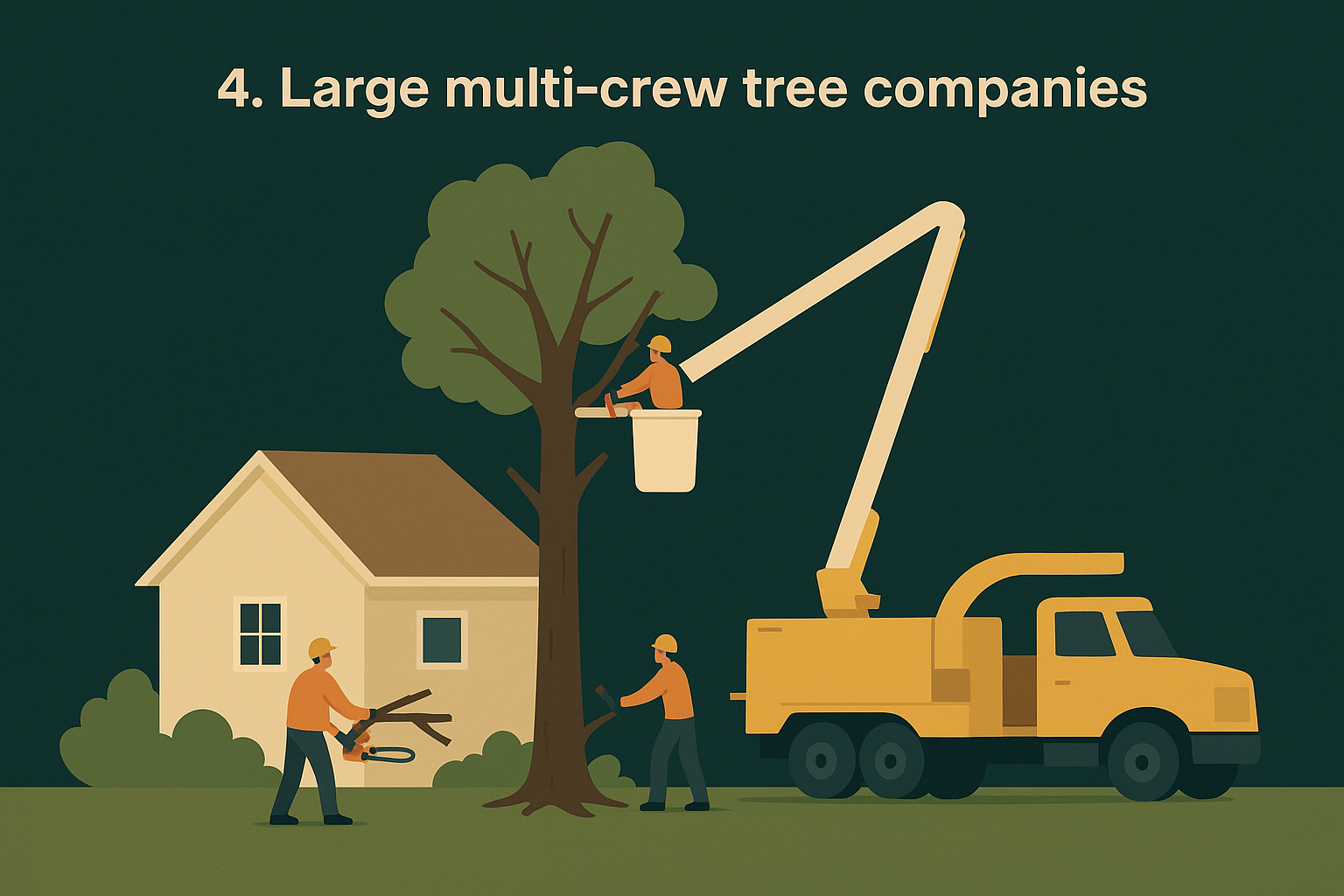
Large companies send several workers with heavy equipment, which helps on big, awkward trees. They are a good fit when a tree towers over a house, a shed, or a fence.
How it works
A big crew can split work across climbers, ground workers, and a chipper operator, and some bring bucket trucks or cranes. That speeds up large removals and lowers the risk near structures. You will usually get a site visit from an estimator rather than the person who does the work.
One safety note applies to every company. If a tree touches or leans into power lines , call the utility first. Only qualified line-clearance workers should cut near live wires.
Who it suits
This option suits property owners with oversized trees or tight access.
- Tall conifers beside a house
- Several large trees in one project
- Commercial sites that need a heavy-duty crew
Cost and trade-offs
Bigger overhead usually means higher quotes and longer scheduling lead times . Stump grinding is often an add-on line item, so ask for it in the first quote. The upside is capacity. If your job is a single mid-size tree with open access, you rarely need this level of equipment.
Pay for a big crew only when the tree's size or location actually demands one.
5. Online quote marketplaces and review sites
Marketplaces let you describe the job once and collect several bids. They are a fast way to compare nearby providers when you do not know who to call.
How it works
You post photos, tree size, and location, and interested companies reply with price ranges or request a visit. Review sites let you see ratings and written feedback for the same companies. Used together, they give you a short list in an evening.
Treat the results as a starting point. Platforms vary in how they vet providers , and a listing alone does not confirm insurance or licensing. Ask each company for proof before you book.
Who it suits
This route suits people who want speed and comparison more than a personal referral.
- Homeowners new to the area with no contacts
- Anyone who wants three bids without three phone calls
- Jobs with clear photos and a simple scope
Cost and trade-offs
Bids from photos tend to be rough. A tree that looks easy in a picture can be hard to reach, which changes the final price. Companies may also pay the platform for leads, which can feed into quotes. Always confirm the final price in writing after someone has seen the tree.
Use marketplaces to build a shortlist, not to choose a winner.
6. Renting a grinder and doing the stump yourself
Renting a stump grinder is the lowest-cost route for a single small stump if you are comfortable with heavy equipment. It is also the option with the most ways to go wrong.
How it works
You rent the machine, haul it home, and grind the stump down in passes, working side to side. Before you start, call 811 to have underground utilities marked, which is free. Wear eye protection, hearing protection, and sturdy boots, and clear rocks and metal from around the stump.
Rental machines are usually smaller than professional units. A stump that takes a pro 30 minutes can take you a good part of a day, and a large hardwood can take much longer.
Who it suits
DIY works for a small softwood stump in open ground.
- One stump under about a foot wide
- A comfortable owner with a free weekend
- No tree removal needed, only the stump
Cost and trade-offs
Once you add the rental fee, transport, fuel, and your own day, savings on a single stump are often small compared with a professional price of $120 and up. You also carry the injury and damage risk yourself. If you have more than one stump, or a big one, hiring out usually wins.
DIY stump grinding saves money only when the stump is small and the rental is short.
What tree and stump removal costs in Vancouver, WA
Tree and stump removal costs depend mostly on tree size, access, and whether you bundle the work. The ranges below are what Alexa's quotes locally, and other companies price differently.
Typical price ranges
| Job | Price | Typical time |
|---|---|---|
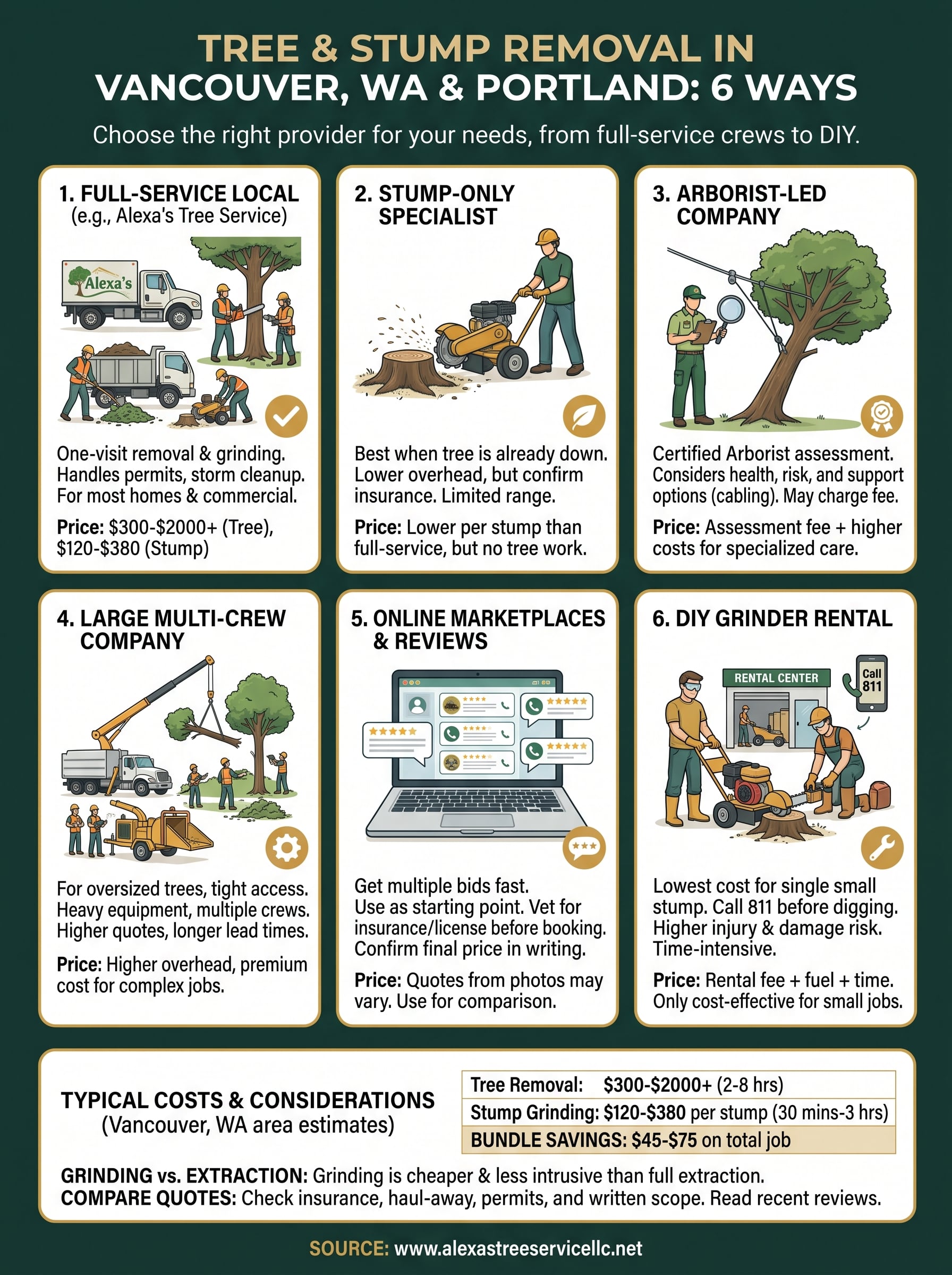
| Tree removal | $300 to $2,000+ | 2 to 8 hours |
| Stump grinding | $120 to $380 per stump | 30 minutes (small softwood) to 2 to 3 hours (large hardwood) |
| Removal and grinding together | Saves $45 to $75 | One visit |
Here is a worked example. Say your quote for a medium tree is $800 and the stump is $250. Booked separately, that is $1,050 . Bundled, the saving of $45 to $75 brings it to $975 to $1,005 . Trees close to buildings, with limited access, or needing a permit usually sit toward the top of the range.
Ask for removal and grinding in one quote, because bundling is the easiest saving you will find.
Is grinding cheaper than removing the stump?
Grinding is usually cheaper and faster than pulling a stump out whole. Grinding chips the stump 6 to 12 inches below grade and leaves the roots to decay, so you can sod or plant over it. Full extraction digs out the stump and roots with heavy equipment, which costs more and leaves a large hole to fill. Choose extraction only if you plan to pour a foundation or replant a tree in the same spot, and say so when you ask for quotes.
Can you get tree removal for free?
Free removal is rare, and seniors do not automatically qualify. Some cities, counties, nonprofits, and utilities occasionally help with hazard trees, so call your city or county and the 211 helpline to ask what exists. If a company offers "free" removal in return for the wood, or a price far below everyone else's, check for insurance and cleanup before agreeing. A cheap quote that skips either can cost more later.
How to compare quotes and reviews
Get at least two written quotes from companies that have looked at the tree. Then check each one against this list:
- Proof of liability insurance and workers' compensation
- Whether haul-away, cleanup, and stump grinding are included
- Who handles the permit if your tree needs one
- Start date and how long the job will take
For reviews, read the recent ones first and look for repeated details, such as clean yards and on-time arrival. A long run of specific reviews tells you more than a perfect score on a few.
Choosing who to call
For most jobs, a licensed, insured crew that handles both tree and stump is the least stressful choice. A stump specialist makes sense when the tree is already gone, an arborist makes sense when you are unsure the tree should go, and a DIY rental only works for one small stump.
Whichever route you take, get the price in writing, confirm insurance, and ask what the cleanup includes. If you want a free estimate for tree removal, grinding, or both, contact Alexa's Tree Service and we will look at the job and give you a straight price.