
7 Times You Need Tree Emergency Service in Vancouver, WA
A tree emergency service is a crew that answers the phone at any hour and removes a tree or limb that threatens people, a structure, or your only way out. You need one when a tree is on your house, tangled in a power line, blocking your driveway, or hanging over a spot where people walk. Expect removal to run from about $300 to $2,000 or more, depending on where the tree landed. Call a licensed, insured local crew that gives you a response time on the first call.
A good pick means matching the situation to the right response. A homeowner with a tree on the roof needs a rigging crew and a quick call to the insurer. Anyone with a line down needs the utility first. A property manager with a blocked entrance needs same-day clearing. When wind drops a tree at 2 a.m., you do not want to compare ten listings. This article walks through seven situations that qualify, what to do before help arrives, what each job costs, and how to vet a crew fast.
Alexa's Tree Service has handled storm cleanup in Vancouver, WA and Portland, OR since 2006, with crews available 24/7. The advice below comes from that work, so the prices, timelines and warnings fit homes and businesses in the Pacific Northwest.
1. A tree or limb on your house or roof
Why it counts as an emergency
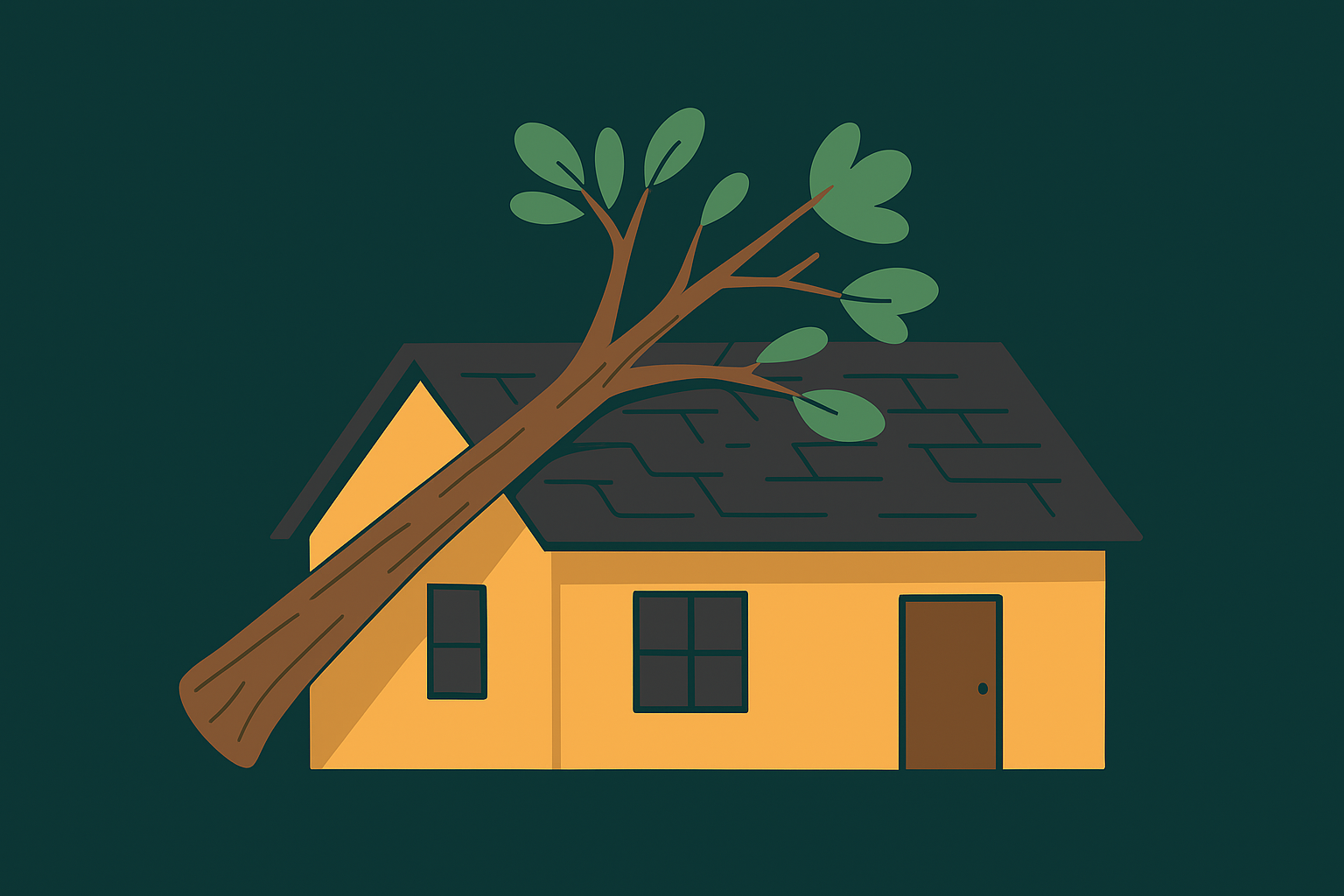
A tree or large limb resting on your home is the clearest case for emergency tree service, because the load can shift without warning. Rain can enter a breached roof within hours , and wind or wet soil can move a tree that looks settled. If you hear creaking or cracking, get everyone outside and stay at a safe distance. Do not go back in for belongings.
These jobs often involve more than wood. Gas meters, electrical service entrances and chimneys sit under many roof lines. If you smell gas or see sparks, call 911 first , then your insurer once everyone is safe. Photograph the damage from the ground before anything moves, because the evidence disappears once cleanup starts.
A tree on a structure is never a wait-until-morning job.
What the crew does and what it costs
The crew first reads what the tree is resting on and where the weight sits. They then remove it in sections, lowering each piece on ropes instead of dropping it onto the roof. The cutting order is planned so the structure does not spring back or collapse. Branches and debris are hauled away afterward. At Alexa's Tree Service, the average response for active hazards is 1.5 to 3 hours.
Our tree removal service runs from $300 to $2,000+, and a tree on a roof with tight access sits at the top of that range or above it. Most residential jobs take 2 to 8 hours. A roofer handles the tarp and the repair , so ask your tree crew to coordinate timing with theirs. Many homeowners policies pay for removal when a tree hits an insured structure. The cost section below covers who pays.
2. A tree across your driveway or road access
Why it counts as an emergency
A fallen tree across your driveway counts as an emergency when it is your only way in or out. That covers a medical need, a shift you cannot miss, a trapped car, or a path that emergency vehicles need. If it blocks a second driveway and damaged nothing, it is urgent rather than an emergency, and you can often schedule it for daylight.
Ownership changes who you call. A tree lying across a public street or in the public right of way is usually the city's or county's to clear, so start with them. A tree that fell from your own yard onto your own driveway is yours to arrange. If a wire touches it, skip to the power line case below.
Clear the path you need first, and finish the rest in daylight.
What the crew does and what it costs
The crew clears a lane first. They cut the trunk into rounds, move them aside and open the driveway. The rest of the tree can be finished at a scheduled time. This clear-now, finish-later approach keeps the rush portion of the job short, which lowers the emergency bill.
With no structure involved, expect pricing in the lower to middle part of the $300 to $2,000+ range. Trunk diameter and debris volume drive most of it. Ask for two quotes, one for the lane only and one for the full job, so you can compare. A proper crew leaves the driveway swept of branches and leftover material when it finishes.
3. A tree touching or tangled in power lines
Why it counts as an emergency
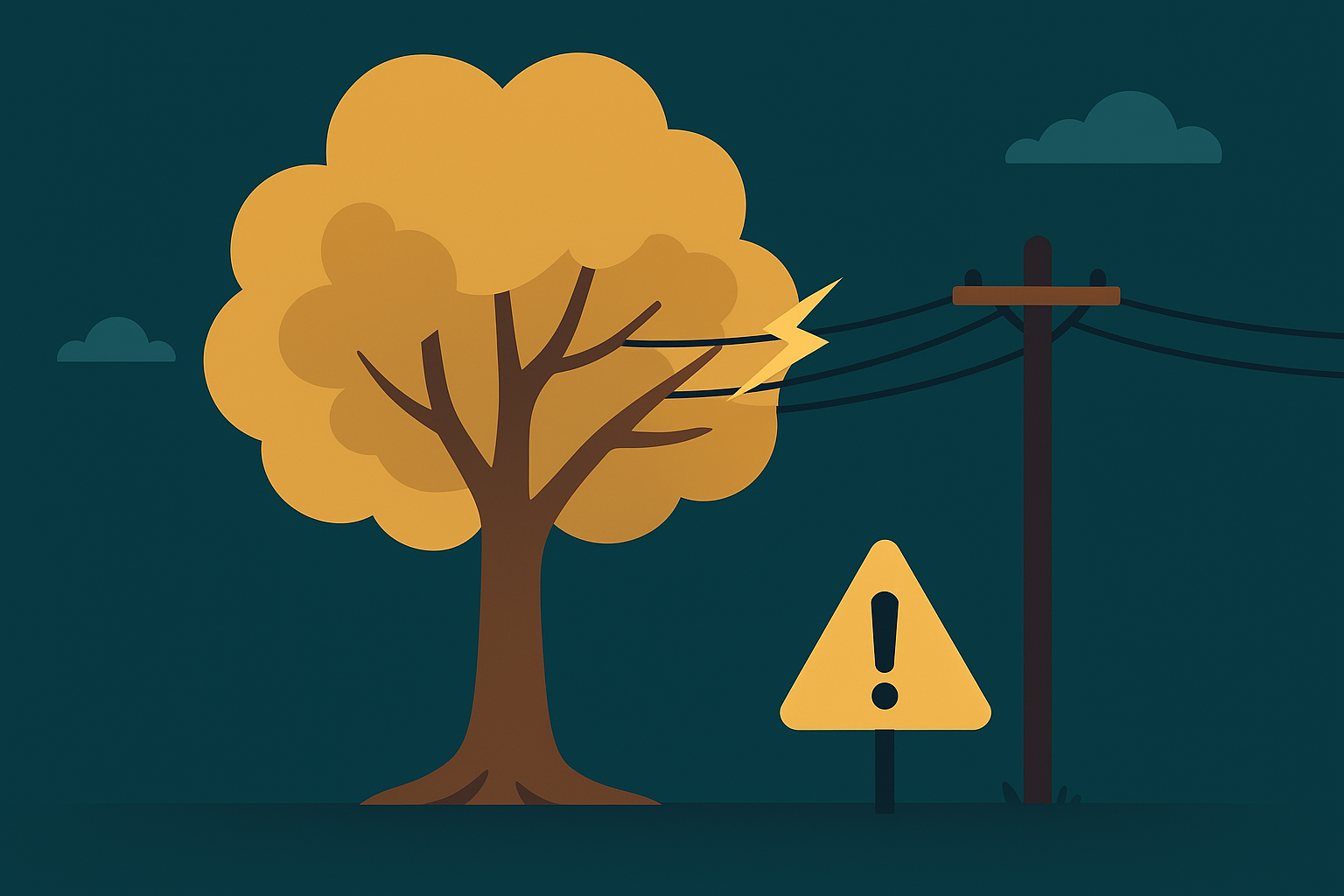
A tree in contact with a power line is an emergency, but a tree crew is not the first call. Treat every downed or sagging line as live, even if it does not spark or hum. Stay far back , keep children and pets away, and do not touch the tree, a metal fence or standing water near it. Call 911 and then your electric utility.
Tree crews cannot safely work on a tree in contact with energized lines until the utility has cleared or de-energized them. The utility owns the lines and sets the sequence. The right order is 911, then utility, then tree crew . An honest crew tells you this on the phone instead of rushing to a job it cannot start.
If a wire touches the tree, the utility goes first.
What the crew does and what it costs
Once the utility has made the lines safe, the crew removes the tree or limbs on your property and clears the debris. Tell dispatch whether the lines are down, whether your power is out and whether the utility has been to the site. That tells the crew what they can start and when .
The cutting itself prices like any other removal, from $300 to $2,000+ depending on size and access. The real cost is waiting. After a big storm, utility crews may take hours or days when many lines are down. Ask the tree service to keep you on the schedule so they can arrive as soon as the utility clears the site. Never hire anyone who offers to cut trees near live power lines.
4. A broken limb hanging over your property
Why it counts as an emergency
A broken limb caught in the canopy counts when it hangs over a roof, driveway, play area or walkway. Arborists call these widowmakers because they drop without warning, and a gust or a little added weight can finish the break. A limb lying on the lawn that hit nothing can wait. A limb still hanging above you cannot.
Do not stand under it to inspect it. Do not pull it down with a rope or cut it with a pole saw. Bark and hidden tension hold it in place, and when it lets go it can swing or kick back toward you. Mark off the area with cones or chairs and keep people clear until a crew arrives.
A limb still in the tree is more dangerous than a tree already on the ground.
What the crew does and what it costs
The crew ties the limb off with rope before the first cut. They then lower it in controlled pieces, and finish with a clean cut back to the branch collar so the wound can close. They also check the rest of the crown for other cracked or hung branches, since a storm that broke one limb often loosened others.
Removing a single hazardous limb usually costs less than removing the whole tree, and most are quoted on the spot once the crew sees the height and access. A crown with several hazards raises the quote. The upside is that prompt limb work often saves the tree , which avoids a full removal bill of up to $2,000 or more.
5. A leaning or partly uprooted tree
Why it counts as an emergency
A tree that has started to lean, or has lifted soil at its base, is an emergency when it can reach a house, a road or people. Watch for a new lean : a trunk that stood straight last week and tilts now, soil cracked or heaved on one side, exposed roots, or a root plate rising. Wet fall and winter soils in the Pacific Northwest let roots lose their grip, so these failures cluster after long rains and wind.
A tree that has tipped but still hangs on by its roots can settle or roll further without warning. Keep clear and do not push or pull it upright . Staking rarely saves a tree whose root plate has lifted, and the attempt puts you in its fall zone.
A new lean is a failure in progress, not a style choice.
What the crew does and what it costs
The crew checks the roots, soil and trunk, then recommends removal in most cases where the tree leans toward a target and the roots have lifted. Removal is done in sections or with rigging so the tree does not drop onto a fence or roof. The root ball leaves a hole that you will need to fill and regrade afterward.
Pricing follows the removal range of $300 to $2,000+. When a trunk snaps and leaves a stump behind, stump grinding costs$120 to $380 per stump. Bundling the grinding with the removal saves $45 to $75 compared with scheduling it separately. Ask for both numbers on the first quote.
6. A split trunk or storm-cracked tree
Why it counts as an emergency
A split trunk, a deep crack or a lightning strike turns a standing tree into a failure waiting to happen. Look for a vertical crack, a split where two stems join, a strip of bark peeled down the trunk, or a limb sheared off at its base. Damage inside the trunk is invisible , so a tree that looks mostly fine can still be structurally unsafe.
It counts as an emergency when the tree can reach a roof, a car or a place where people sit. If it stands in an open corner with nothing beneath it, treat it as urgent but schedulable . Keep people and vehicles out of the fall zone until a professional has looked at it.
You cannot judge a cracked trunk from the outside, so get an assessment before you decide.
What the crew does and what it costs
A crew inspects the tree and gives one of two answers: remove it or stabilize it. Cabling, which uses steel hardware to tie weak limbs or split stems together, can save a valuable tree when the damage is limited. Removal is the safer call when the trunk is cracked through or the tree leans toward a house.
Assessment is where you should not pay extra, because Alexa's Tree Service gives free estimates. Cabling is a smaller job than removal when it fits, and removal falls in the $300 to $2,000+ range. Ask the crew to explain why they chose one over the other , so you are not sold removal by default.
7. Storm debris blocking a business property
Why it counts as an emergency
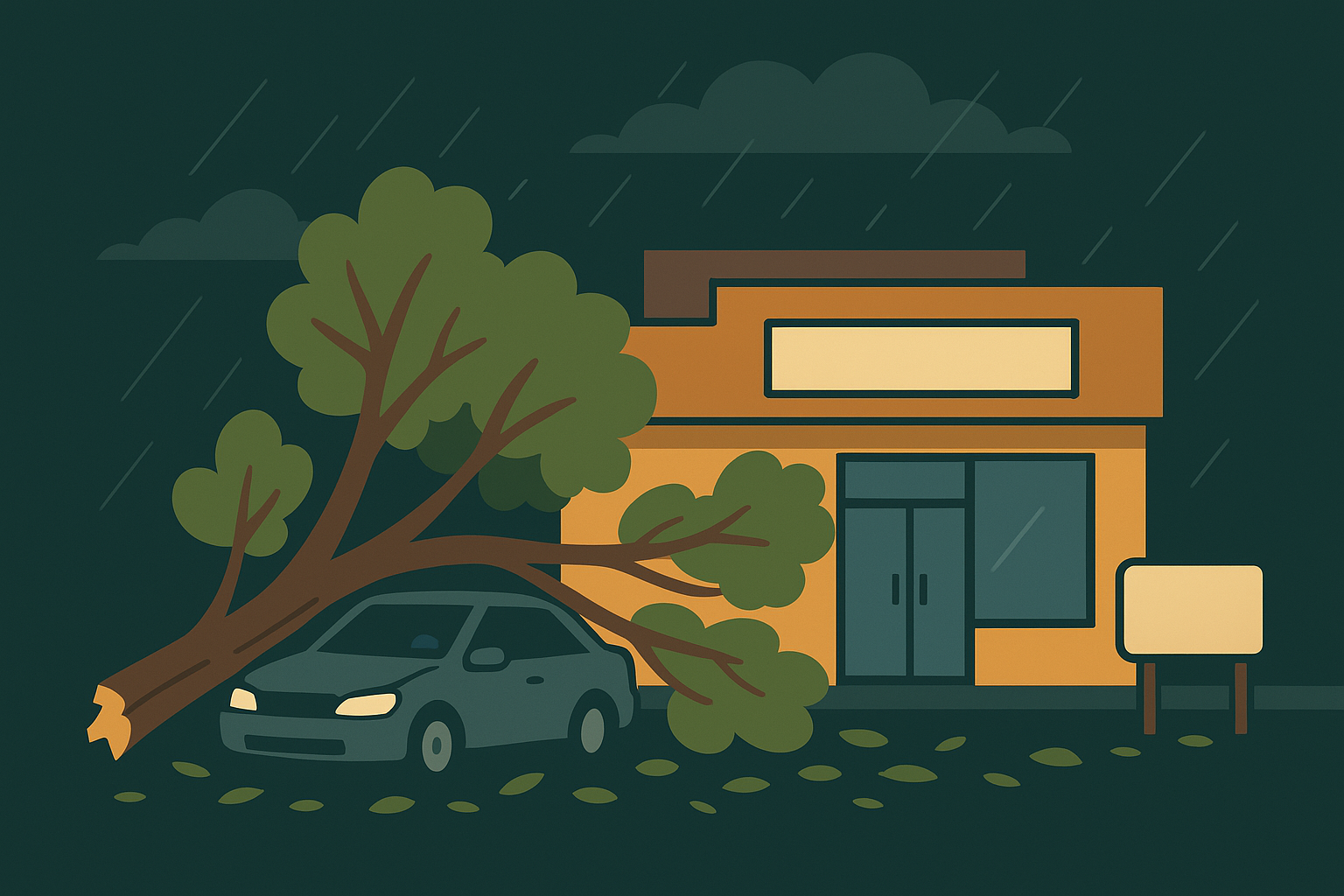
For a business, a tree emergency is any storm debris or hazardous tree that blocks an entrance, parking lot, loading area or sign, or that makes the site unsafe to open. Customers cannot get in, deliveries stop, and a limb on a car or walkway creates liability the same day . Retail centers, office parks and parking lots feel this first.
Property managers should document the damage before cleanup and notify the property insurer. Photograph each blocked entrance and each damaged vehicle or sign. On multi-tenant sites, coordinate with whoever holds the grounds contract so two vendors do not show up for the same job.
For a business, the goal of emergency tree work is reopening, not just removal.
What the crew does and what it costs
Commercial storm damage cleanup is built around reopening. The crew clears limbs and debris from entrances and lots first and hauls the material away. When possible, the property reopens the same day . Hazardous trees near entrances or parking lots are removed afterward, scheduled around business hours so the work does not cost you a second day of sales.
Ask for a written scope that separates emergency clearing from follow-up removals . That helps your insurer see what was storm-related. Alexa's Tree Service runs separate commercial storm cleanup and commercial tree removal lines for this reason.
What to do before the crew arrives
Emergency, urgent, or can it wait
Treat a fallen tree as an emergency when a person, a structure, a power line or your only access is involved. Everything else is urgent or can be scheduled. Sorting it correctly saves money and stress , because after-hours calls cost more than scheduled visits.
| Level | Examples | What to do |
|---|---|---|
| Emergency | Tree on the house, touching a line, blocking your only exit, or leaning at a structure | Get people safe, call 911 if needed, call a 24/7 crew now |
| Urgent | Large limb near the house, hanging limb away from walkways, split trunk with nothing beneath it | Keep the area clear and book within a day or two |
| Can wait | Tree down in an open yard that hit nothing, dead tree far from any target | Schedule a regular visit and get a free estimate |
A tree that fell in an open yard and touched nothing is the case most people overpay for. Photograph it, keep people away, and book a normal slot unless it is still moving or blocks access.
If nothing is at risk, daylight pricing beats midnight pricing.
Steps for the first 15 minutes
Your first job after a tree comes down is safety, and your second is information. Crews respond faster and quote more accurately when you can describe the problem clearly. Have these facts ready when you call: the address, what the tree is touching, how wide the access is, and whether anyone is hurt.
- Move everyone away from the tree and out of any damaged building.
- Call 911 for injuries, fire, a gas smell or downed lines.
- Stay far from any wire and anything touching it, including fences and puddles.
- Do not cut, climb or pull on the tree, because stored tension can snap back.
- Take photos and video from a safe distance, then start your insurance claim.
- Call a 24/7 tree crew and send the photos if they ask for them.
What tree emergency service costs
Typical price ranges
Emergency tree work costs more than scheduled work, and the final price depends on where the tree landed. The ranges below are typical for tree work in Vancouver, WA.
| Service | Typical price | Good to know |
|---|---|---|
| Tree removal | $300 to $2,000+ | Most residential jobs take 2 to 8 hours, debris hauled away |
| Stump grinding | $120 to $380 per stump | 6 to 12 inches below grade, 30 minutes for small softwood to 2 to 3 hours for large hardwood |
| Grinding bundled with removal | Saves $45 to $75 | Compared with scheduling separately |
| Storm cleanup | - | Available 24/7, average response 1.5 to 3 hours for active hazards |
Free estimates are available on request. Treat any crew that will not give a written price before cutting as a warning sign .
What pushes the price up, and a worked example
Several factors that drive tree removal cost move a quote toward the top of the range:
- A tree on a house, fence or vehicle instead of open ground
- Tight or blocked access that keeps equipment away from the tree
- Large trunk diameter or a tall, heavy crown
- Power lines nearby, which add coordination and waiting time
- A large volume of debris to haul away
- Work done at night or during a widespread storm
To see how this adds up, picture a storm dropping a mid-size tree across a backyard fence. Say the removal quote is $900 and the stump grinding is quoted at $200 separately. Bundled, you save $45 to $75, so the total is $1,025 to $1,055 instead of $1,100 . These are illustrative numbers, not a quote, but they show why you should ask for the stump price on the first call.
The location of the tree sets the price more than its size does.
Insurance, free options and who pays
Many homeowners policies cover removal when a tree falls on an insured structure such as your house, garage or fence because of a covered event like wind. A tree that falls in the yard and hits nothing is usually not covered, and a dead tree you ignored may be denied. Check your own policy and call your insurer before work starts when you can. Keep the invoice and your photos either way.
Free removal on private property is rare, but free estimates are common. A tree in the public right of way is usually handled by the city or county. When a neighbor's tree lands on your property, who pays can depend on your policy and on whether the owner knew the tree was hazardous. Talk to your insurer before you assume either way.
How to choose a 24/7 emergency tree crew
Questions to ask on the first call
The best emergency crew answers fast, tells you the truth about timing and puts the price in writing. You can check all of that in a two-minute phone call. Do not hire on the first ad you see just because it says 24/7.
- Do you have a live person or a fast callback, and what is the real arrival window for my situation?
- Are you licensed and insured, and can you send proof?
- Will you give a written estimate before cutting, and is the haul-away included?
- Do you know the local permit rules, and what does the city expect for emergency work?
- Can you document the job for my insurer?
Alexa's Tree Service is licensed and insured and picks up storm calls 24/7 at (360) 723-6688. We clean up branches, debris and leftover material after the work. Some removals in Vancouver need a permit, with processing of 5 to 10 business days, which is why true emergencies are handled differently. Ask the crew what the city expects, and take photos before anything is cut. We have helped with permit paperwork for 31 Vancouver properties between 2024 and 2026.
Red flags after a storm
Storms draw out the worst operators. Be wary of crews that knock on your door after a storm, ask for cash up front or cannot show proof of insurance. A crew that pressures you to sign on the spot or has no local address and no reviews deserves the same caution. If a crew's response is "we can be there in ten minutes" on a night with widespread outages, ask what they mean.
Watch also for bad technique. A crew that wants to cut a tree without looking at what it touches, or that recommends topping a storm-damaged tree, is not working to professional standards. Reviews help here. Alexa's Tree Service has 180+ five-star Google reviews, and you should expect any crew you hire to point you to a track record you can check.
A fast answer is only worth something if the crew is licensed, insured and honest about timing.
Keep a plan before the next storm
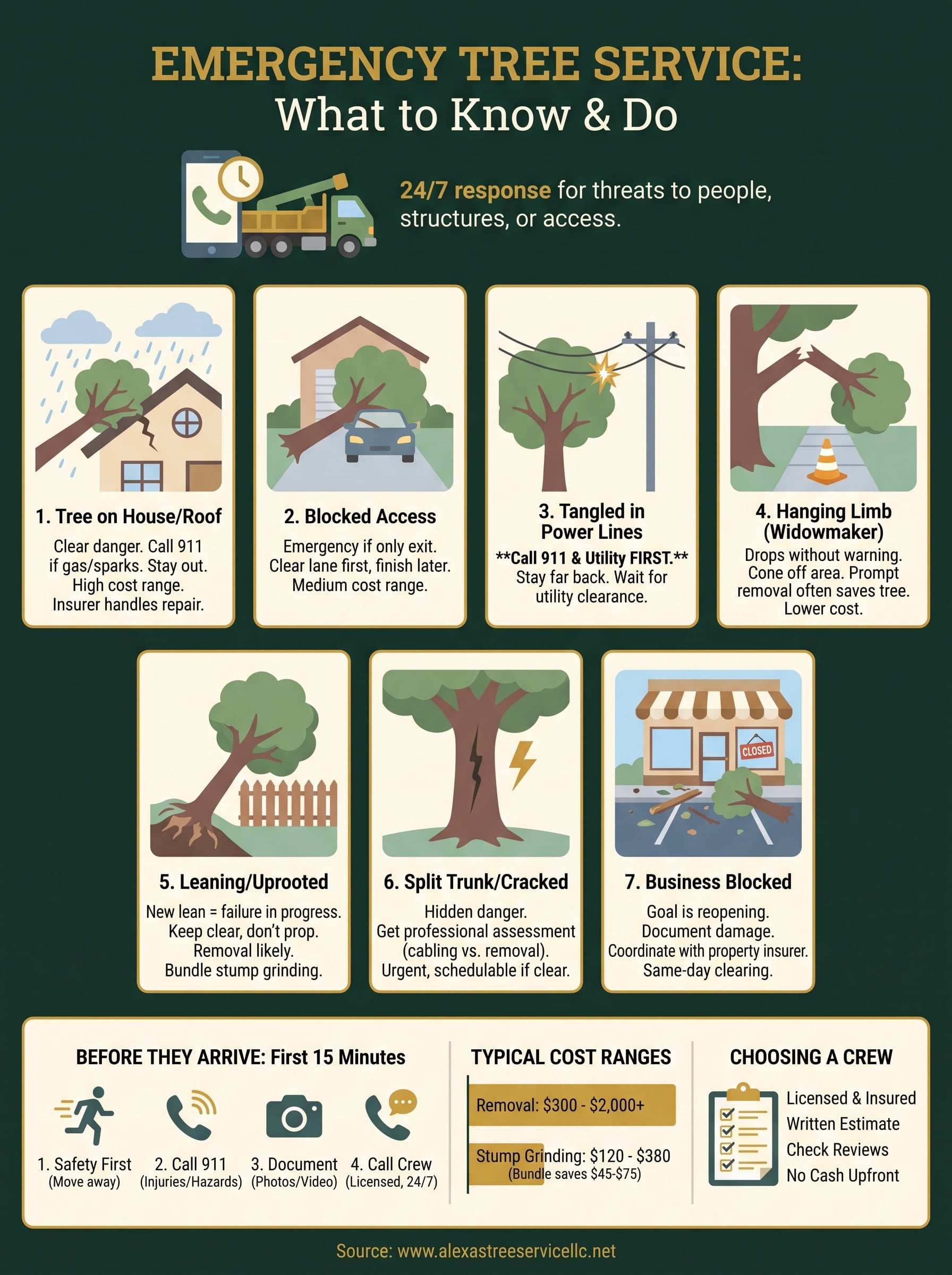
A tree emergency comes down to four moves: get people safe, call the utility if a wire is involved, document the damage, and call a crew that is licensed, insured and honest about timing. Tree on a house, power line contact, blocked access, hanging limb, leaning tree, cracked trunk, or a blocked business entrance: each qualifies, and each has a clear first step.
Prices start around $300 for removal and reach $2,000 or more when the tree sits on a structure. Saving a crew's number before the wind picks up costs nothing. If you have a tree down or a hazard hanging over your property in Vancouver or Portland, you can request a free estimate from Alexa's Tree Service and get a storm cleanup crew moving.