
How Much Does Tree Removal Cost in Vancouver, WA?
Tree removal cost is the total a contractor charges to cut a tree down safely and clear it away, and the stump is usually priced separately. Nationally, the average is about $750, and most jobs fall between $200 and $2,000. That is the short answer to how much tree removal costs . Your own number depends on the tree's height, trunk width, condition, and what stands near it. A small ornamental tree in an open yard can come down for a few hundred dollars. A tall tree over a roof or near power lines can cost several thousand.
At Alexa's Tree Service, we have removed trees around Vancouver, WA and the Portland area since 2006. Our tree removal jobs are priced from $300 to $2,000 and up, and every job starts with a free estimate. Below, we show you how crews arrive at that number, so you can check any quote against it.
This article covers why removal costs what it does, price ranges by height and trunk size, the cost of dead tree removal, the extras that change a quote, and how to tell whether an estimate is fair.
Why tree removal costs what it does
You pay for a trained crew, heavy equipment, and the risk of lowering several tons of wood next to a house, not just for the time a chainsaw runs. Once you see that, quotes are easier to read and averages are easier to trust.
Labor and risk make up most of the bill
Most residential jobs take 2 to 8 hours , and that time covers a whole crew: climbers, ground workers, a truck, a chipper, and the contractor's liability coverage. A mature tree can weigh thousands of pounds, so one wrong cut can damage a roof, a fence, or a person. Insurance, training, and experience are part of what you buy.
Contractors usually quote a flat price per job rather than an hourly rate, after looking at the tree in person. A few use a per-foot rule of thumb, which we cover in the next section. Either way, the price reflects what could go wrong as much as what has to be cut.
You are paying for the tree to come down safely, and safety is the most expensive part of the job.
What the national averages say
If you ask what the average cost of tree removal is, national cost surveys give these figures for a single tree.
| Measure | National figure |
|---|---|
| Average cost to remove one tree | About $750 |
| Typical range | $200–$2,000 |
| Middle of the market | $450–$1,450 |
| Tree plus stump removal | $884–$1,627 |
| High-end single tree | $2,500–$3,300 |
| Hardest jobs (large trees near power lines) | Up to $10,000 |
These figures disagree at the edges because each survey draws on different jobs. An average also blends a 15-foot ornamental pear with a 90-foot fir. Treat averages as a sanity check , not a prediction. The tall conifers common around Vancouver and Portland tend to push jobs toward the upper half of the range.
Why quotes for the same tree can differ
Two contractors can look at the same tree and quote prices that are hundreds of dollars apart. One may own a bucket truck while the other rents equipment. One may include hauling and cleanup while the other bills it separately. One may carry full insurance while the other does not.
The lowest bid is not always the best deal . A price that leaves out cleanup, the stump, or proper coverage can end up costing more than a higher, complete quote. Compare what each price includes before you compare the totals.
How to estimate your tree removal cost by size
Start with height and trunk diameter. Trees under 30 feet usually cost $150 to $500 to remove, trees from 30 to 60 feet cost $450 to $1,200, and large tree removal costs climb quickly above that. Width, access, and condition then decide where inside the band you land.
Cost by tree height
| Tree height | Typical national range | What the job usually involves |
|---|---|---|
| Under 30 ft | $150–$500 | Ornamental or small trees, often felled in one or two pieces |
| 30–60 ft | $450–$1,200 | Climbing, rigging, and cutting the tree down in sections |
| 60–80 ft | $800–$2,200 | Larger crew, a lift or heavy rigging, more cleanup |
| Over 80 ft | $1,000–$2,000 and up | Crane or heavy lift if the tree is near a house or lines |
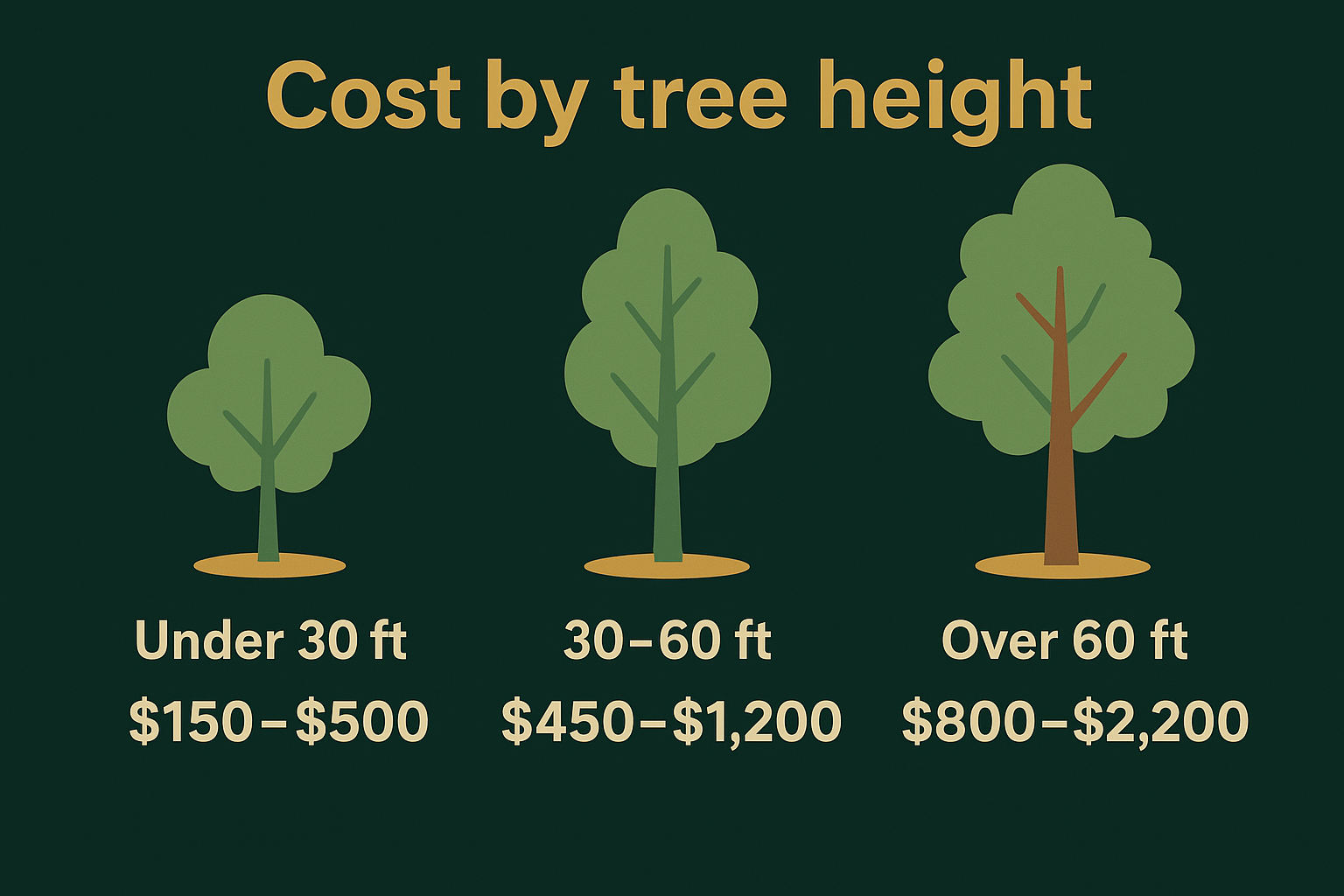
A 30-foot tree sits at the border of the first two rows. In an open yard, expect roughly $400 to $600 , and more if it leans toward a structure. A 40-foot tree falls in the second row.
Some contractors use a per-foot rule of thumb of about $9 to $15 per foot of height, plus extras. A 50-foot tree at $12 per foot comes to about $600 before add-ons. The rule breaks down on tall trees. A 100-foot tree costs far more than 100 times the per-foot rate, because the rigging, the crane, and the risk grow faster than the height.
Cost by trunk diameter and canopy
Height alone can mislead. A short tree with a wide trunk and a spreading canopy has more wood to cut and haul. These national ranges include labor and equipment.
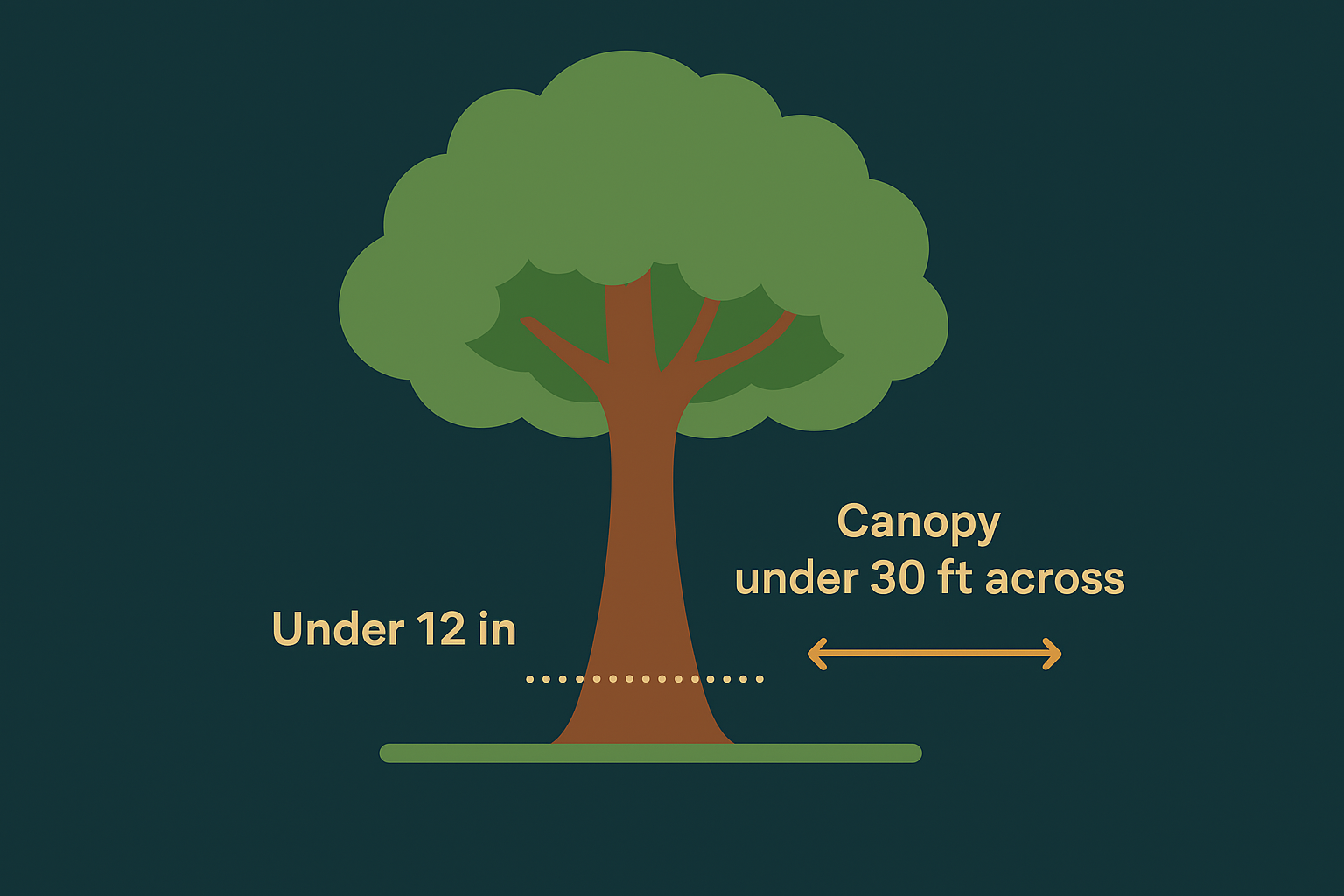
| Trunk diameter | Canopy under 30 ft across | Canopy over 30 ft across |
|---|---|---|
| Under 12 in | $226–$596 | $359–$946 |
| 12–24 in | $517–$1,364 | $808–$2,132 |
| 24–36 in | $976–$2,573 | $1,562–$4,117 |
Measure the trunk about 4.5 feet above the ground and estimate the canopy spread before you call. A contractor will give you a more accurate number if you share both.
A worked example
Take a 50-foot tree with a 20-inch trunk and a canopy under 30 feet, in a backyard with clear access.
- Height row: $450 to $1,200.
- Trunk and canopy row: $517 to $1,364.
- Per-foot check: about $600.
A reasonable removal price is $600 to $1,200 . Add stump grinding at $120 to $380 and the total is $720 to $1,580 . If the same tree sits in a cramped yard with a fence and a roof nearby, access can add 25% to 50%, which moves the removal alone to about $750 to $1,800 . A quote of $3,000 for the open-yard version, with nothing unusual about the site, deserves a request for a line-by-line breakdown.
Height puts you in the right price band, and trunk width, access, and condition decide where inside it you land.
Cost of dead tree removal and other condition factors
A dead tree costs about the same to remove as a healthy tree of the same size, and sometimes less. It can also cost more, because dead wood is brittle and unpredictable. Condition changes the method more than the price tag, and the method is what drives the cost.
Dead and diseased trees
Dead wood is often drier and lighter, so a solid dead tree can come down faster. National data puts a diseased tree with soft, easily broken wood at around $400 to $900 , and poor health accounts for up to roughly 15% of the final price. The savings disappear when the trunk is hollow or rotten. Then the crew cannot trust a climbing line or a cut, and they switch to specialized rigging to lower the pieces under control. You cannot always see hollow rot from the ground, so a simple-looking job can change once a climber is up there.
| Tree condition | Effect on price | Why |
|---|---|---|
| Dead, structurally solid | Similar, sometimes lower | Lighter wood, less concern for the surrounding landscape |
| Hollow, rotten, or decayed | Higher | Specialized rigging, slower and more careful cutting |
| Leaning toward a house or fence | Higher | Must come down in sections, not felled whole |
| Already on the ground | Lower, often $300–$500 for an uprooted tree | No climbing, mostly cutting and hauling |
| Fallen on a structure or after a storm | Premium, up to $5,000 in urgent cases | Emergency response and hazardous conditions |
Do not let a dead tree wait for a storm to make the decision for you. A scheduled removal is cheaper than an emergency one, and a dead tree that falls can damage far more than the tree costs to remove.
A dead tree rarely saves you much on removal, but removing it before it falls saves you a lot.
Storm-damaged and fallen trees
A tree that has already landed is not always the cheapest job. If it is flat on open ground, crews only cut and haul. If it is on your roof, over a car, or tangled in lines, the work becomes an emergency with real hazards. Emergency pricing carries a premium , especially when many homeowners call after the same storm.
Take photos before anything moves, and call your insurance company before the tree is removed, because adjusters often want to see the damage. Our storm cleanup crew is available 24/7, and active hazards typically get a response in 1.5 to 3 hours on average. If the tree is touching a power line, stay clear and call the utility first.
Will homeowners insurance pay?
Insurance usually pays when a covered event, such as a storm, drops a tree on your house or another structure. It usually does not pay to remove a dead or leaning tree that has not fallen yet, because that counts as preventive maintenance. Policies differ, so ask your agent before you assume either way.
Add-ons and site factors that change a quote
Extras cause most of the gap between two quotes for the same tree. Stump grinding, hauling, cranes, permits, and tight access are the usual ones, so ask what each estimate includes before you compare totals.
Access, equipment, and crane work
A tree alone in an open yard is a different job from one squeezed between a house, a fence, and a power line. Tight or hazardous access adds 25% to 50% , because crews need more time, more rigging, and sometimes special equipment. Moving a fence, a shed contents, or yard ornaments out of the work zone before the crew arrives can trim that increase.
Crane work is the biggest equipment cost. A crane typically adds about $500 on a simple job, runs $250 to $600 per day, and can reach $6,000 to $7,000 on difficult removals. A crane is worth paying for when it is the only safe way to remove a large tree over a structure.
Stump grinding, hauling, and permits
| Add-on | Typical cost | Notes |
|---|---|---|
| Stump grinding | $120–$380 per stump (our pricing) | Grinds 6–12 inches below grade; bundling with removal saves $45–$75 |
| Debris hauling | About $70 nationally | Often included, so confirm |
| Wood chipping | About $95 nationally | Leaves you mulch if you want it |
| Crane | About $500, or $250–$600 per day | Higher on complex jobs |
| Permit | $60–$150 nationally | An arborist report, if required, averages about $860 |
Stump size and wood hardness set the stump grinding price. A small softwood stump takes about 30 minutes, while a large hardwood stump can take 2 to 3 hours. On our jobs, the crew hauls away branches and debris after the work.
Permit rules depend on your city and the tree. Vancouver and Portland both regulate some removals, so check before cutting. We offer permit assistance guidance for Vancouver properties, and permit processing takes 5 to 10 business days, so plan ahead.
Timing, season, and location
When you ask what tree removal near you costs, season and distance matter alongside the tree. Spring, summer, and early fall are the busiest months, so scheduling a non-urgent removal in the off-season can lower the price. Emergencies right after storms run the other way and carry a premium.
Local competition also shapes prices. Rural properties that crews have to drive farther to reach can see travel charges. If you have several trees, ask for a bundle price, because crews save setup time when they remove them in one visit.
Ask what is included before you compare totals, because extras cause most of the gap between quotes.
How to tell if a tree removal quote is fair
A fair quote is itemized, falls inside the ranges for your tree's size and condition, and sits close to two other written estimates. If it fails any of those tests, ask questions before you sign.
Get three itemized quotes
Ask at least three tree services to look at the tree in person, and ask each for a written, itemized quote. A phone price without seeing the tree is a guess. Check that every quote answers these questions:
- Scope: does it cover the full tree, or only part of it?
- Cleanup: is hauling, chipping, and raking included or billed separately?
- Stump: is grinding included, quoted separately, or skipped?
- Insurance and license: can the company show proof of liability coverage?
- Permit: who handles it, and who pays?
- Access notes: did the estimator account for slopes, fences, and nearby structures?
- Timeline: when will the work happen, and how long will it take?
Use the size tables above as your reference. A quote far above the band for your tree, with no explanation such as power lines, a hollow trunk, or crane access, is worth questioning. A quote far below it usually means something is missing.
Ways to lower the cost
You can reduce the bill without cutting corners on safety.
- Schedule non-urgent removal in the off-season.
- Bundle multiple trees into one visit.
- Bundle stump grinding with removal, which saves $45 to $75 at our shop.
- Clear fences, furniture, and yard items out of the work area.
- Keep the wood as firewood instead of paying for hauling.
- Skip the stump if you do not need it gone.
Small, healthy saplings far from your house can be a DIY job. Anything tall, near a structure or lines, or needing more than a ladder to reach should go to a licensed and insured crew. The injury and damage risk costs more than the savings.
The best quote is the one that shows exactly what you get, not the one with the lowest number.
Putting a number on your tree
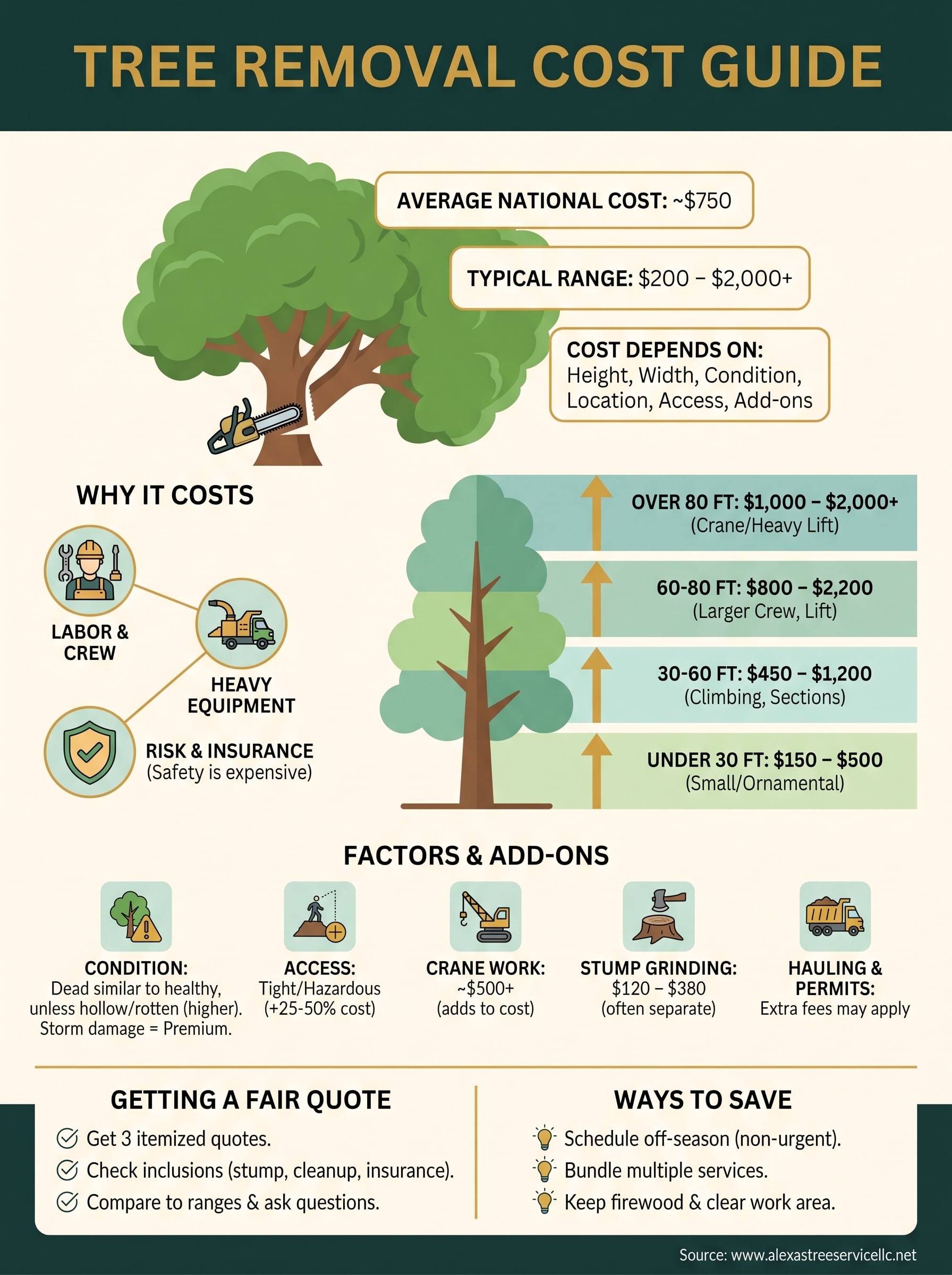
Tree removal usually costs $200 to $2,000 nationally, with an average near $750. Height, trunk width, condition, access, and extras like stump grinding and cranes decide where your job lands. A dead tree costs about as much as a healthy one, but waiting for it to fall costs more. Get three written, itemized quotes and compare what each one includes, not only the total.
If you are in Vancouver, WA or the Portland area, you can get a firm number for your own tree. Request a free estimate from Alexa's Tree Service for tree removal in Vancouver and Portland and our team will get back to you soon to discuss your tree service needs and schedule your free estimate.