Tree Removal Companies Near Me: 5 Types in Vancouver, WA
The best tree removal companies near me searches turn up share four traits: a valid license and liability insurance, reviews you can verify, a free written estimate, and a crew that cleans up after itself. For a full-service local job in Vancouver, WA or the Portland area, Alexa's Tree Service suits most homeowners and commercial properties. An ISA-certified arborist suits a valuable or sick tree. A small owner-operated crew suits a simple, budget-driven job. A regional company suits crane-heavy work, and an online marketplace suits fast quote comparison.
The hard part is not finding names. A search returns dozens of listings with near-identical star ratings, and national cost guides put tree removal anywhere from $200 to $2,000 depending on the tree. What helps is knowing which kind of company you are calling, what that kind does well, and what to check before anyone climbs your tree.
This article sorts local tree removal providers into five types and explains how each works, who it suits, and what it costs. A short section then covers how to verify licenses, read reviews, and compare quotes. Alexa's Tree Service has worked in the Pacific Northwest since 2006, so we list ourselves first and describe the other four types as plainly as we can.
1. Alexa's Tree Service
Alexa's Tree Service is a licensed and insured local company that handles removal, trimming, stump grinding, tree cabling, and storm cleanup for homes and businesses around Vancouver, WA and Portland, OR. It works across Vancouver, Camas, Battle Ground, Ridgefield, Portland, Gresham, Beaverton, and Lake Oswego.
How it works
You call or send the online form and get a free estimate. The crew removes the tree, hauls away branches and debris, and can grind the stump in the same visit. Most residential removals take 2 to 8 hours , and storm cleanup is available 24/7, with an average response of 1.5 to 3 hours for active hazards.
Permits are part of the service in Vancouver. We have provided permit assistance for 31 Vancouver properties between 2024 and 2026, and processing takes 5 to 10 business days . The company has operated since 2006 and has 180+ five-star Google reviews , which you can read before you call.
A local, licensed crew that handles the permit, the removal, the debris, and the stump saves you from coordinating four vendors.
Who it suits and what it costs
This option suits homeowners with hazardous, diseased, or unwanted trees, and commercial property managers who need work done around business hours. For storm cleanup at commercial properties, we aim to reopen the same day when possible.
Our service list prices tree removal at $300 to $2,000+ , stump grinding at $120 to $380 per stump, and trimming at $200 to $800+. Bundling stump grinding with a removal saves $45 to $75 versus booking them separately. As a hypothetical example, a $900 removal plus a $250 stump comes to $1,150 booked separately. Bundled, it lands between $1,075 and $1,105.
2. ISA-certified arborist companies
An ISA-certified arborist holds a credential from the International Society of Arboriculture, earned by passing an exam and kept current through continuing education. This is the type to call when the real question is whether the tree needs to come down at all.
How it works
The arborist inspects the tree for structural defects, disease, and risk to nearby buildings. You receive a recommendation, which may be removal, pruning, cabling, or monitoring. Some arborist companies perform the work themselves. Others only consult, so ask which you are getting.
Certification is verifiable. Ask for the certification number and look it up through the ISA's public directory before you book. The credential covers knowledge of tree biology and safe practice. It does not replace a business license or insurance, so check those separately.
Call a certified arborist first when the tree is valuable or the diagnosis is unclear, because the best outcome may be keeping it.
Who it suits and what it costs
This type suits owners of mature or large trees, trees close to the house, and anyone who needs a written risk assessment for a city permit, an insurer, or a dispute with a neighbor. It also suits a tree that looks sick but may be savable.
Expect a consultation fee in addition to any work, and removal priced much like other full-service companies. We cannot give a reliable range for assessment fees, so ask for one when you call. The fee is often small next to the cost of removing a tree you did not need to remove.
3. Large regional tree care companies
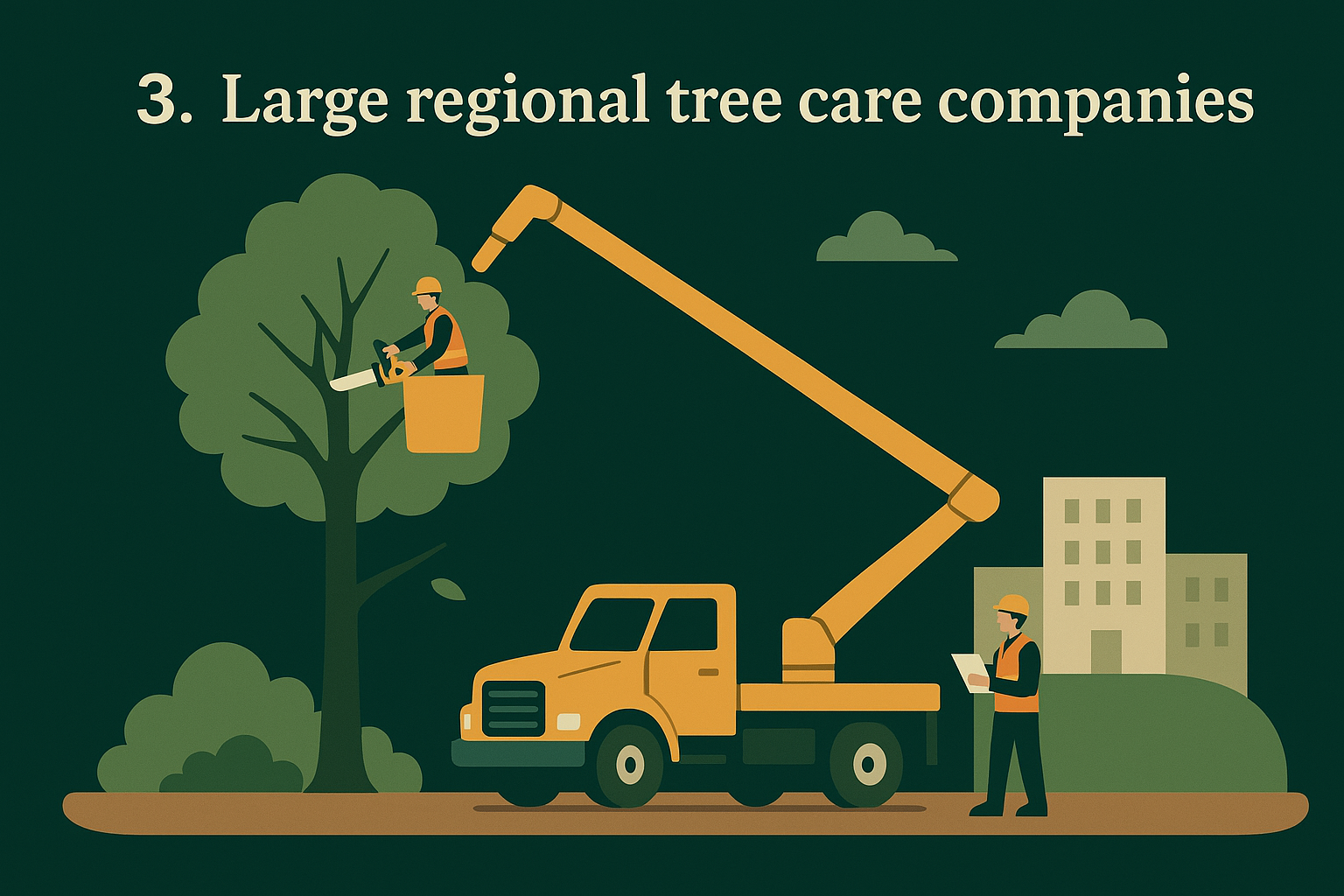
Large regional companies run bigger fleets, with cranes, bucket trucks, and dedicated estimators and office staff. They are built for volume and for jobs that smaller outfits may not have the equipment to do.
How it works
A sales arborist or estimator visits, then sends a formal proposal with scope, insurance documents, and a schedule. Jobs often run with larger crews and standardized safety procedures. Crane work is the main advantage , for example on a tall tree over a house with no space for a drop zone.
The tradeoff is overhead. Larger companies often quote higher, and the person who sells the job may not be the person who runs the crew. Ask who will be on site and who answers the phone if something goes wrong.
Pay for a large company when the equipment is the reason, not out of habit.
Who it suits and what it costs
These companies suit commercial campuses, office parks, multi-tree jobs, and owners who want a formal contract. National cost guides note that trees over 80 feet commonly cost $1,500 or more to remove, and crane access pushes that higher. Small trees run far less, so match the company to the tree.
4. Small owner-operated crews
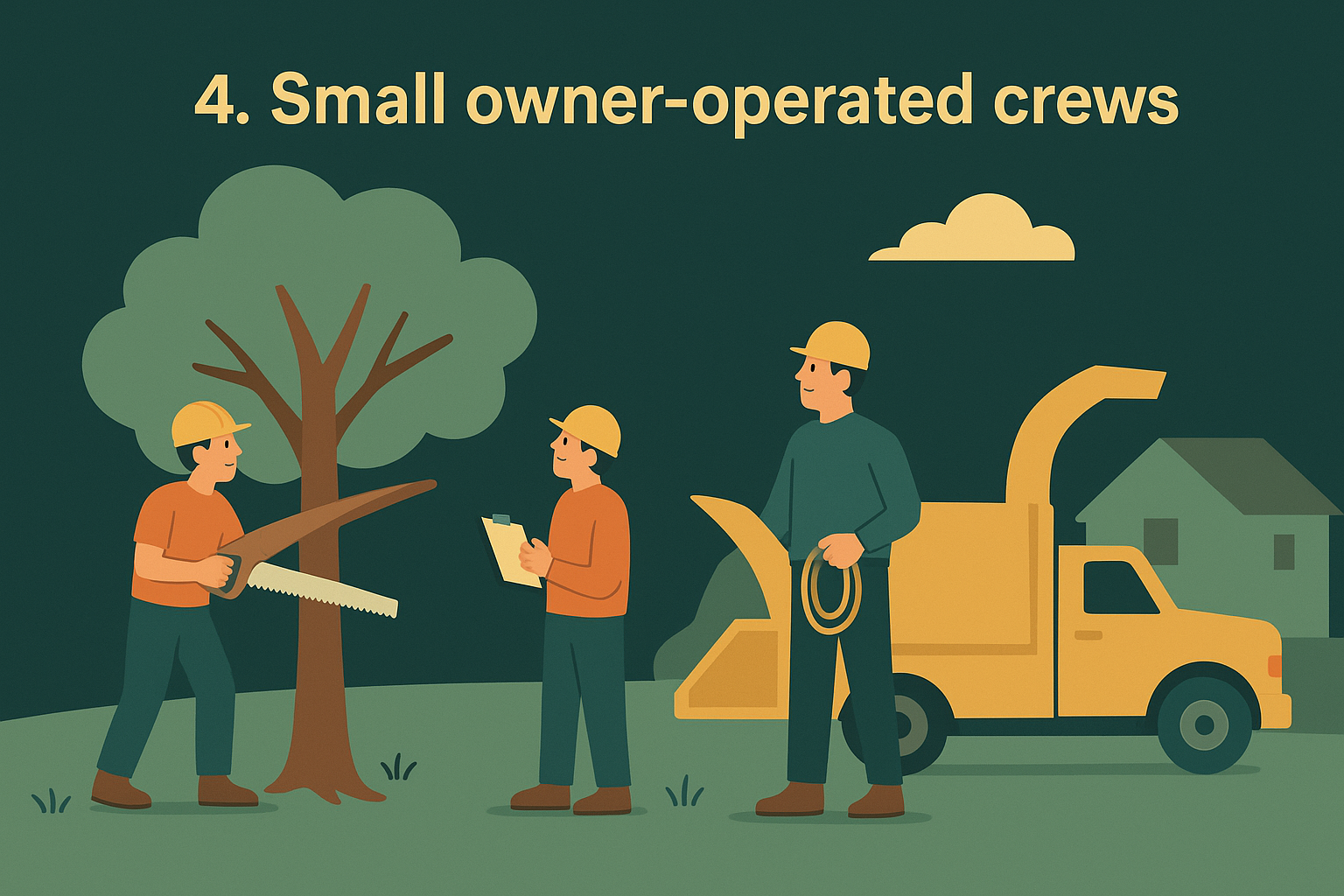
A small crew usually means an owner and a few workers with a truck, a chipper, and climbing gear. This type often gives the lowest quote and the quickest scheduling, and the owner is often the person you talk to.
How it works
The owner looks at the tree, quotes a price, often on the spot, and does the work with a small team. Flexibility is the benefit. Many will take small jobs that bigger companies pass on.
The risk is gaps in paperwork and equipment. Some small operators carry no liability or workers' compensation coverage, and a handful knock on doors after storms. Always ask for a certificate of insurance that comes from the insurer, not a photo of a card. An uninsured crew can leave you exposed if someone is hurt or property is damaged.
A low quote from an uninsured crew is not a saving, it is a risk you pay for later.
Who it suits and what it costs
This type suits small, easy-access trees with no structures, wires, or fences nearby. Cheap tree removal is realistic here, and some operators start from roughly $8 per foot on small trees, according to national cost guides. Verify the license and insurance first, then compare the quote against two others.
5. Online marketplaces and review sites
Google Maps, business profiles, BBB listings, and lead-matching sites do not remove trees. They connect you to companies, which makes them a good starting point for comparison and a poor stopping point.
How it works
You search your area or enter your zip code, and a matching site sends your request to several local pros who reply with quotes. Maps and profile listings show star ratings, photos, hours, and written reviews. This is how most "near me" searches work.
Paid placement shapes what you see. Pros often pay to be listed or to appear first, so a top listing is not an endorsement. Read the 1 to 3 star reviews, look at how recent the reviews are, and check how the company responded to complaints.
Use listings to build your shortlist, then verify each name yourself.
Who it suits and what it costs
This is for homeowners who do not know anyone local and want three quotes quickly. It is usually free to the homeowner. Treat any "badge" as a starting point, not a license check. A company that is both on a listing and licensed, insured, and well reviewed on Google is a safe bet to call first.
How to vet quotes, licenses, and prices
Before you hire any tree removal company, confirm the license and insurance, read the reviews for patterns, and compare at least three written quotes line by line. Ten minutes of checking protects you from the biggest risks in this trade.
Verify license and insurance
Ask for proof of the license or registration your state requires, and look it up on the state's own lookup tool. Ask the insurer to send a certificate of insurance directly. Then work through this list:
- License and registration: confirm the name matches the company that quoted you.
- Liability and workers' compensation coverage: confirm both, with dates that are current.
- References and reviews: if reviews are thin, ask for referrals from recent jobs.
- Equipment: confirm they have the gear for your tree, such as a crane for tall trees near a house.
- Permits: ask who handles them. Vancouver and Portland each have their own tree rules, so check with the city or ask the company.
No certificate of insurance, no job. That one rule screens out most bad actors.
Compare quotes line by line
A fair quote names the work, the cleanup, and the stump. Compare scope first, then price. This table shows our own service ranges as a reference point:
| Service | Price range | What moves the price |
|---|---|---|
| Tree removal | $300 to $2,000+ | Height, trunk size, access, nearby structures |
| Stump grinding | $120 to $380 per stump | Size and wood type |
| Tree trimming | $200 to $800+ | Number of trees, height, canopy |
National cost guides give an average removal near $750, with a range of $200 to $2,000. A job that costs $1,000 usually means a taller or harder-to-reach tree, not a small one. Trees over 80 feet often start around $1,500. Extra costs to ask about are debris haul-away, stump grinding, permits, and crane time. Free tree removal usually means you give up the wood or the job is a city program, so treat it with care.
Time the job and save money
The cheapest approach is to book a non-urgent removal outside storm surges, when crews have open schedules. Some companies offer off-season discounts, so ask. For tree trimming, late winter to early spring, February to March, is the best window, and no more than 25% of a tree's living canopy should come off in one season.
The cheapest company is rarely the one with the lowest number on the first call. It is the one whose quote includes cleanup, proof of insurance, and a clear scope. Get three estimates and ask each to itemize.
Pick the type that matches your tree
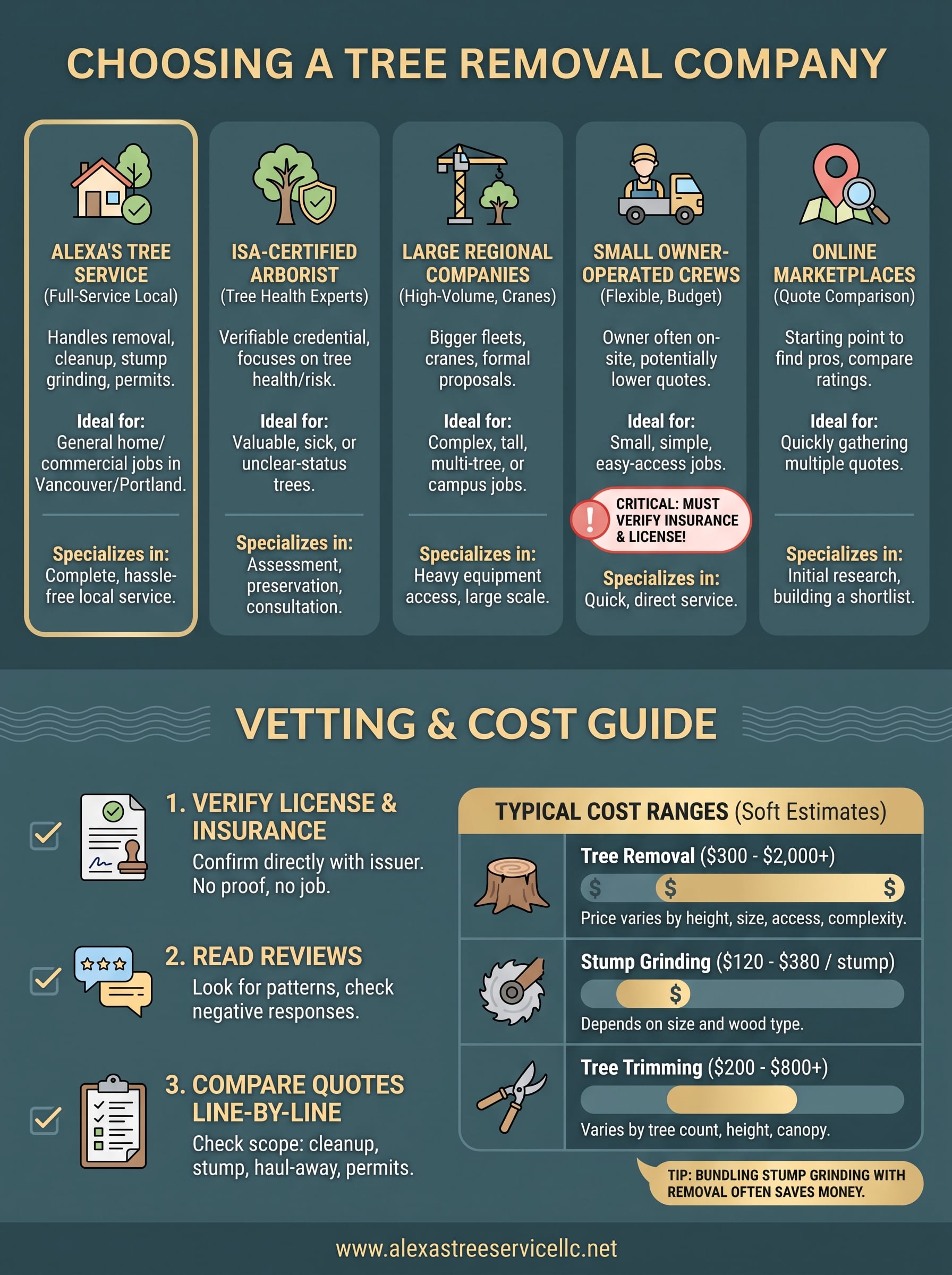
The right tree removal company depends on the tree. Call an ISA-certified arborist when you are unsure the tree needs to go, a regional company for crane-heavy work, a small crew for a simple job with verified insurance, and a marketplace to build your shortlist. For a full-service local job with permits, cleanup, and stump grinding handled together, a licensed local tree removal crew is the simplest route.
Whoever you choose, confirm the license and insurance, read the negative reviews, and compare itemized quotes. If you are in Vancouver or the Portland area, you can request a free estimate from Alexa's Tree Service or call (360) 723-6688 and we will look at your tree.