
Tree Removal Services Cost: How to Estimate a Fair Price
Tree removal services cost between $200 and $2,000 for most residential jobs, and national averages sit around $750 to $850. That price covers a crew safely felling the tree, cutting it into sections, and leaving the stump in the ground. Height, access, and condition decide where your tree lands in that range, and extras like stump grinding and haul-away are billed on top.
This guide explains why the price varies, how each factor moves your estimated tree removal cost, and which add-ons to expect. You will also get a simple method for building your own budget and testing a contractor's quote against it.
We have priced and removed trees across Vancouver, WA, Portland, OR, and nearby towns since 2006. The examples here come from the Pacific Northwest, where tall conifers and tight lots shape almost every quote. Treat the numbers as a starting point, then confirm them with a written estimate for your own tree.
Why tree removal services cost what they do
Tree removal costs what it does because you are paying for skilled labor, heavy equipment, insurance, and risk, not just a few hours with a chainsaw. A tree that looks simple from the lawn often takes a full crew most of a day.
What the price actually pays for
A typical removal needs two to five people , depending on the tree. One climber works aloft and rigs each section so it lowers under control instead of crashing onto your roof or fence. The ground crew handles ropes, moves wood, and feeds the chipper. Add a truck, a chipper, saws, and sometimes a bucket truck, and the equipment and labor outweigh the cutting itself.
Insurance and overhead sit inside the price too. A legitimate company carries liability and workers' compensation coverage , which protects you if a limb lands on your car or a climber is hurt on your property. That coverage costs real money, and it is the first thing a suspiciously cheap quote leaves out.
A removal quote is mostly labor, equipment, and insurance, so the cheapest bid usually cuts one of the three.
Typical cost by tree size
Height is the biggest single number on any estimate, because it drives crew size, rigging time, and the volume of wood to haul. The ranges below assume a standard removal with reasonable access and no stump grinding or other extras .
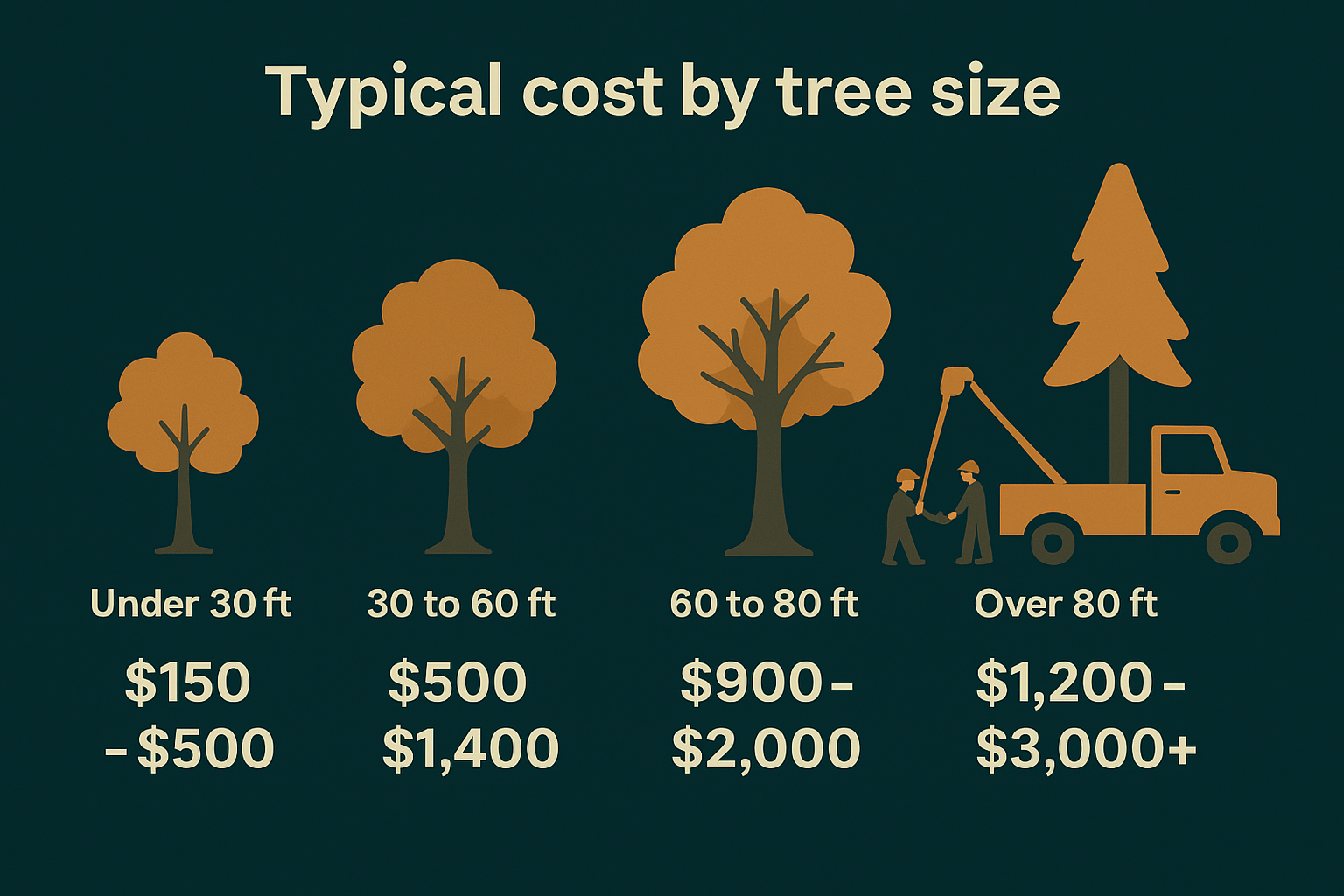
| Tree height | Typical range | What drives the price |
|---|---|---|
| Under 30 ft | $150 to $500 | Small crew, little rigging, easy chipping |
| 30 to 60 ft | $500 to $1,400 | Climbing and section-by-section lowering |
| 60 to 80 ft | $900 to $2,000 | Larger crew, heavy rigging, large wood volume |
| Over 80 ft | $1,200 to $3,000+ | Bucket truck or crane often needed |
As a rule of thumb, most residential jobs work out to roughly $10 to $40 per foot of height . Use that only as a sanity check. Many companies quote a flat price per tree rather than by the hour or the foot, and a hazardous giant leaning over a house can run well past $5,000, occasionally reaching $10,000.
Here in the Pacific Northwest, mature Douglas firs, western red cedars, and bigleaf maples regularly pass 80 feet. That pushes many local jobs into the bottom rows of the table , so budget accordingly if your tree towers over the roofline.
What pushes your estimated tree removal cost up or down
Height sets the starting price, and four things move it from there: the tree itself, how hard it is to reach, how urgent the job is, and where you live. Each one can shift the final number by hundreds of dollars.
Species, condition, and trunk width
Species matters because wood weight and structure differ. Dense hardwoods such as oak and maple are heavy and slow to cut, aspens spread through connected root systems, and palms are surprisingly heavy for their size. Wide trunks also mean bigger cuts and heavier pieces, which means more rigging time and more people on the ropes.
Condition works against intuition. A dead or rotting tree often costs more than a healthy one of the same height, because brittle wood can snap without warning and may need extra supports or a bucket truck to work safely. Leaning trunks, hollow cores, and storm-split limbs belong in the same group.
Access, hazards, and urgency
Access is where quotes jump most. If a truck cannot reach the tree, or the tree stands close to structures, the crew must rope pieces down instead of dropping them. Expect the following adjustments:
- Tight sites: a tree near a house, fence, pool, or retaining wall can add roughly 25% to 50% to the price.
- Power lines: a tree touching or leaning into lines is a job for your utility company first, not a tree crew and never you.
- Emergencies: storm damage or a fallen tree can cost two to three times the normal price because of the urgency and risk.
The same 50-foot tree can cost twice as much in a boxed-in backyard as it does in an open front lawn.
Location and permits
Where you live changes both the labor rate and the paperwork. Dense metro areas with a higher cost of living charge more per crew hour than rural areas, and a remote property may add a mileage fee. Permit rules vary by city, and both Portland and Vancouver regulate the removal of some trees, especially larger or protected ones, so check before you schedule. Where permits apply, fees commonly run about $50 to $150.
Skipping that step is the costly mistake. Removing a regulated tree without approval can bring fines that dwarf the removal bill. A reputable company will tell you whether your tree needs a permit, and good ones will guide you through the process.
Extras that add to tree removal services cost
Most extras add between $70 and $500 each, and the price of stump grinding is the one that surprises people most. A basic removal ends with the tree on the ground and a stump in your yard, so anything beyond that is usually priced separately.
Typical add-on prices
The table lists common extras and what they typically add to the base removal price.
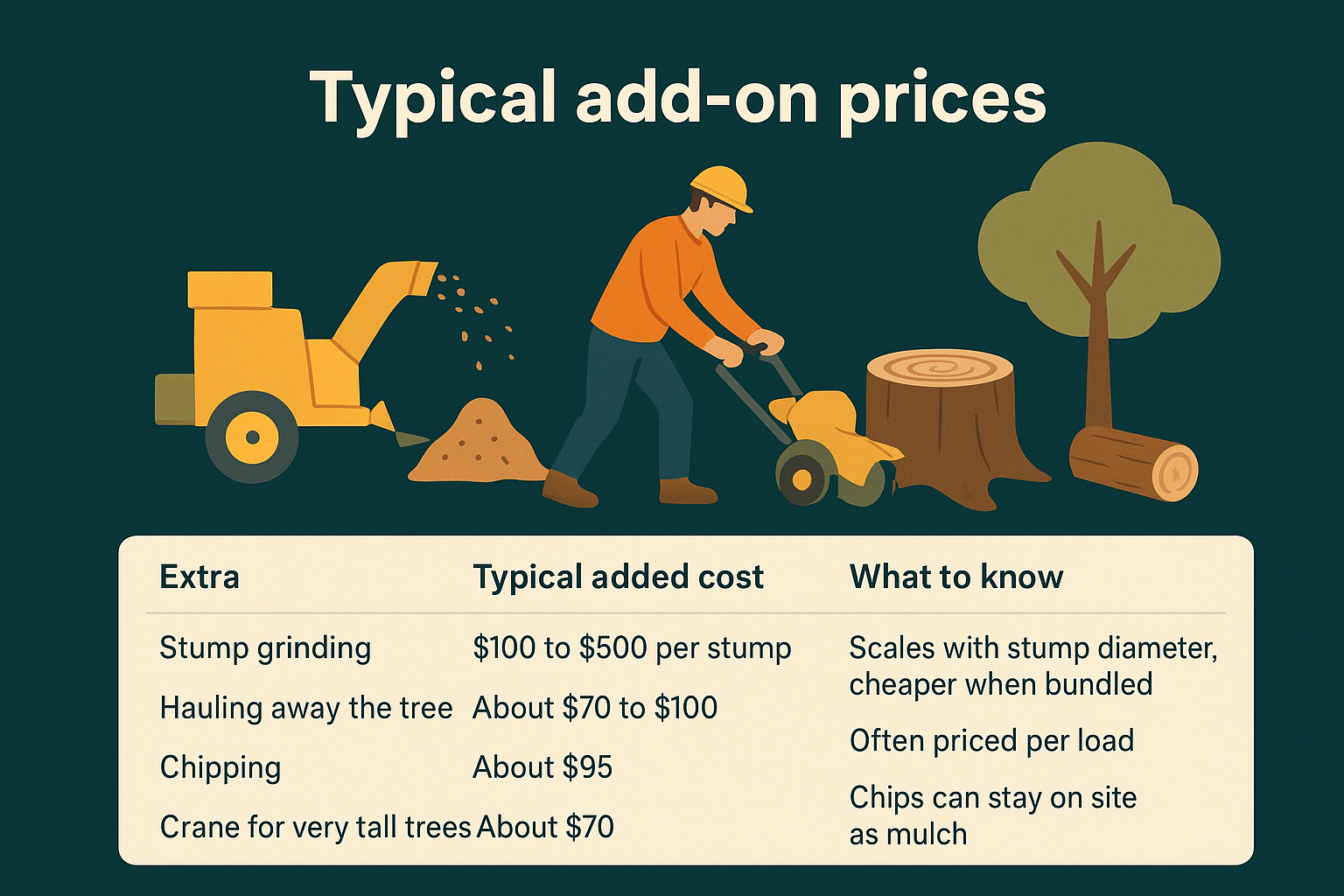
| Extra | Typical added cost | What to know |
|---|---|---|
| Stump grinding | $100 to $500 per stump | Scales with stump diameter, cheaper when bundled |
| Hauling away the tree | About $70 to $100 | Often priced per load |
| Chipping | About $95 | Chips can stay on site as mulch |
| Splitting into firewood | About $70 | Ask if wood is stacked or left in rounds |
| Crane for very tall trees | About $500 | Truck rental and extra crew |
| Permit | About $50 to $150 | Only where the city requires one |
| Storm or emergency work | 2x to 3x normal | Urgent, hazardous conditions |
What a base quote should include
Before you accept a number, ask exactly where the job ends. Some companies include cleanup and haul-away in the price, others leave the logs and brush for you. Neither approach is wrong, but a quote that hides the difference makes comparison impossible.
Stump grinding is the item to settle early. Paying for it during the removal is almost always cheaper than hiring a separate stump visit later , because the crew is already on site with the truck. Decide up front whether you want the stump gone, the wood kept, or the chips left for your garden beds.
Ask whether your quote ends with a stump on the lawn or a clean, level yard.
How to estimate your budget and judge a quote
Estimate your tree removal services cost by matching your tree's height to the size table, adjusting for access and condition, and adding the extras you want. Then compare at least three written quotes against that number.
Build your own estimate in five steps
- Estimate the height. A two-story house is roughly 25 to 30 feet, so compare your tree to the roofline.
- Note the species and condition. Write down trunk width, any dead limbs, lean, or fungus at the base.
- Check access. Can a truck reach the tree? Are there fences, structures, or wires in the way?
- Pick the range from the size table. Add 25% to 50% if access is tight.
- Add your extras. Include stump grinding, haul-away, and firewood splitting if you want them.
Here is a worked example. Say you have a 50-foot maple behind a fence. Start at the middle of the 30-to-60-foot range, then add the access premium and extras.
| Line item | Estimate |
|---|---|
| Base removal, 30 to 60 ft | $1,000 |
| Tight access, +25% | $250 |
| Stump grinding | $250 |
| Haul-away | $100 |
| Estimated total | About $1,600 |
A quote between roughly $1,200 and $2,000 would be in line. One at $600 or $3,500 deserves questions.
Judge whether a quote is fair
Get three written, itemized quotes from licensed and insured companies, and compare scope before price. If two quotes cover the same work and land within about 15% to 20% of each other, you are probably looking at fair pricing. A certified arborist, credentialed through the International Society of Arboriculture, is a good sign on any company's team, especially for risky trees.
Watch for these red flags:
- A price far below every other bid, with no explanation.
- No proof of liability and workers' compensation insurance. Ask for the certificates and confirm them with the insurer.
- No written contract, or a vague scope that never mentions cleanup or the stump.
- Pressure to decide today, or a large cash deposit before any work starts.
Compare what each quote includes first, because two prices only mean something when the scope matches.
How to lower the cost without cutting corners
You can lower tree removal services cost through timing, bundling, and small tasks you handle yourself. You cannot safely lower it by hiring an uninsured crew or climbing the tree on your own.
Timing and bundling
Late winter is often the cheapest window. Leaves are down, the tree is easier to read, and demand for crews is lower than in storm season or spring. Do not wait if the tree is leaning, split, or hanging over a structure, because a hazard is worth removing at any price.
Bundling also helps. Removing several trees in one visit spares the crew repeat setup and travel, so ask about a multi-tree discount. Pairing a removal with trimming or stump grinding gives you the same benefit.
Savings that are real and ones that are not
Small jobs are legitimate savings. Handling debris yourself can save roughly $50 to $200, and keeping the chips or firewood saves disposal fees. After storm damage to a structure, check your homeowners policy, since some policies cover removal in that case. If the tree is healthy, ask whether pruning is enough, because trimming often costs a fraction of removal.
Do-it-yourself felling is not a saving. Chainsaw kickback, a misjudged fall line, and wood that shifts on a cut cause serious injuries and damage every year. One mistake, such as a dropped trunk through a roof or fence, can cost many times what a professional would have charged.
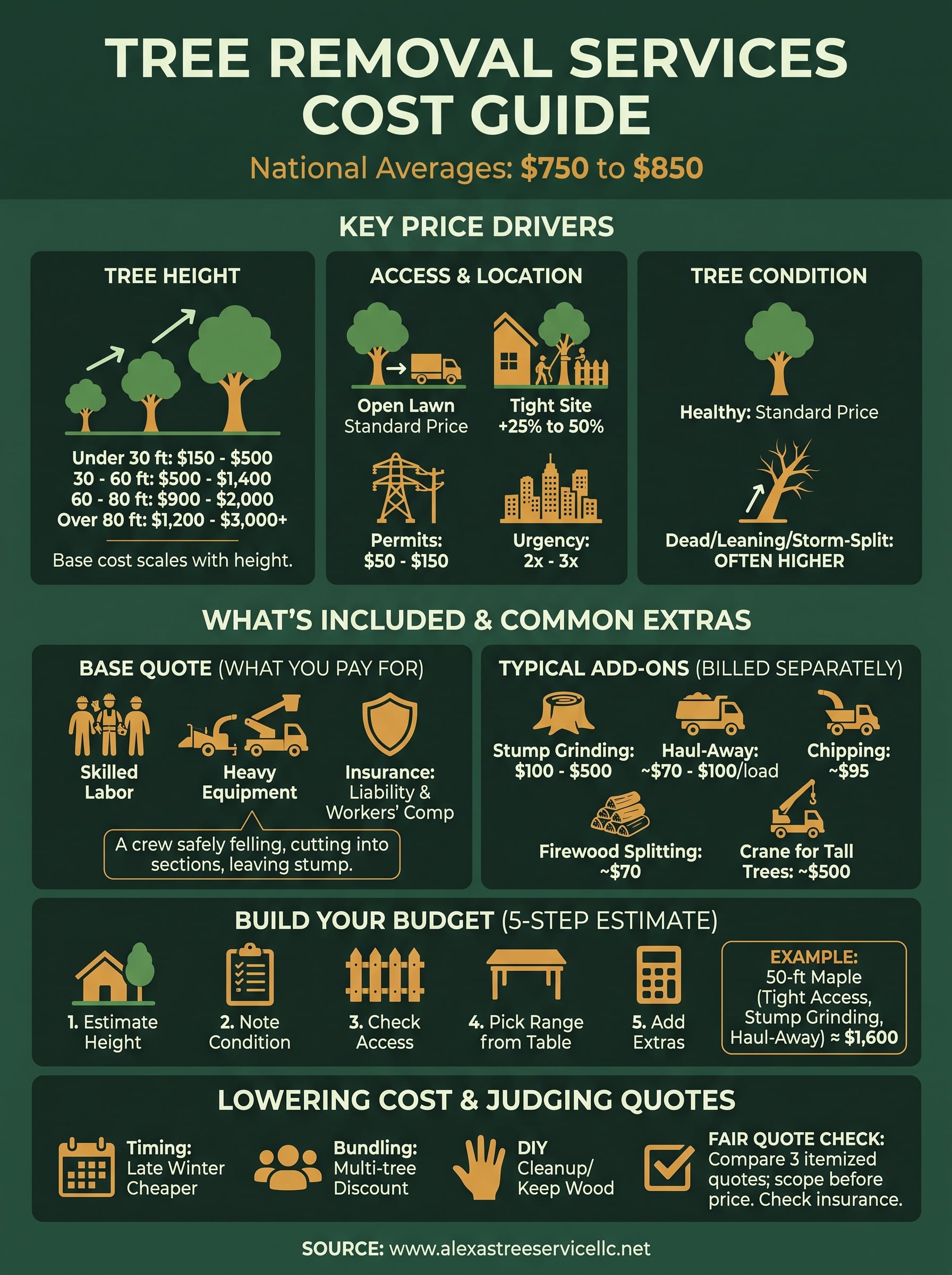
Put a number on your tree
The honest answer to what tree removal costs is a range, not a single figure. Height sets the base, access and condition move it, and extras like stump grinding and haul-away finish the bill. Build your own estimate, collect three itemized quotes, and compare scope before price.
If you are in Vancouver, Portland, or the surrounding area, you can request a free estimate from Alexa's Tree Service and see exactly what your tree will cost, in writing, with nothing left out.