Cost for Large Tree Removal: Average Prices and Key Factors
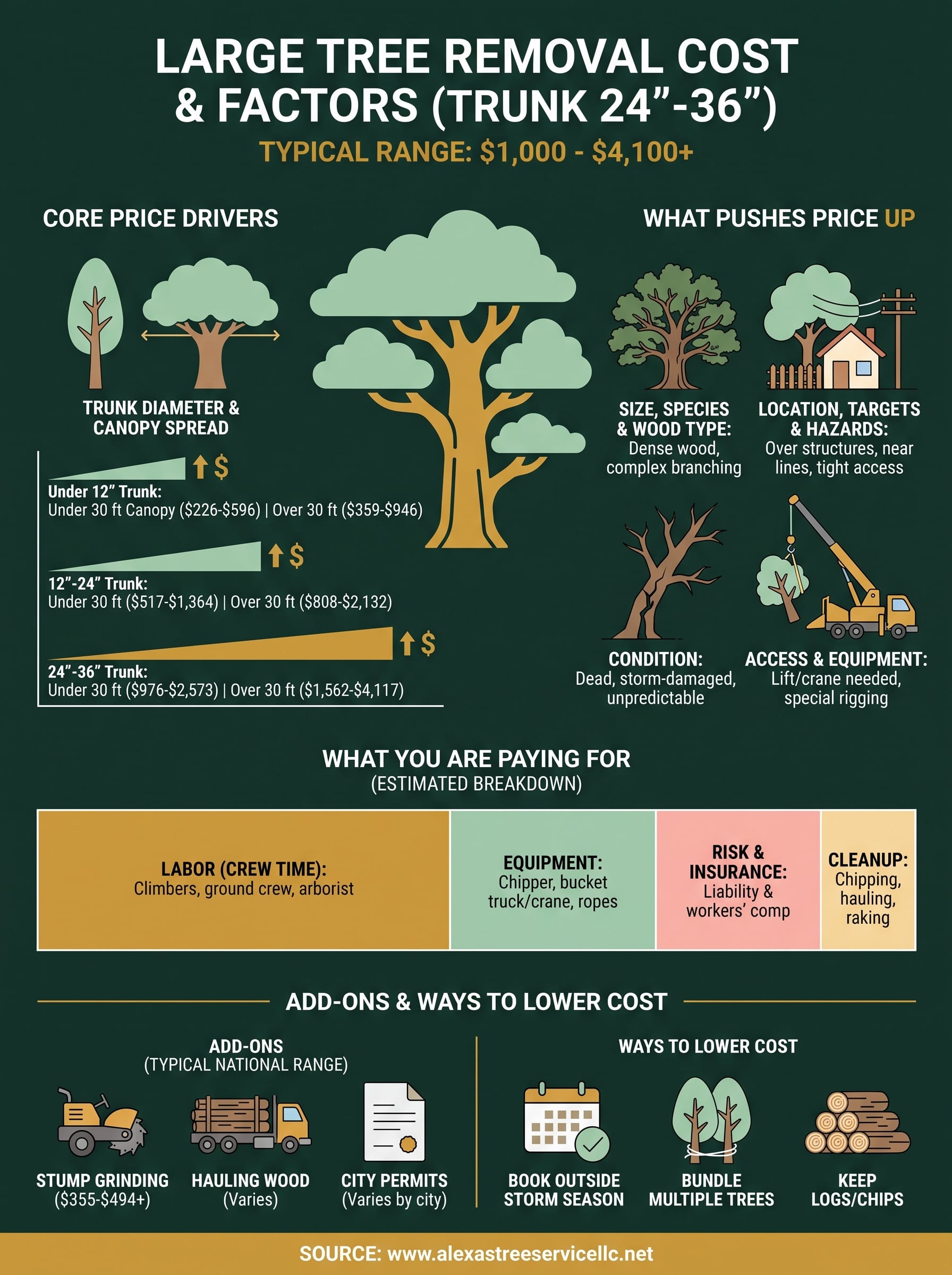
The cost for large tree removal usually falls between about $1,000 and $4,100 for a tree with a trunk 24 to 36 inches across. It climbs from there when the tree is dead, leans over a roof, or stands near power lines. That figure is the price for a standard removal, not a rate per inch or per foot. It is the total of crew labor, equipment, risk, and cleanup, so two trees of the same height can quote very differently.
In pricing terms, a "large tree" means one with a trunk about 24 inches or wider, or one that stands taller than roughly 60 feet. Many mature Douglas firs, bigleaf maples, and oaks in Pacific Northwest yards fall into this group. A tree this size needs a trained crew, rigging, and often a lift or crane. That is why the bill looks nothing like a small-tree job.
This guide explains why the number matters, what typical prices look like by size and height, and which factors raise or lower a quote. It also shows how to collect bids you can compare. Alexa's Tree Service has removed large trees around Vancouver, Portland, and nearby communities since 2006, so the advice here comes from jobs we have actually priced and completed.
Why the cost of large tree removal matters before you book
The cost of large tree removal matters because it is one of the few home expenses where the cheapest bid can become the most expensive outcome. A large tree comes down in sections over a roof, fence, or driveway, so the price reflects risk as much as labor. Understanding the price lets you judge a quote instead of just accepting or rejecting it.
Why quotes for the same tree can differ so much
National pricing data for trees with a 24 to 36 inch trunk runs from about $976 to $4,117. That spread is not noise. Each contractor prices the rigging plan, the equipment, the crew size, and the chance of something going wrong in a different way. One company may plan to use a lift and fell the tree in big sections. Another may climb and lower small pieces by rope.
A fair quote is one the contractor can explain line by line. A wide gap between bids usually means the bidders disagree about the plan, so ask each one to describe how the tree will come down.
What you are actually paying for
Labor is the largest piece. National figures for typical removals put labor at roughly $257 to $2,476 and equipment at $155 to $363, and large trees push both toward the top of those ranges. Your quote is built from four parts:
- Crew time: climbers, ground crew, and a supervising arborist.
- Equipment: chipper, bucket truck or crane, ropes, and rigging hardware.
- Risk and insurance: liability and workers' compensation coverage that protects your property and the crew.
- Cleanup: chipping, hauling branches and logs, and raking up debris.
A large tree quote is mostly paying for people and planning, not for the saw.
What a very low bid can cost you
A bid far below the others often comes from a crew without proper insurance, rigging gear, or experience with large trees. If a limb lands on your roof or a worker is hurt on your property, you may end up paying for it. Ask for proof of liability insurance and workers' compensation before you sign anything. A reputable company hands over the paperwork without hesitation, and the extra few hundred dollars for a properly covered crew is cheap protection on a tree that weighs several tons.
What large tree removal costs by size and height
A large tree costs roughly $1,000 to $4,100 to remove, while most published national averages for a tree of any size land between $750 and $850. The average cost to remove a tree is a misleading budgeting number for a big tree, because it blends in small ornamental trees that take an hour to drop.
Average cost to remove a tree of any size
Across all sizes, national data shows most removals costing between $450 and $1,450, with extremes from about $200 to $2,000 for ordinary jobs. If you are asking what a removal costs in general, expect somewhere near $750 to $850 for a mid-sized tree in an open yard. Large trees, tight sites, and hazards all sit above that line.
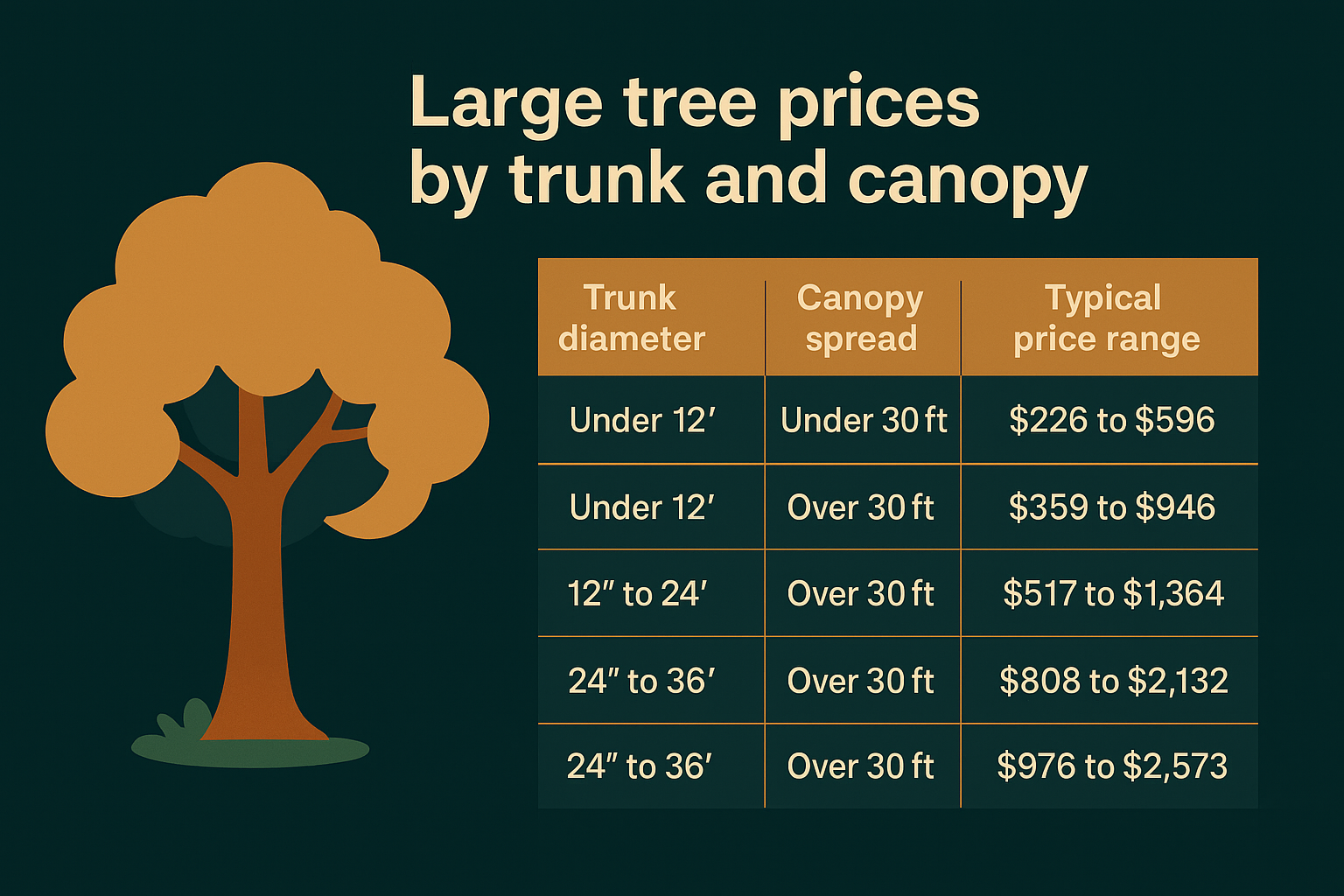
Large tree prices by trunk and canopy
Trunk diameter and canopy spread are the two measurements that drive the base price. This table shows national ranges that include labor and equipment.
| Trunk diameter | Canopy spread | Typical price range |
|---|---|---|
| Under 12" | Under 30 ft | $226 to $596 |
| Under 12" | Over 30 ft | $359 to $946 |
| 12" to 24" | Under 30 ft | $517 to $1,364 |
| 12" to 24" | Over 30 ft | $808 to $2,132 |
| 24" to 36" | Under 30 ft | $976 to $2,573 |
| 24" to 36" | Over 30 ft | $1,562 to $4,117 |
A wide canopy adds cost because there is more wood to cut, lower, and haul. These figures are national benchmarks, so your own local quote will shift with labor rates and site conditions.
What a 40 foot tree and a $1,000 tree look like
On height alone, trees between 30 and 60 feet are usually benchmarked at about $435 to $870 nationally. A 40 foot tree with a moderate trunk in an open yard fits that range. The same height with a thick trunk, a wide canopy, or a house underneath moves into the trunk-based ranges above. Very tall trees over 80 feet reach about $2,000 on height alone, and more once the trunk and hazards are counted.
If you wonder how big a tree is likely to cost $1,000, the answer is a trunk around 24 inches with a compact canopy, or a 12 to 24 inch trunk with a canopy wider than 30 feet. Past that size, expect the price to rise quickly.
Trunk diameter and canopy spread predict the base price better than height does.
What pushes a large tree removal price up or down
Four things move a large tree quote more than anything else: the trunk and canopy, what sits underneath the tree, the tree's condition, and the extras around the job. The cost for large tree removal is a base price plus adjustments for each one.
Size, species, and wood type
Beyond trunk and canopy, species affects how hard the tree is to take apart. A dense oak weighs far more per section than a similar-sized conifer, and a bigleaf maple with several heavy stems leaning in different directions takes more planning than a straight Douglas fir. Wet wood after a rainy stretch is heavier too, which slows rigging and loading.
Location, targets, and hazards
What lies within the tree's fall zone changes the method, and the method changes the price. A tree in an open field can be felled whole. The same tree over a house, a fence, or a neighbor's yard has to be dismantled piece by piece. Power lines raise the stakes further, and some large trees close to lines have been priced as high as $10,000.
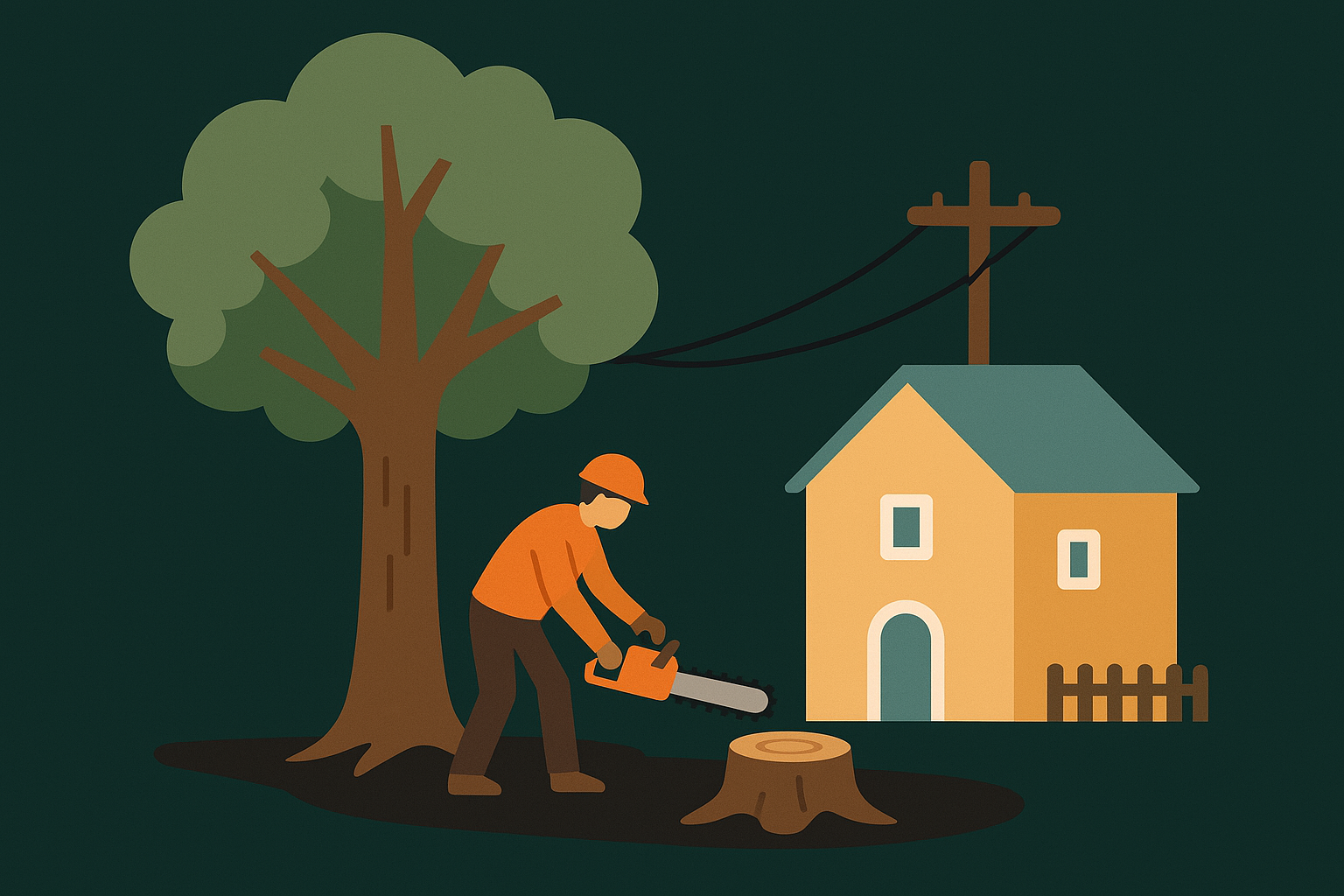
Condition matters just as much. A dead, decayed, or storm-damaged tree is unpredictable, so crews use extra rigging and move slower. Tight access, such as a narrow gate or a steep backyard, can also require a lift or crane. Equipment delivery alone can run several hundred dollars.
Add-ons that sit outside the base price
Many quotes cover only the cutting. Ask what is and is not included, because these items often appear as separate lines:
| Add-on | Typical national range |
|---|---|
| Stump grinding, large stump (24" to 36") | $355 to $486 |
| Stump grinding, extra large (36" to 48") | $372 to $494 |
| Tree and stump removed together | $884 to $1,627 |
| Hauling away logs and wood | Varies by company |
| City permit or review fees | Varies by city |
Ask whether the quote includes cleanup and the stump before you compare totals.
How to get an accurate quote for large tree removal
You get an accurate quote by giving every company the same facts, asking the same questions, and comparing line items instead of totals. A contractor can ballpark a tree from photos, but a firm price needs an on-site look.
Measure and photograph the tree first
Gather the details before you call. Wrap a tape around the trunk about 4.5 feet above the ground, then divide that circumference by 3.14 to get the diameter. Estimate the height and canopy spread, and take photos from several angles that show the house, fences, and wires nearby. Then run through this short list:
- Note any dead limbs, fungus, cracks, or a lean.
- Check how a truck or lift could reach the tree.
- Write down everything the tree could hit if it fell.
What to ask each tree service
Send the same message to every company so the bids line up. You can copy this:
 Hi, I need a quote to remove one large tree.
Trunk diameter: about ___ inches. Height: about ___ feet.
Canopy spread: about ___ feet.
Nearby: house / fence / power lines / neighbor's yard.
Please tell me: does the price include cleanup, wood haul-away,
and stump grinding? Are you insured and can you send proof?
Do I need a city permit, and do you help with it?
The answers tell you more than the totals do. Compare the plan for removal, what is included, and the proof of insurance.
Ways to lower the bill
You can trim the cost without cutting corners on safety. Book outside storm season when your area's windstorms keep crews busy. Bundle several trees into one visit, because setup and equipment costs spread across the job. Keep the logs for firewood and the chips for mulch if you have a use for them. Skip stump grinding if you plan to leave the stump, though you can always add it later.
Compare line items across bids, and give every company the same description of the tree.
When costs jump: emergencies, permits, and DIY risks
The final cost for large tree removal can rise sharply from emergency work, permit requirements, or a failed DIY attempt. All three are avoidable with a little planning.
Emergency work and permit fees
Storm cleanup after a tree has fallen or split costs more than scheduled work. The tree is under tension, crews work fast, and equipment may need to be pulled from other jobs. If a tree is damaged but not yet down, getting it assessed early can turn an emergency into a planned job.
Permits also affect the total. Vancouver, Portland, and other cities in the region can regulate the removal of larger or protected trees, and fees and rules differ by city. Check with your local city office before you schedule, and ask the tree service whether they guide customers through the process.
Why large trees are not a DIY job
Cutting down a small, healthy tree yourself can save money. A large tree is a different matter. You need climbing gear, rigging, a chipper, and the experience to control where heavy sections fall. Hidden decay can make a trunk behave unpredictably once you start cutting. Doing the cleanup yourself, such as chipping branches or stacking firewood, is a safer way to cut costs.
Does homeowners insurance help?
Homeowners insurance often covers removal when a tree falls on a covered structure, such as your house or garage. It generally does not cover routine or preventive removal. Policies differ on limits and deductibles, so read yours and call your insurer before work begins. Take photos of the damage first.
If a large tree has already fallen, call your insurer and a licensed crew before touching it.
Get a firm number before the saw starts
Large trees cost more because the work is riskier, slower, and needs more equipment. Expect roughly $1,000 to $4,100 for a 24 to 36 inch trunk, with more for hazards, tight access, emergency timing, or add-ons like stump grinding. Measure the tree, describe it the same way to every company, and compare plans and coverage along with the price.
If you are in Vancouver, Portland, or the surrounding area, request a free estimate from Alexa's Tree Service and get a written, line-by-line quote for your tree.