
Tree Trimming Service Cost: What You'll Really Pay
You've got a few quotes back and the numbers don't match up. One tree company said $200, another said $800, and you're wondering which one is actually reasonable. Tree trimming service cost varies more than most homeowners expect, and without knowing what drives the price, you can't tell a fair quote from an inflated one.
Here's the short answer: most homeowners in the Vancouver and Portland area pay somewhere between $250 and $1,200 per tree, depending on height, canopy size, and how hard the crew has to work to reach it safely. Tree height and access matter more than almost anything else, followed closely by how many trees you're getting done at once and whether hazards like power lines or tight fencing are involved.
We've priced and trimmed thousands of trees across Clark County and the Pacific Northwest since 2006, so this isn't guesswork. Below, we'll break down typical price ranges by tree size, explain what pushes costs up or down, and show you what to expect when you request a quote from a local crew.
Why tree trimming costs vary so much
Ask five tree companies for a quote on the same tree and you might get five different numbers. That's not a scam, it's because tree trimming rates depend on a handful of variables that change from property to property, and even from tree to tree in the same yard. Height, canopy spread, species, access, and hazards all factor into the final price, and a crew that skips over these details in their estimate is usually the one that surprises you with add-on charges later.
Height and canopy size drive the base price
Size is the biggest single factor behind tree trimming cost . A 20-foot ornamental maple takes a fraction of the time to prune compared to a 70-foot Douglas fir with a canopy spreading over your roofline. Bigger trees need bigger equipment, more rigging, and more time aloft, which adds labor hours directly to your bill. Climbers also have to work more carefully around thicker limbs and heavier deadwood, since a falling branch off a mature fir can do real damage to a fence, shed, or vehicle below.
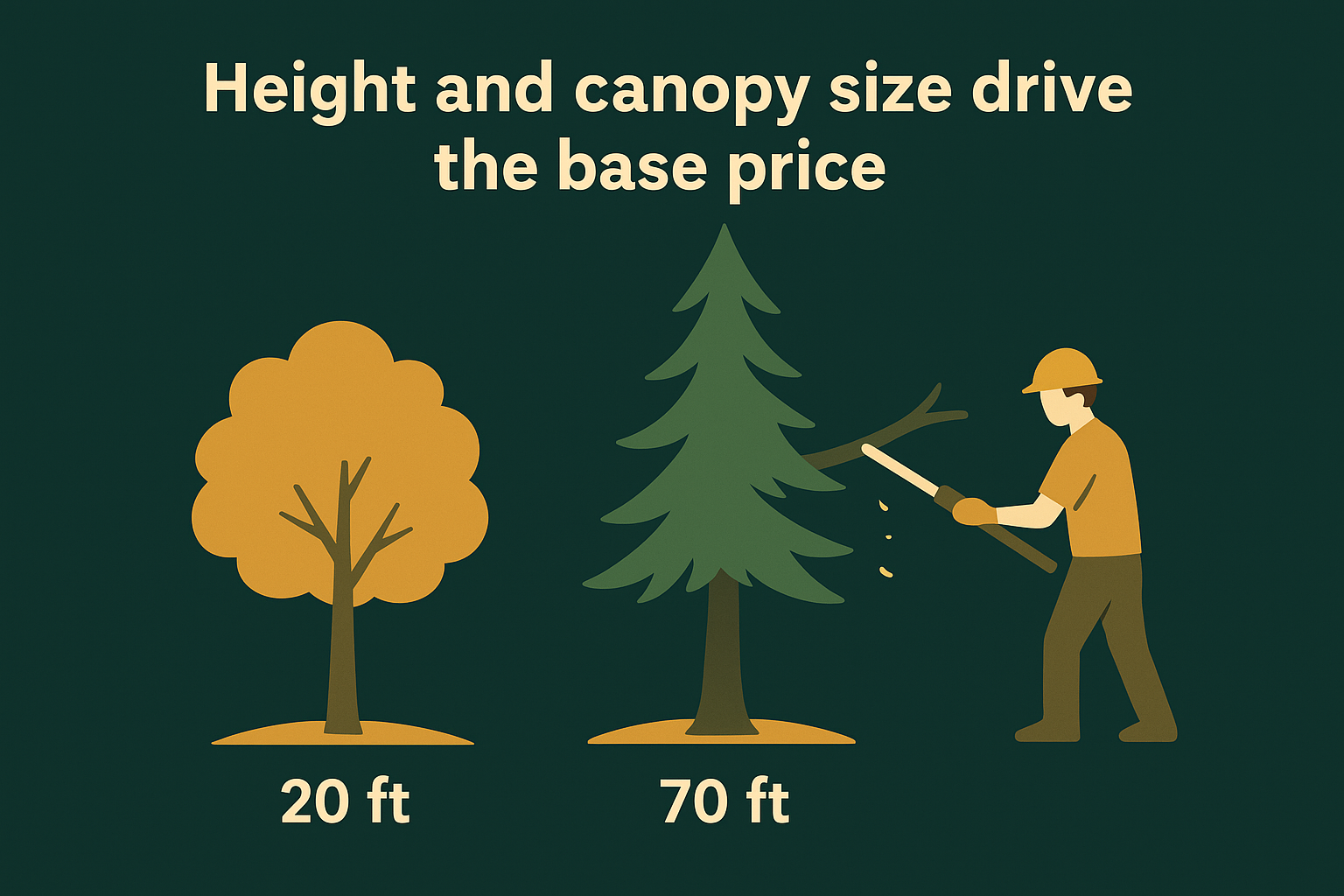
Height and access determine most of your quote before a single branch gets cut.
Access and hazards change the labor required
A tree standing alone in an open backyard is straightforward work. A tree wedged between a house, a fence line, and overhead power lines is a different job entirely. Access limitations force crews to use hand tools instead of bucket trucks, rig ropes to lower limbs piece by piece, and sometimes bring in a second climber for safety. Power line proximity often means calling in a utility-certified arborist, which adds cost but isn't optional given the risks of cutting trees near power lines if the tree grows anywhere near electrical service. Steep slopes, narrow side yards, and fences that block truck or chipper access all add time, and time is what you're paying for.
Species and tree condition affect difficulty
Dense hardwoods like oak and maple take longer to prune than softer species like alder or cottonwood, simply because the wood is harder to cut and the branch structure is more complex. Diseased, storm-damaged, or dead trees also require extra caution, since brittle limbs can snap unpredictably during the climb. A tree with heavy deadwood or storm damage from a recent Pacific Northwest windstorm often costs more to trim safely than a healthy tree of the same size, because the crew has to remove hazardous wood in addition to the routine shaping work.
Number of trees and seasonal demand
Multiple trees on one property usually bring the per-tree price down, since the crew is already on site with equipment set up. Seasonal timing matters too:
- Late fall and winter tend to have lower demand and sometimes better pricing, since most homeowners call in spring and summer, and there are good reasons arborists recommend winter trimming.
- Spring rush after storm season can mean longer wait times and firmer pricing, especially right after a major windstorm.
- Summer is peak season for ornamental tree and shrub pruning and often the most expensive window to book.
- Emergency and 24/7 storm damage cleanup work almost always costs more than scheduled trimming, because it requires immediate crew dispatch regardless of the day or hour.
Understanding these variables is the first step toward reading a quote correctly instead of just comparing bottom-line numbers.
How to get an accurate tree trimming estimate
Getting a number you can trust starts with what you show the estimator, not just who you call. A tree trimming service cost quoted over the phone from a photo is a guess. A quote given after someone walks your property and looks up at the actual canopy is a real number. If you want prices for tree trimming that hold up on the day of the job, insist on an in-person visit before you sign anything.
What a solid estimate should include
Any arborist worth hiring will walk the property, look at each tree from multiple angles, and check for hazards like power lines, structures, or fencing that limit access. They should also ask what you want done, since "light trim" and "full canopy reduction" are very different jobs with very different price tags. A written estimate should spell out the scope clearly so there's no confusion once the crew arrives.
A quote that skips the walkthrough is a quote you can't trust.
Questions to ask before you accept a quote
Use these questions to compare bids apples-to-apples instead of just looking at the bottom line:
- Is the price per tree or a flat rate for the whole job?
- Does it include debris hauling and cleanup, or is that extra?
- Is the crew licensed and insured, and can they show proof?
- Will the same crew handle stump grinding or storm cleanup if it comes up?
- What happens if hidden hazards, like rot or a hidden power line, show up mid-job?
Asking these upfront weeds out lowball bids that balloon later and gives you a clear picture of the actual cost for trimming a tree on your specific property.
Get multiple quotes, but compare details, not just totals
Two bids that look close on paper can cover very different scopes of work. One crew might include cleanup and debris hauling, while another charges that separately. Three quotes is usually enough to spot outliers and get a realistic sense of fair pricing in your area. If you're in Clark County or the greater Portland metro, request a free estimate from Alexa's Tree Service and we'll walk your property in person, so the number we give you is the number you pay.
Tree trimming costs by size and tree type
Size gives you the fastest way to ballpark a number before an arborist ever sets foot on your property. Tree trimming prices for arborist-led trimming in Vancouver, WA climb steadily as trees get taller and canopies get wider, and species adds another layer on top of that baseline. Here's what small, medium, and large trees typically run in the Vancouver and Portland market, assuming reasonable access and no major hazards.
Typical price ranges by tree height
| Tree Size | Height Range | Typical Cost | Examples |
|---|---|---|---|
| Small | Under 30 ft | $250-$450 | Dogwood, Japanese maple, crabapple |
| Medium | 30-60 ft | $450-$800 | Red maple, birch, ornamental pear |
| Large | 60-80 ft | $800-$1,200 | Oak, Douglas fir, western red cedar |
| Very large | Over 80 ft | $1,200+ | Mature fir, old-growth cedar, tall pine |
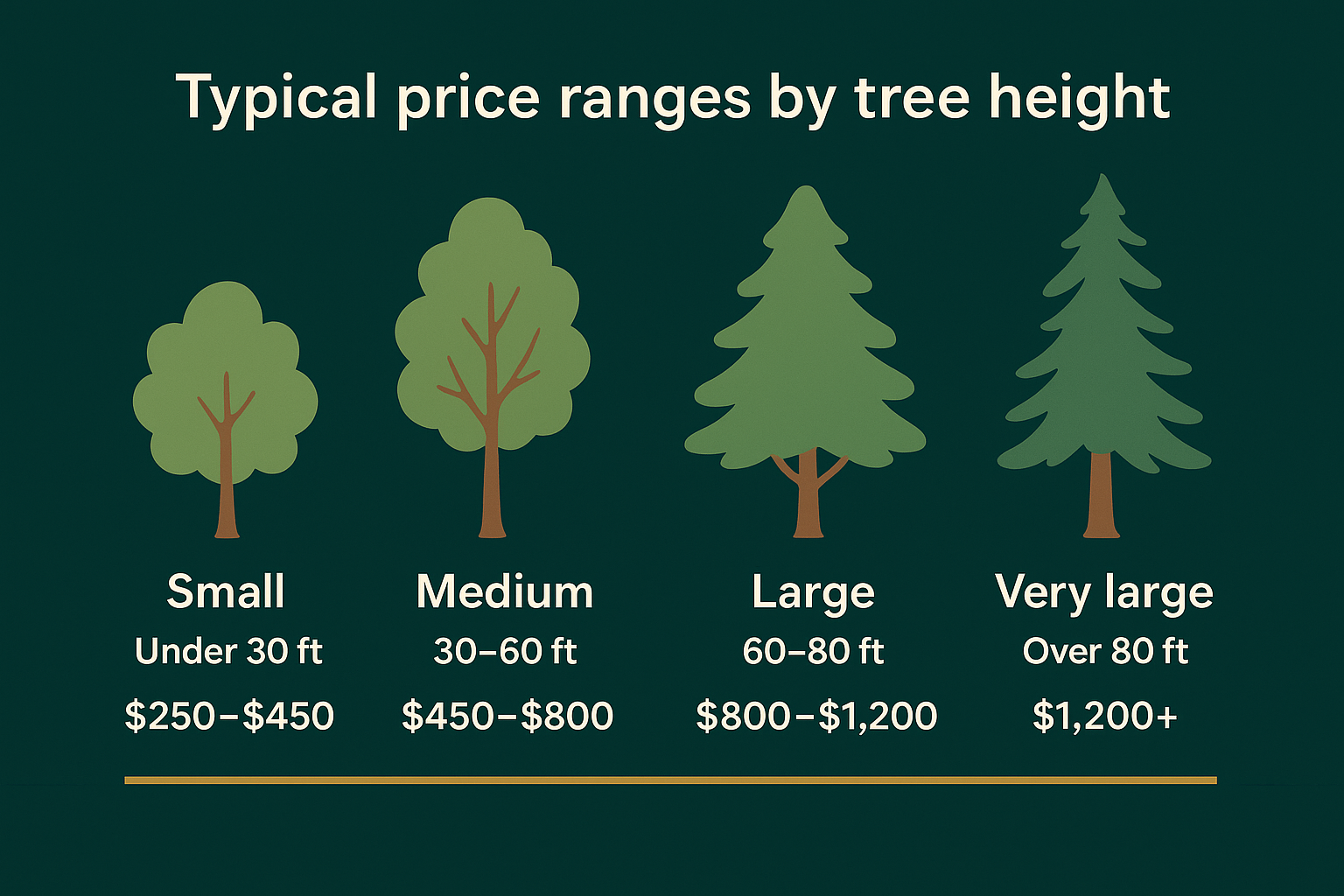
These figures reflect a straightforward job with decent access. Add power lines, tight fencing, or heavy deadwood, and the price moves toward the top of the range or beyond it.
Height alone can double or triple your bill before species or access even enters the picture.
Why species changes the number even at the same height
A 50-foot maple and a 50-foot Douglas fir aren't the same job, even though they're the same height. Conifers like fir, cedar, and pine often need more careful limb removal because their branch structure is brittle and their sap can slow down cutting. Hardwoods like oak and maple have denser wood that takes longer to cut cleanly, but their branch spacing is usually more predictable, which can offset some of that extra time. Softwoods like alder and cottonwood tend to trim faster since the wood cuts easily, though they also drop deadwood more often and may need more frequent attention.
Native Pacific Northwest species you'll see quoted most
Most properties in Clark County and the greater Portland metro carry a handful of species that show up again and again on our estimates:
- Douglas fir : tall, common in older neighborhoods, often needs deadwooding
- Bigleaf maple : wide canopy, moderate cost, frequent storm damage
- Western red cedar : dense, slow to trim, higher labor time
- Oregon white oak : strong wood, moderate height, steady demand for structural pruning
Knowing which of these grow on your lot helps you interpret a quote instead of just reacting to the number at the bottom.
Extra costs and ways to save on tree trimming
A quote that looks reasonable on paper can still grow once the crew starts working, so it helps to know what typically gets tacked on. Extra costs show up most often when a job needs more than a standard trim, and understanding them ahead of time keeps a fair estimate from turning into a surprise invoice.
Common add-ons that raise the final bill
Beyond the base tree trimming charges , watch for these line items:
- Stump grinding if trimming reveals a stump you want gone too
- Debris hauling when the crew has to chip and remove large volumes of brush, often paired with a full property cleanup
- Permit fees for work near property lines or protected trees in Vancouver, WA
- Crane rental for very tall or hard-to-reach trees
- Emergency dispatch fees for after-hours or storm-related calls
Ask your estimator to list these separately so you know exactly what's included before the crew shows up.
Practical ways to bring the price down
Bundling matters more than most homeowners realize. Grouping several trees into one visit spreads the crew's setup time across the whole job, which usually lowers your cost tree trimming total per tree compared to booking one at a time. Combining trimming with stump grinding or storm cleanup in a single visit works the same way, since the crew is already on site with equipment running.
Regular pruning almost always costs less over time than waiting for a problem to force an emergency call.
Scheduling also plays a real role. Booking in late fall or winter, outside the spring and summer rush, often gets you better availability and sometimes a better rate. Putting your trees on a year-round tree care plan, rather than waiting until branches are dead or overgrown, keeps each visit smaller and cheaper than a major overdue prune. Finally, don't skip the multiple-quote step from earlier. Comparing three itemized bids side by side is still the single most reliable way to spot inflated pricing and confirm you're getting a fair rate for the work your property actually needs.
Tree trimming costs in Vancouver and Portland
Local market conditions push tree trimming costs up or down more than most homeowners expect, even within a 20-mile radius. Vancouver, Portland, and the smaller towns around them share the same Pacific Northwest tree species, but permit rules, neighborhood density, and travel distance from a crew's home base all shift the final number on your invoice.
How pricing shifts across the metro area
Downtown Portland, where our Portland tree crews work in tight quarters, and older Vancouver neighborhoods often carry mature trees planted decades ago, which means bigger canopies and tighter access between houses. Outlying towns like Battle Ground, WA and Ridgefield tend to have larger lots with easier truck access, which can trim labor time and lower the bill slightly. Camas and Lake Oswego fall somewhere in the middle, with a mix of older growth and newer development.
| Area | Typical Access | Price Trend |
|---|---|---|
| Vancouver, WA | Mixed, older neighborhoods tighter | Average to slightly above |
| Portland, OR | Dense urban lots, limited truck access | Above average |
| Camas / Battle Ground | Larger lots, easier access | Average |
| Ridgefield / Beaverton | Suburban, moderate access | Average |
| Gresham / Lake Oswego | Mixed density | Average to above |
Where you live changes your quote almost as much as the tree itself.
Permits and local rules that affect Vancouver, WA jobs
Vancouver, WA has specific rules around removing or heavily pruning certain trees, especially on corner lots or near protected species, and skipping that step can mean fines or a stalled project. Requesting permit assistance guidance from a licensed arborist in Vancouver, WA before work starts is worth the extra conversation, since a company familiar with Clark County code can flag issues before they cost you money. Portland has its own tree code enforced through the city, so a crew working both sides of the river needs to know which rulebook applies to your address.
Why local experience matters for accurate pricing
Experience in a specific neighborhood adds up over time. A crew that has trimmed hundreds of Douglas firs in Vancouver's older neighborhoods, or maples along Portland's tree-lined streets, quotes faster and more accurately than one guessing from a photo. That local knowledge is exactly what keeps your price for tree trimming honest instead of padded to cover unknowns the crew hasn't seen before.
Budgeting for your next tree trim
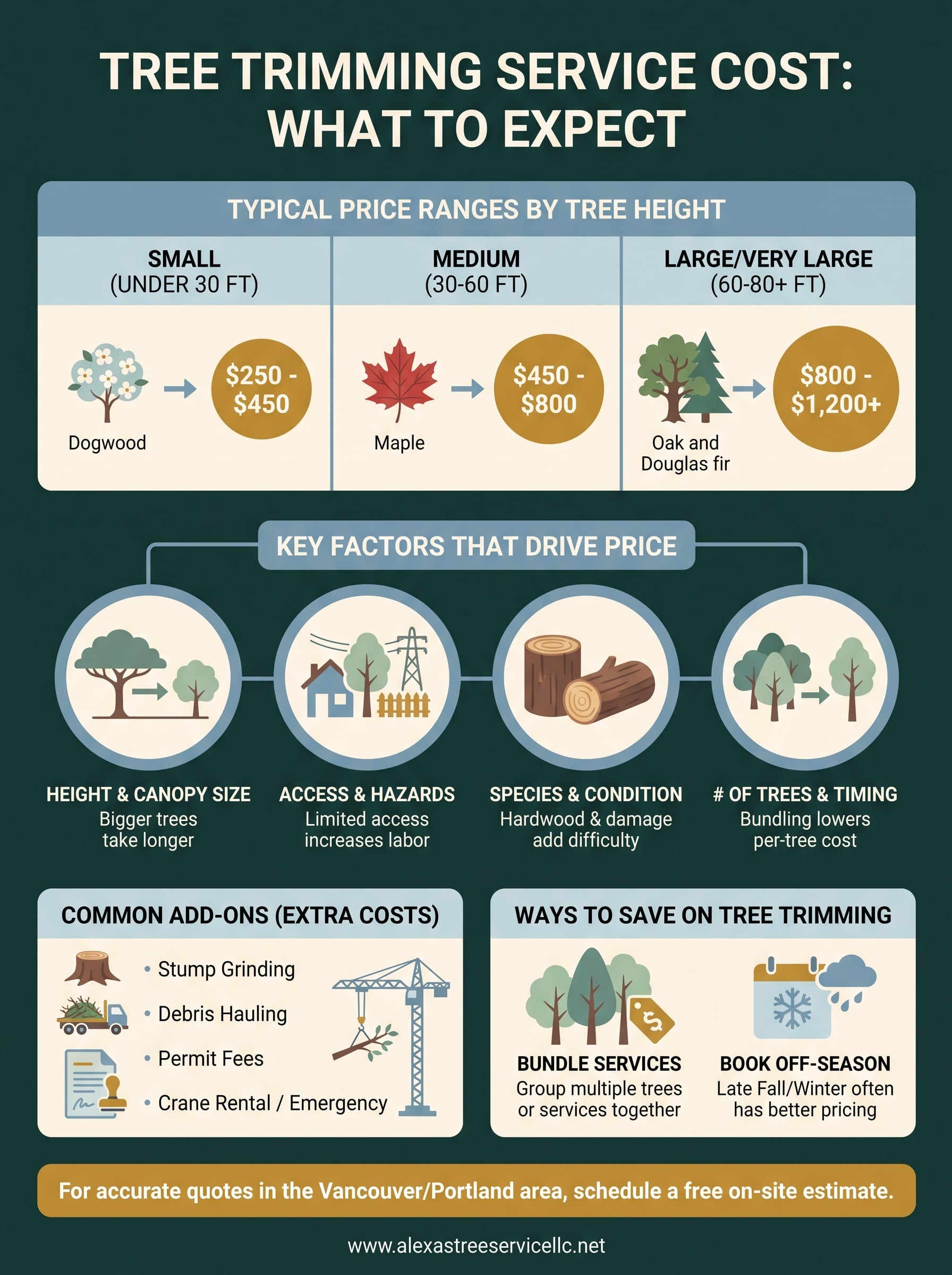
Most quotes fall between $250 and $1,200 per tree once you account for height, access, and species. That range isn't random. It reflects real labor, equipment, and safety factors that any honest crew will walk you through before cutting a single branch. Tree trimming service cost makes sense once you know what to look for, and now you do.
Don't judge a bid by its total alone. Compare what's included, ask about hazards up front, and get at least three quotes before you decide. A crew that walks your property, explains the scope, and prices it clearly is worth more than one that just texts you a number.
If you're in Vancouver, Portland, or anywhere in between, schedule your free on-site tree estimate and see what a fair, itemized quote actually looks like.