
Tree Stump Grinding Before and After: What to Expect
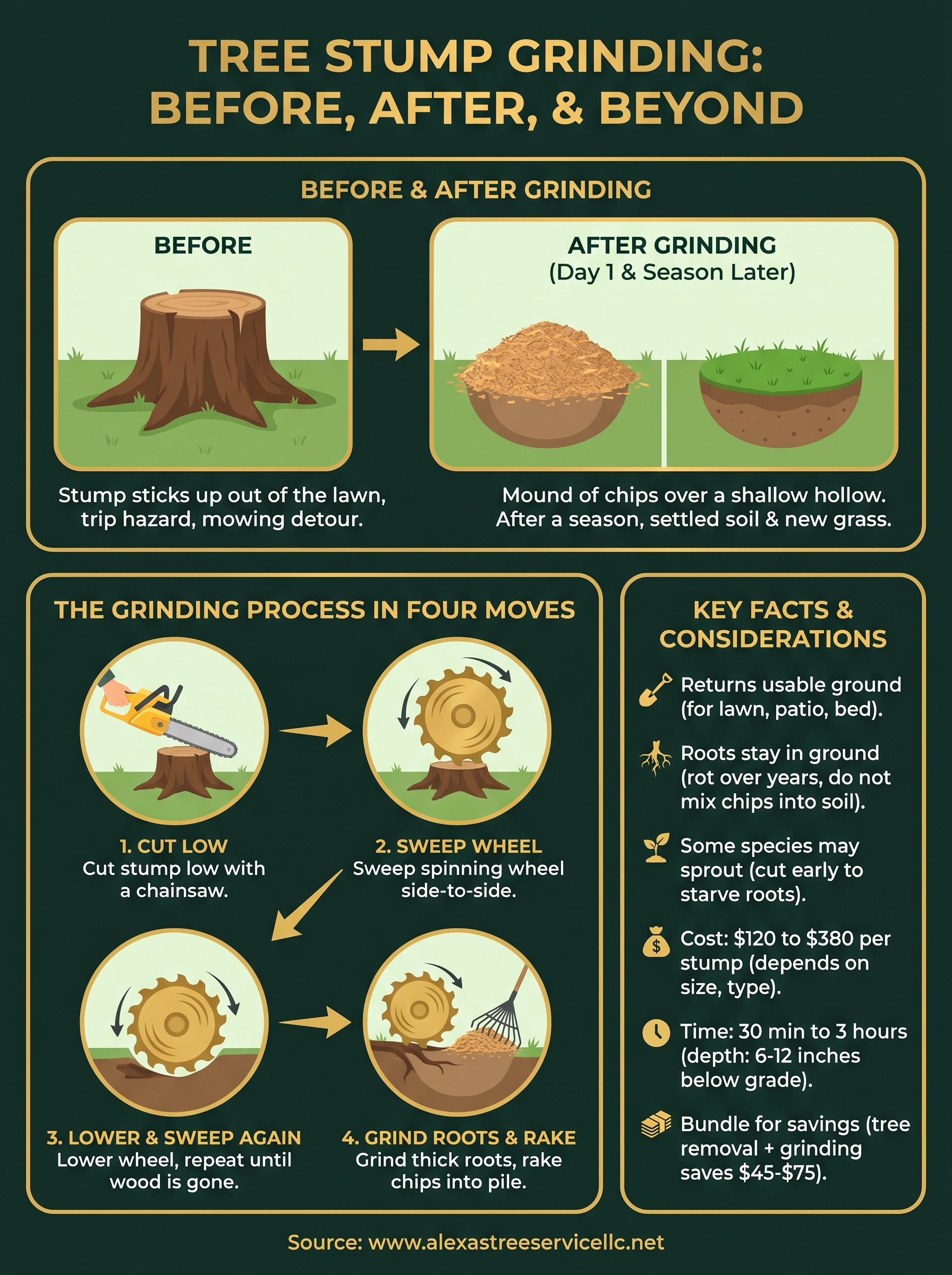
Tree stump grinding before and after looks like this: a stump that sticks up out of your lawn becomes a mound of loose wood chips, and the wood below it is gone to a depth of 6 to 12 inches below ground level. A grinder shreds the stump with a spinning, toothed wheel. It does not pull out the stump or its roots, so what remains is chips, a shallow hollow, and roots that rot away over the years.
Photos only show the first day, though. This article covers what you see at each stage, how to read stump grinding before and after photos, how to prepare your yard, what the ground does over the following months, and what the job costs. That gives you what you need to decide whether to grind a stump in your own yard or leave it.
Alexa's Tree Service has run tree care crews in Vancouver, WA, and Portland, OR since 2006, and stump grinding is part of that regular work. The advice below reflects what we see on real yards, including the parts that never make it into a photo.
Why the before and after matters before you grind
Looking at both ends of a grinding job tells you whether it solves your real problem, which is rarely the stump itself. It is the mowing detour, the trip hazard, the sprouts, or the spot you want back for a patio, a bed, or a new tree.
What a ground stump gives you back
Grinding returns usable ground without the digging that full stump removal needs. Pulling a stump takes a large hole of soil with it and tears up roots near the surface, while a grinder only works on the wood. It also removes the trip hazard that a low stump creates in tall grass, along with a hiding place for insects.
| Before | Right after grinding | After a season | |
|---|---|---|---|
| Surface | Stump sticks up out of the lawn | Chip mound over a shallow hollow | Settled soil with a patch of new grass |
| Below ground | Solid wood and root flare | Wood ground out 6 to 12 inches down | Leftover roots start to rot |
| Mowing | You steer around it | Clear once chips are raked | You mow straight across |
| Pests | Decaying wood can shelter ants and other insects | Most of the wood is gone | Little left to host them |
What you give up
Grinding has tradeoffs. You pay for it, you get a pile of chips to deal with, and the roots stay in the ground . The hollow also settles, so expect to top it up with soil, and a heavy machine can rut soft turf on a wet day.
Leave a stump alone when it sits out of the way, does not trip anyone, and you like it as a rustic planter or seat. Otherwise it takes many years to rot , depending on the species, and keeps getting in the way while it does.
Grind a stump when it sits where you walk, mow, plant, or build, and leave it when it does none of those.
How stump grinding works and what it leaves behind
A grinder cuts the stump away in thin layers from the top down, so the result is a pile of wood chips mixed with soil, not a clean hole.
The grinding process in four moves
Most crews follow the same pattern:
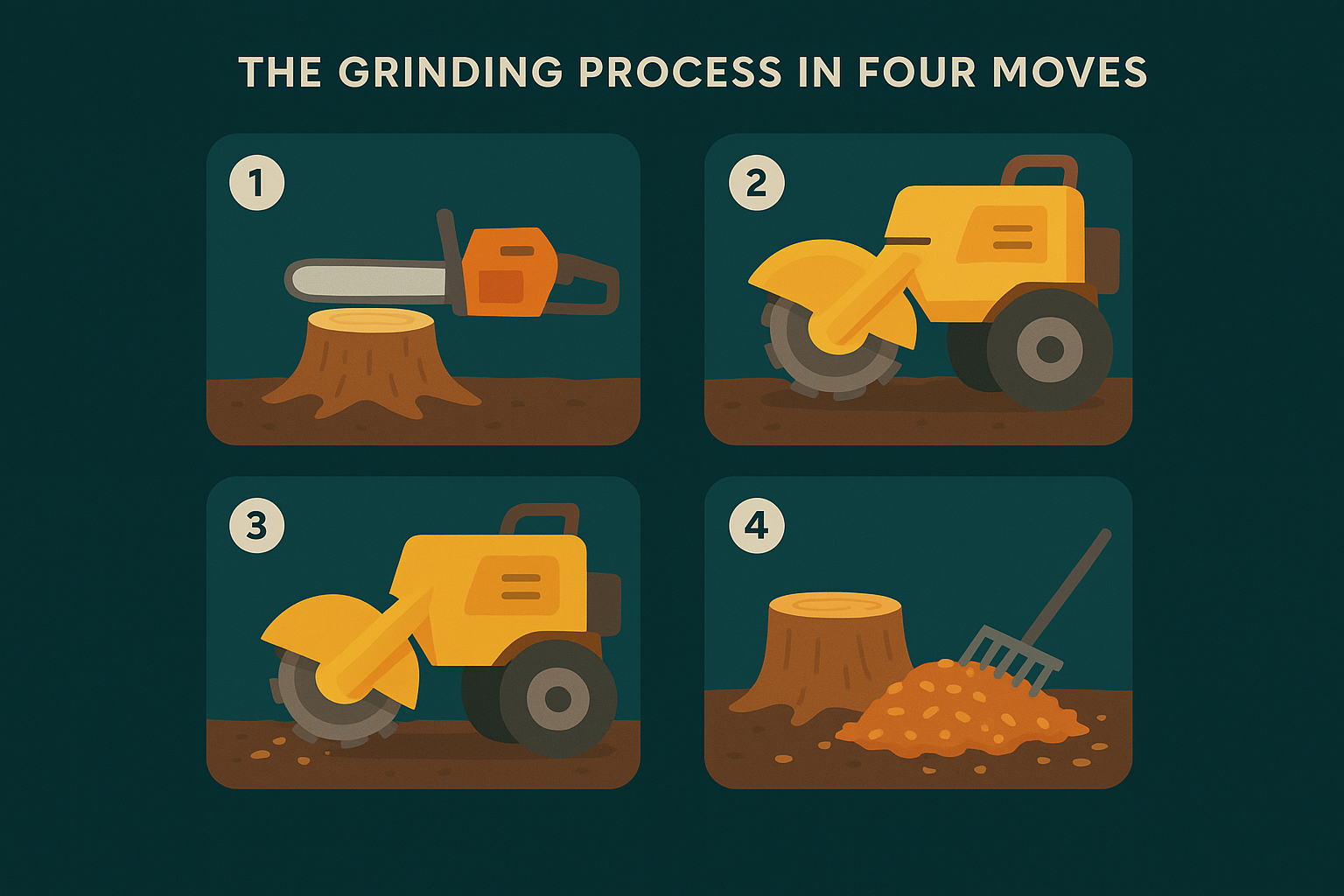
- Cut the stump as low as possible with a chainsaw, so the machine does not waste time on wood above ground.
- Position the grinder and sweep the cutting wheel side to side across the stump.
- Lower the wheel a few inches and sweep again, repeating until the wood is gone to the target depth.
- Grind the thick roots that surface next to the stump, then rake the chips into a pile.
Small softwood stumps take about 30 minutes. Large hardwood stumps take 2 to 3 hours. Our standard grinding depth is 6 to 12 inches below grade.
How to read a before and after photo
A photo of a chip mound is the normal result, not a flaw. A bad result shows wood still visible above grade, or torn turf and bare dirt in a wide circle around the spot. Use this checklist when you look at any grinding photo:
- Is there a scale reference, such as a boot or a fence board, so you can judge the stump's real size?
- Is there lawn damage, such as ruts or churned soil, in the wide shot?
- Were the chips removed or left, and was the photo taken right after or days later?
- Were the surface roots next to the stump ground down too?
Be wary of close-ups that hide the surroundings. A wide shot of the whole area tells you more about the crew's care than a tight shot of the finished hole.
A good grinding photo shows no wood above grade and no damage to the lawn around the spot.
How to prepare your yard for stump grinding
Preparation takes about an hour and prevents most surprises: hidden lines, hard objects in the wood, and an argument about chips on grinding day.
Prep checklist
- Call 811 a few days ahead so underground utilities get marked, since the grinder cuts into the soil.
- Tell the crew where irrigation lines, sprinkler heads, low-voltage lights, and pet fences run.
- Pull nails, screws, wire, and fence staples out of the stump. Metal and rocks damage the cutting teeth.
- Move vehicles, toys, and patio furniture, and clear a path to the stump.
- Mention gate width and slope when you book, because the machine has to reach the stump.
Tell the crew what happens next
Depth should follow your plan for the spot. Say what you want there before the crew arrives, because a deeper cut takes longer.
| Your plan for the spot | What to ask for |
|---|---|
| Lawn | At least 4 to 6 inches below grade, then topsoil and seed |
| Garden bed or new tree | Toward 12 inches, with chips hauled off and fresh soil brought in |
| Patio, shed, or fence post | Full depth, and tell the crew before they start |
Also decide what happens to the wood chips . You can have them hauled away, left in a pile, or kept for mulch in beds. Fresh chips work well as a mulch layer on top of soil, but not mixed into it.
Tell the crew your plan for the spot before they start, because the plan sets the depth.
What the ground looks like afterward
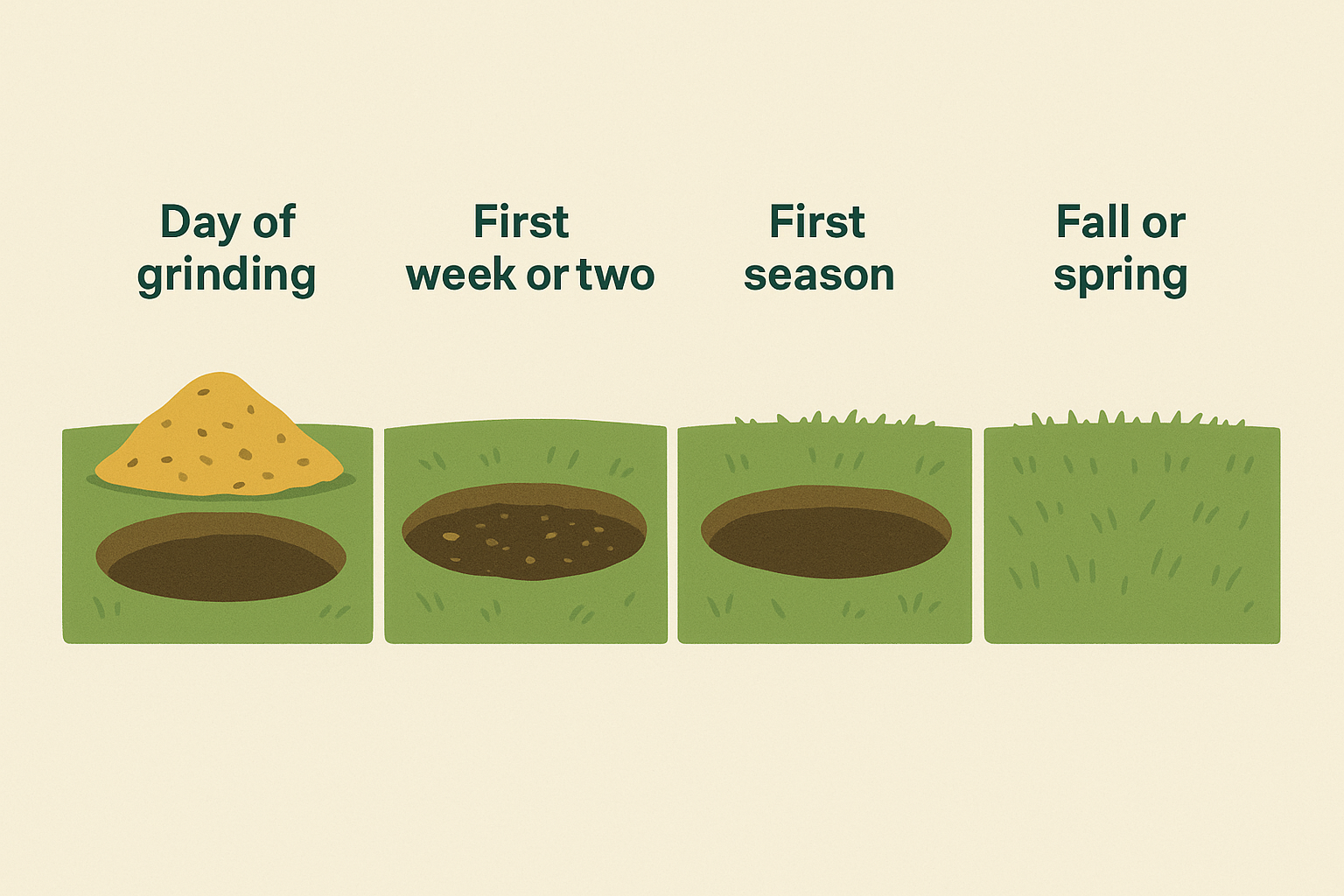
Right after grinding you have a mound of chips over a shallow hollow, and within a season it can become ordinary lawn if you backfill and reseed.
From day one to new grass
| Timing | What you see | What to do |
|---|---|---|
| Day of grinding | Chip mound over a hollow | Rake chips into a pile, then haul them away or reuse them as mulch |
| First week or two | Bare hollow with a chip and soil mix | Fill with clean topsoil and leave it slightly mounded |
| First season | Soil settles and dips | Top up and keep the patch moist |
| Fall or spring | Ready for grass | Seed or lay a sod patch |
| Following years | Leftover roots decay | Nothing to do |
Do not mix fresh chips into the top few inches of soil. As they break down they pull nitrogen from the soil , and new grass struggles. Cap the hollow with several inches of topsoil instead. In the Pacific Northwest, fall and spring rain does most of the watering for you.
Will the tree grow back?
Usually no, because the stump is gone and the wood that fed sprouts is shredded. Some species still try. Trees such as poplar, black locust, and cherry can send up shoots from roots that stay in the ground.
Cut any sprout at the base as soon as you see it, or mow it down in the lawn. Repeated cutting starves the root over time. If sprouts keep returning in force, ask an arborist to look at the roots.
Grinding removes the stump, not the roots, so cut any sprouts early before they gain strength.
What stump grinding costs and how long it takes
At Alexa's Tree Service, stump grinding runs $120 to $380 per stump , and the machine time ranges from about 30 minutes to 3 hours depending on the stump.
Price and time at a glance
| Item | Figure |
|---|---|
| Price per stump | $120 to $380 |
| Small softwood stump | About 30 minutes |
| Large hardwood stump | 2 to 3 hours |
| Grinding depth | 6 to 12 inches below grade |
| Saving when bundled with tree removal | $45 to $75 |
Take three stumps as an example. At the low end, 3 × $120 is $360. At the high end, 3 × $380 is $1,140. If all three are small softwoods, expect about 90 minutes of grinding. Large hardwoods push both the price and the time toward the top of the range.
Getting an accurate quote
Free estimates are available by phone or through the contact form. Your quote is more accurate when you give the crew:
- The number of stumps and a photo of each with something next to it for scale.
- The tree species, if you know it.
- Access details, such as gate width, slopes, and fences.
If a tree still needs to come down, ask for removal and grinding as one job. Bundling saves $45 to $75 compared with scheduling them separately.
Send a photo with a scale reference and your access details, and the quote you get will be more accurate.
Grind with the after in mind
A ground stump is a chip mound on day one, a settled patch within a season, and plain lawn after you backfill and reseed. The roots stay and rot out slowly, and sprouts are the one thing to watch. Grind when the stump sits in your way, and tell the crew your plan so the depth matches it.
If you want a price for your own yard, request a free stump grinding estimate from Alexa's Tree Service.