
Emergency Tree Removal Service: How to Hire One Fast
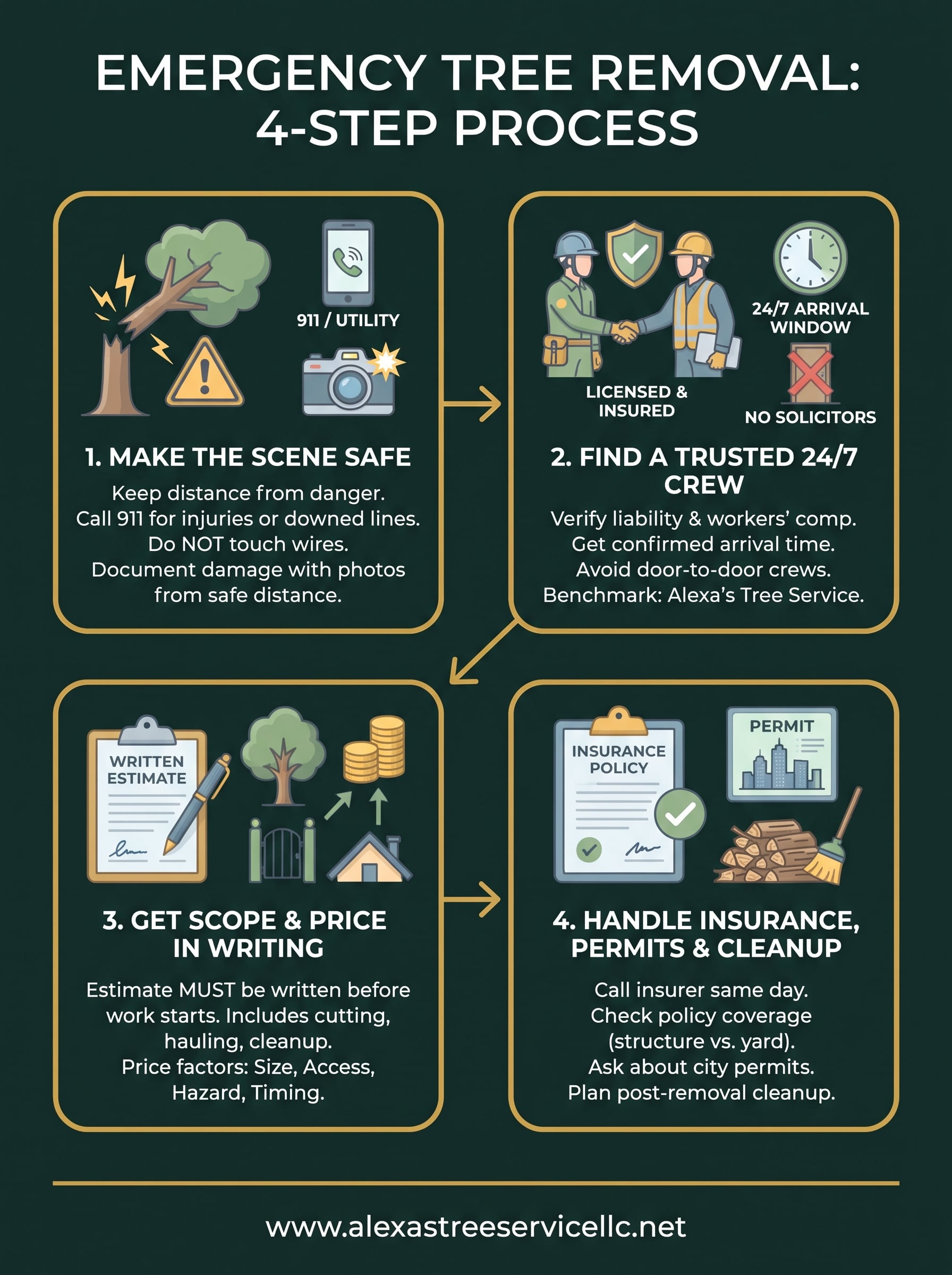
To hire an emergency tree removal service , make the scene safe first. Then call a licensed and insured crew that answers around the clock, confirm its arrival window and a written scope before it starts, and photograph the damage for your insurer. Follow that order and a fallen tree can be cleared within hours, with the paperwork for your claim already in place.
Storm damage rarely happens at a convenient time. A limb lands on the roof at 2 a.m., a fir blocks the driveway, and a search for help returns a dozen numbers that all promise 24/7 service. Under that pressure, people hire the first voice that answers, pay more than they should, or pick up a chainsaw and take a risk no tree is worth. In the Portland and Vancouver area, winter windstorms and ice can drop trees across whole neighborhoods at once, so a clear process matters even more when crews are stretched thin.
This guide gives you that process in four steps: secure the scene, vet a crew, lock in scope and price, and handle insurance and permits. Alexa's Tree Service has served Vancouver, WA and Portland, OR since 2006.
What counts as a tree emergency
A tree emergency is any fallen or damaged tree that threatens people, a structure, a power line, or your ability to get in and out of your property. If one of those applies, you need a professional crew now, not a quote next week.
Situations that justify an emergency call
Call an emergency crew right away when you see any of these:
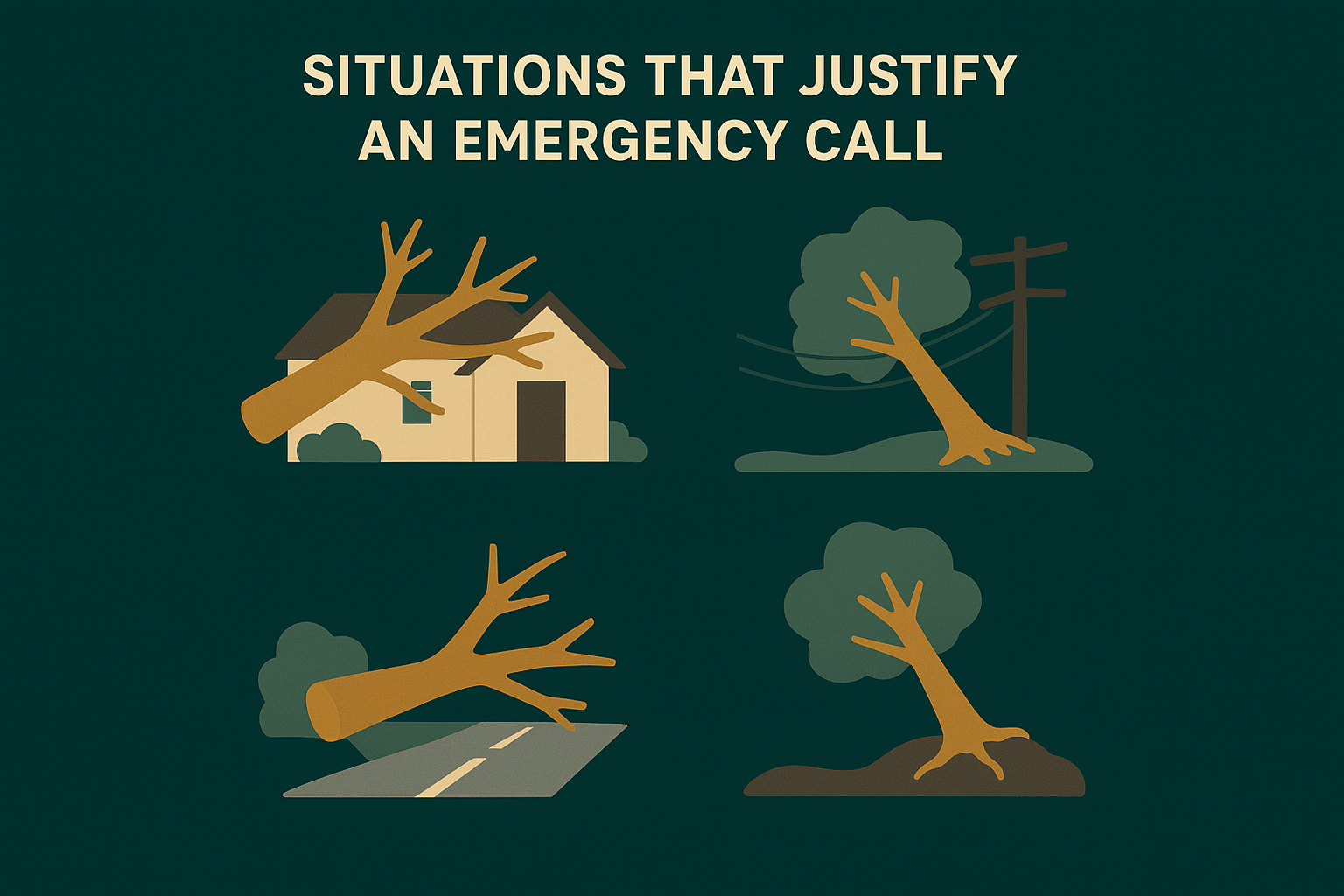
- A tree or large limb on your house, garage, or vehicle
- A tree touching or tangled in power lines
- A trunk blocking your driveway, a road, or the only exit
- A leaning tree with soil heaving up around the roots
- A cracked or hanging limb above a walkway, play area, or parked cars
A tree that fell in a far corner of the yard and threatens nothing can wait for a regular appointment , which usually costs less than an after-hours call.
Why cutting it yourself is the wrong move
A fallen tree is rarely at rest. Trunks and limbs pinned under tension can spring, roll, or split when cut, and the cut that frees one end can drop the other onto you. Add wet ground, poor light, and power lines hidden under branches, and a chainsaw job becomes the most common way a storm turns into an injury. Crews use rigging, controlled sectioning, and cranes for exactly this reason.
If a tree is under tension, on a structure, or near a line, it is a job for a crew, not for you.
Step 1. Make the scene safe
Your first job is to keep people away from the tree, not to get it moved. Stay inside or well back, keep children and pets away, and treat every wire as live.
Protect people first
Call 911 for injuries, fire, or a tree that has brought down power lines. Report downed lines to your electric utility, such as Clark Public Utilities or Portland General Electric, and never touch a tree that is in contact with a line . If you smell gas, leave the building and call from outside. Only after that should you call an emergency tree removal service, since a crew cannot start work near an energized line until the utility clears it.
Document the damage before anything moves
Insurers want evidence of how the damage happened. Take these photos while you wait, from a safe distance:
- A wide shot showing the whole tree and where it fell
- Close shots of every damaged structure, fence, vehicle, or roof section
- The trunk base, showing roots, rot, or the break point
- Any lines, meters, or utilities nearby
Do not move debris before you finish, and write down the time the damage happened.
Photos taken before the crew arrives are the strongest proof you will have for an insurance claim.
Step 2. Find a 24/7 crew you can trust
Pick the crew that proves it is insured, gives you an arrival window, and puts the scope in writing. A search for an emergency tree removal service near you will return plenty of numbers, and the difference between them shows up in the first phone call.
Check credentials and spot red flags
Ask for proof of liability insurance and workers' compensation , plus the company's state contractor registration or license, and verify both. After a storm, out-of-area crews often go door to door. Compare what you hear against this table.
| Good sign | Red flag |
|---|---|
| Local company name, address, and callback number | Knocks on your door right after the storm |
| Sends proof of insurance on request | Says it is "fully covered" but will not show it |
| Gives an arrival window and a written estimate | Texts a lump sum with no description of the work |
| Clear payment terms after the work | Demands full cash payment upfront |
Questions to ask on the first call
Ask five things: Do you have a crew available now, and when can it arrive? Can you send proof of insurance? Will you put the estimate in writing before cutting? Does the price include hauling and cleanup? Can you make the property safe tonight and finish the removal later?
For a benchmark, Alexa's Tree Service is licensed and insured, runs storm cleanup 24/7, and averages 1.5 to 3 hours to reach an active hazard. It also holds 180+ five-star Google reviews . You can reach the crew at (360) 723-6688. Measure any other company against those numbers.
The best emergency crew is the one that can show insurance, name an arrival time, and write down the scope.
Step 3. Get the scope and price in writing
Emergency work costs more than a scheduled job, and the final number depends on size, access, hazards, and timing. Ask for a written scope before cutting starts so the price cannot drift.
What drives the price
Alexa's lists tree removal at $300 to $2,000+ , and emergency conditions tend to push a job toward the upper part of any range. Height alone does not set the price. A 30-foot tree in an open yard is a very different job from the same tree leaning on a roof. A job moves toward $1,000 and beyond when the tree is large, access is tight, or rigging is needed around structures.
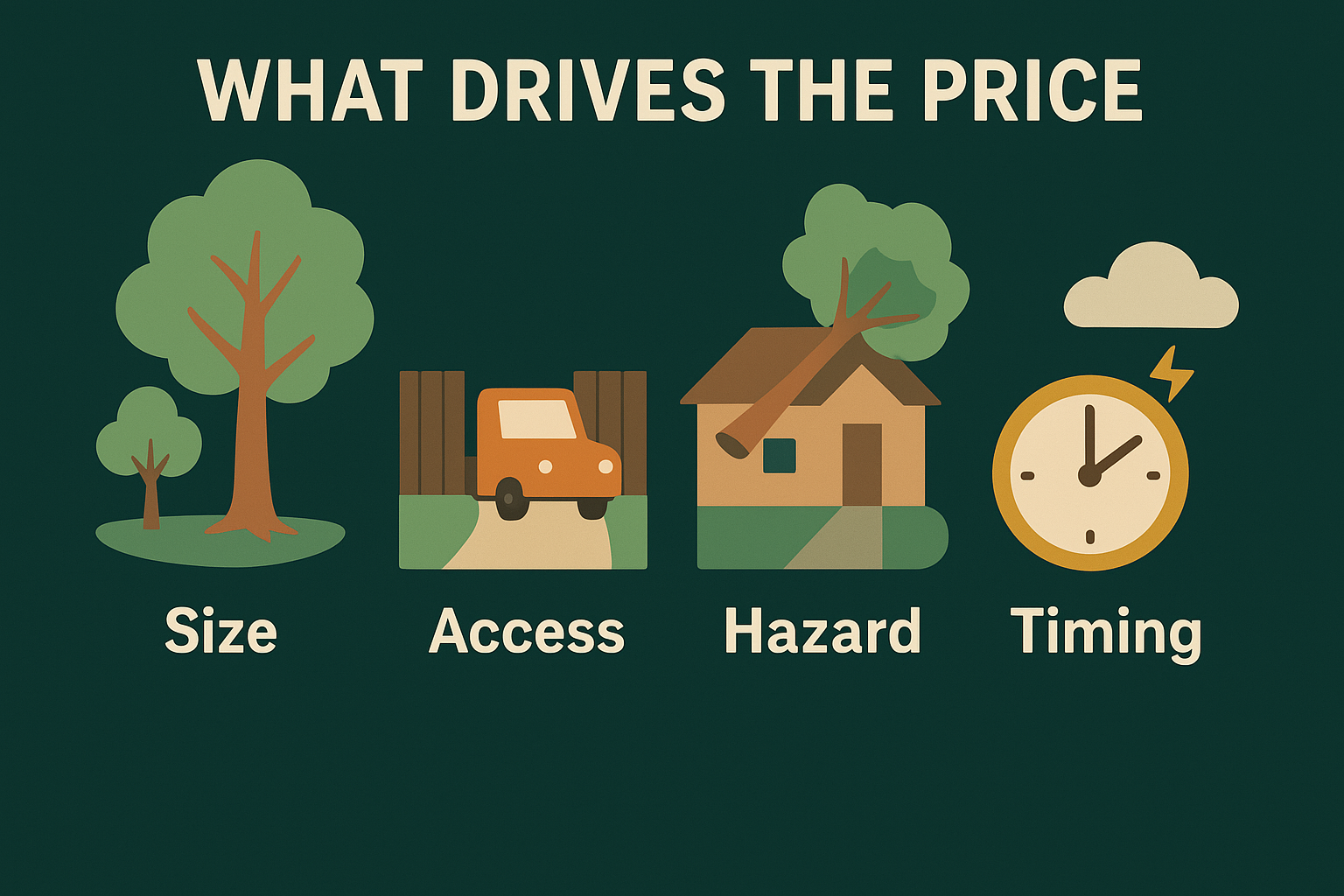
| Factor | Pushes the price up | Keeps it down |
|---|---|---|
| Size | Tall tree, wide trunk, heavy limbs | Small or medium tree |
| Access | Fenced yard, narrow lot, no truck access | Open driveway or yard |
| Hazard | On a roof, near lines, over structures | Lying flat on open ground |
| Timing | Night, weekend, active storm | Normal business hours |
| Cleanup | Full hauling and debris removal | Wood left on site |
Scope, a worked example, and a money-saving option
Ask the crew to list what is included: cutting, hauling, stump work, and cleanup. Here is an illustrative example. A crew quotes $800 to remove a fallen tree and $250 to grind its stump. Booked separately, that is $1,050. Stump grinding at Alexa's runs $120 to $380 per stump, and bundling it with removal saves $45 to $75 , so the same job lands between $975 and $1,005.
You can also split the work. Ask the crew to make the property safe tonight , which means clearing the tree off the roof or driveway. Then schedule the full cleanup during normal hours, when rates are lower.
Ask for a written scope that lists cutting, hauling, and cleanup, and the final bill will rarely surprise you.
Step 4. Handle insurance, permits, and cleanup
Call your insurer the same day, ask about permits before any non-emergency removal, and plan for what happens after the crew leaves. Doing this early keeps small problems from turning into denied claims.
Insurance and the "free removal" question
Many homeowners policies cover tree removal when a tree damages an insured structure , and some cover debris removal when it blocks a driveway or access, often up to a limit. A tree that falls without hitting anything is frequently not covered. Read your policy, call your insurer, and keep the itemized invoice.
Free removal is rare. The realistic routes are insurance, the utility company for trees tangled in its lines, or your city for trees on public land.
Permits and follow-up work
Cities set their own rules. In Vancouver, WA, permit processing for a standard removal takes 5 to 10 business days , and Alexa's has helped with permits on 31 Vancouver properties from 2024 to 2026. For an imminent hazard, ask your city whether an emergency exception applies and keep your photos as proof.
Once the tree is gone, have the crew look over nearby trees , since storms often weaken their neighbors. Cabling can support a damaged tree that is worth saving, and a leftover stump can go on the same visit.
Call your insurer and your city before you worry about the invoice, because both can change what you owe.
Be ready before the next storm
An emergency tree removal service works best when you have already done the thinking. Keep people back, document the damage, hire a crew that proves its insurance and names its arrival time, and get the scope in writing. Then deal with insurance and permits while the details are fresh.
Save a trusted number now, while the weather is calm. If a tree is down on your Vancouver or Portland property, call Alexa's Tree Service for 24/7 storm cleanup and get a crew on the way.