5 Best Tree Removal Service Options Near Me, Compared
The best tree removal service near me is a licensed, insured local crew that gives you a written quote, protects your lawn and roof, and hauls everything away. For most homeowners in the Vancouver and Portland area, that means a full-service local tree company. If you are unsure whether a tree needs to come down at all, an independent arborist comes first. If the tree touches a power line or stands on city land, someone else has to make the first call.
Search results for this keyword are crowded with directories, star ratings, and lead-generation pages. None of them tell you which kind of provider fits your tree, your budget, and your risk. A $400 quote and a $1,400 quote for the same tree can both be honest, and either can be a mistake if the crew is uninsured or the job is not what you needed.
This article compares five types of provider by what they do, what they cost, and what to verify before you hire. We are Alexa's Tree Service, a Vancouver, WA company operating since 2006, so item one is ours. We say so up front, and we hold ourselves to the same checklist we give you for everyone else.
1. Alexa's Tree Service, a local full-service crew
Alexa's Tree Service is a licensed and insured company serving Vancouver, WA, Portland, OR, Camas, Battle Ground, Ridgefield, Gresham, Beaverton, and Lake Oswego. It handles removal, stump grinding, trimming, cabling, and storm cleanup from one crew.
How it works and what it costs
You request a free estimate by phone or through the online form. The crew removes the tree, then cleans up branches, debris, and leftover material. Most residential jobs take 2 to 8 hours. Storm cleanup is available 24/7, and commercial removal near entrances or parking lots is scheduled around business hours.
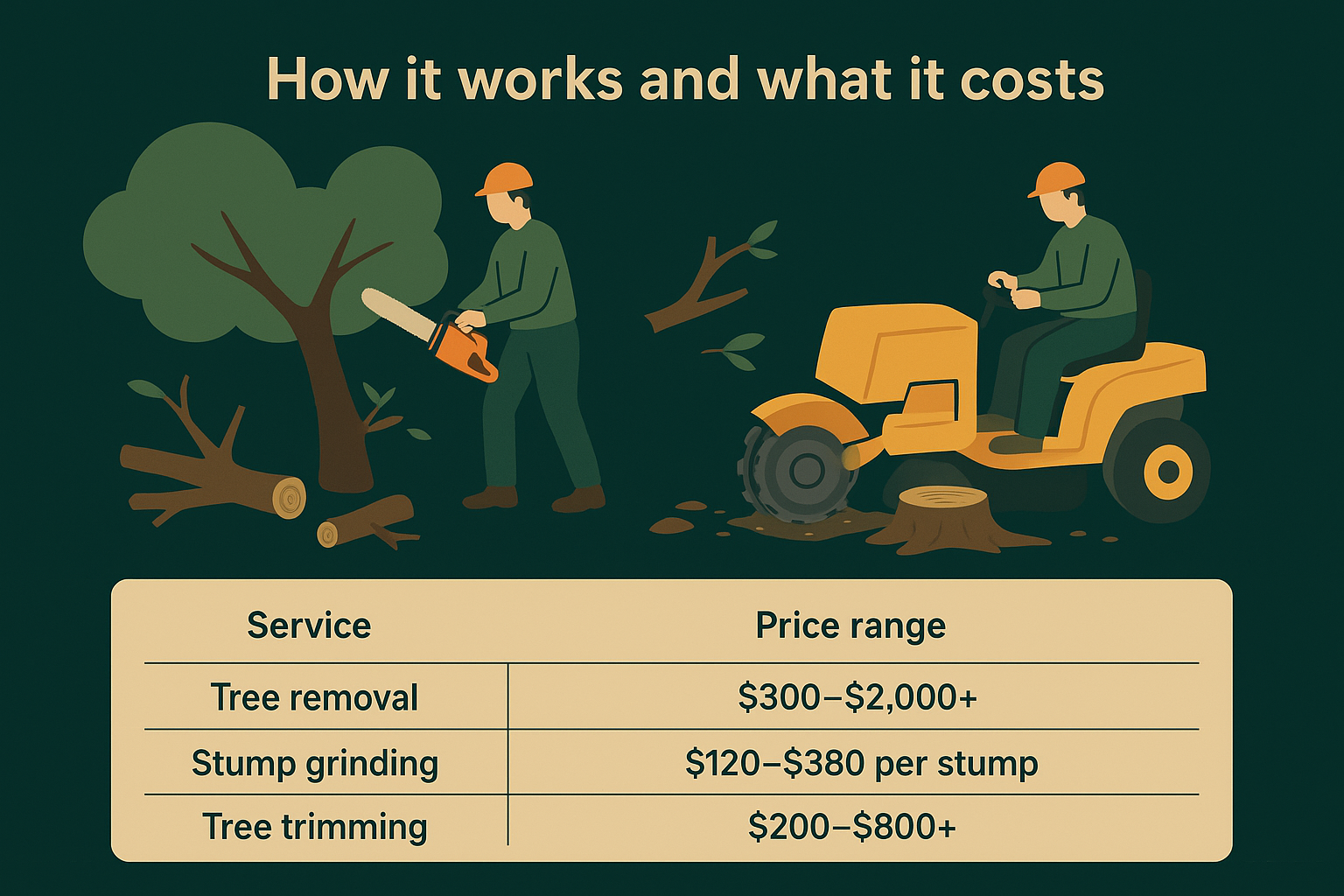
| Service | Price range | Useful detail |
|---|---|---|
| Tree removal | $300–$2,000+ | 2–8 hours for most residential jobs |
| Stump grinding | $120–$380 per stump | Ground 6–12 inches below grade |
| Tree trimming | $200–$800+ | Best in February-March |
Here is a worked example. Say a mid-size tree is quoted at $900 and its stump at $250. Separately that is $1,150. Bundling saves $45 to $75 , so you pay about $1,075 to $1,105. As a rule of thumb, a quote near $1,000 usually covers a mature tree with decent access. Height, tight access, and nearby structures push it higher. Emergency work is typically priced higher too, so book planned removals before storm season.
A fair price is an itemized one: removal, cleanup, and stump each written on the quote.
Who it suits and what to verify
This option suits homeowners and property managers who want one crew for removal, grinding, cleanup, and paperwork . We have provided permit assistance for 31 Vancouver properties from 2024 to 2026. Permit processing takes 5 to 10 business days, so ask about it early. Whoever you hire, check these:
- A certificate showing liability insurance and workers' compensation.
- A written estimate that names the work, cleanup, and stump.
- Reviews read for patterns: on-time arrival, cleanup, and no property damage. Our 180+ five-star Google reviews are public, and you can check them yourself.
2. An independent ISA certified arborist
An independent arborist is a tree health expert who inspects your tree and tells you whether it should come down. Many do not remove trees themselves, which is the point: they have no stake in selling you a removal.
How it works and what it costs
An ISA Certified Arborist has passed the International Society of Arboriculture exam and must keep up continuing education. You pay a fee for the assessment , usually hourly or flat, and you receive a written report. Ask for the fee before the visit. The report names the species, the defects, the risk level, and a recommendation.
That report can support a permit application , an insurance claim, or a dispute with a neighbor. It also protects you from paying for a removal a trimming or cabling job could have avoided.
Who it suits and what to verify
This option fits owners of large mature trees, trees leaning toward a house, trees with fungus or dead tops, and removals that need documentation . Verify the certification number on the ISA website, confirm the arborist is independent from any removal company, and ask for the findings in writing.
Pay for an arborist when the question is "should it go?" and a crew when the answer is already yes.
3. A large regional tree care company
A large regional company runs tree care through branch offices, estimators, and dispatched crews. You get a standardized process, but not always the same people from quote to cleanup.
How it works and what it costs
An estimator visits, writes a quote, and schedules a crew from the branch. Online booking and set procedures are common. Prices are often higher than a small local crew because of overhead, sales staff, and equipment fleets, though that varies by company and job. Always compare at least three written quotes.
Who it suits and what to verify
It suits owners who want formal paperwork, large commercial coverage, or a company with many crews for a big job. Ask whether the people on site are employees or subcontractors, whether the quote is itemized, and how stump grinding and haul-away are billed. Check that the local office, not a call center, is accountable for the work.
A bigger company is not automatically a safer one; the insurance certificate and the itemized quote decide that.
4. A landscaper or handyman crew
A landscaper or handyman crew is the budget choice for small, ground-level work. It is the right call for shrubs and small trees and the wrong call for anything tall.
How it works and what it costs
These crews bring chainsaws and a chipper for small jobs, and they usually quote the lowest price of the five. The savings are real on a small tree you could almost reach from a ladder. They disappear fast when one injury or one broken roof makes you liable.
Who it suits and what to verify
Use this option only for small trees with no structures or lines nearby. Ask for a certificate of insurance and proof of workers' compensation, because an uninsured worker's injury can become your problem. Walk away from anyone who:
- Knocks on your door after a storm and wants cash only.
- Offers no written estimate.
- Suggests "topping" the tree, a practice arborists consider harmful.
If you cannot reach the work from the ground or a ladder, hire a climbing crew.
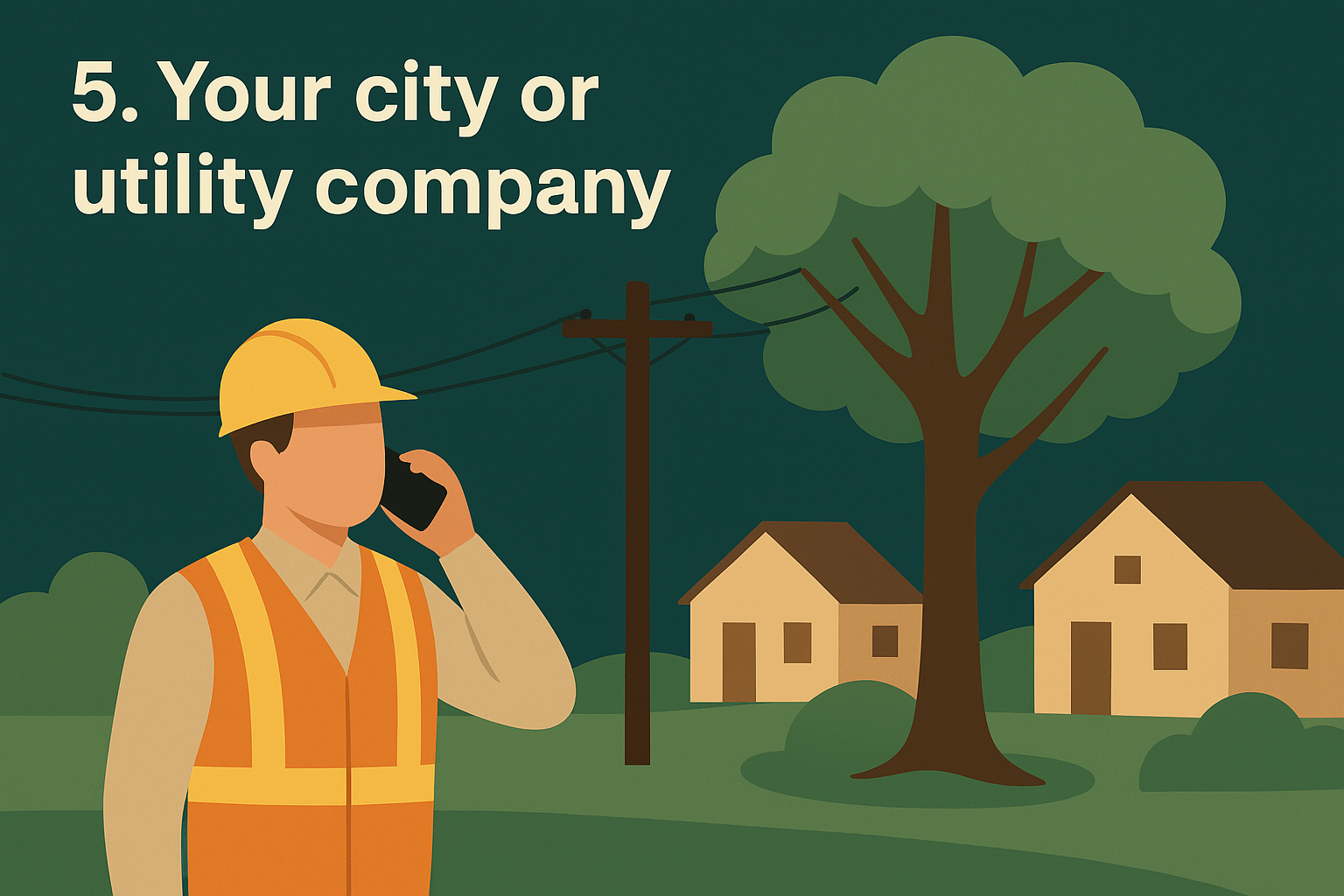
5. Your city or utility company
Your city or your electric utility is the right first call when the tree is on public land or touching power lines. It is not a replacement for a private crew, but hiring one first can break a rule or create a hazard.
How it works and what it costs
Street trees in the public right-of-way generally belong to the city, and many cities require permission to prune or remove one. Utilities clear trees from their own lines, often at no direct charge. You do not control timing, and they only do what the line needs. Your own tree, once it is clear of the line, is still your job to remove.
Who it suits and what to verify
This route suits anyone with a tree in the parkway strip or branches near a power line. Never go near a downed or sagging line . Stay far back and call your utility and 911. For a street tree, contact your city's public works or urban forestry office first, and get approval in writing before you hire anyone to cut it.
Call the owner of the land or the line before you call a crew.
Choosing your crew
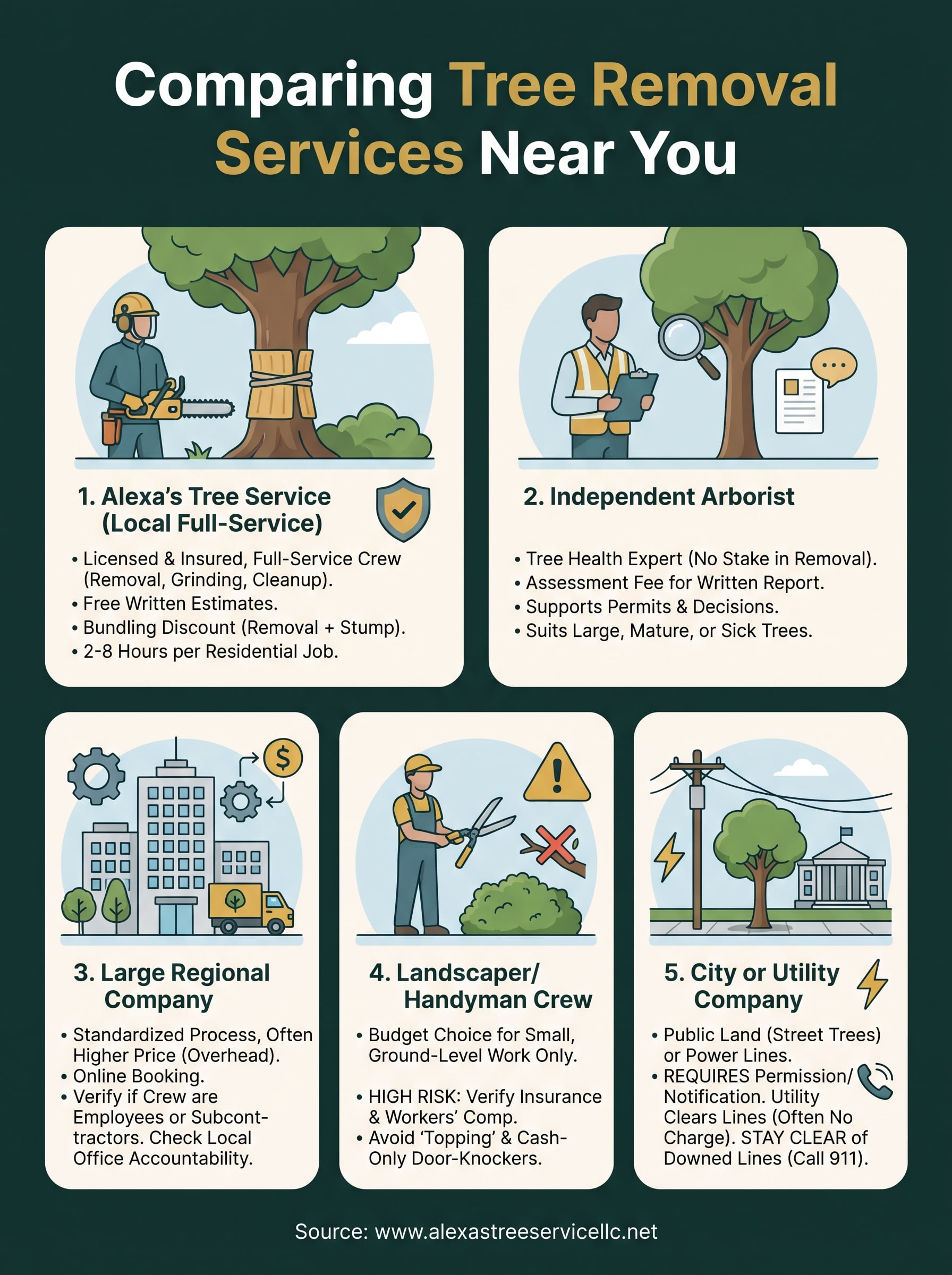
The right provider depends on the tree. A healthy-looking tree with an unclear problem needs an arborist. A clear removal on your own property needs a licensed, insured local crew with an itemized quote. A small shrub can go to a landscaper. Anything near a line or on city land starts with the city or utility.
Whoever you pick, ask for insurance proof, read reviews for patterns, and compare written quotes line by line. If you are in Vancouver, Portland, or a nearby town and want a clear price on a removal, request a free estimate from Alexa's Tree Service.