
Tree Branch Removal Cost in Vancouver, WA: What to Expect
Tree branch removal cost is what a tree service charges to cut a branch or limb off a tree and, usually, clear it away. A limb is just a large branch. Nationally, a small or medium branch costs about $75 to $250 , and a large limb over 10 feet long costs $150 to $850 . Most homeowners pay somewhere in the low hundreds.
The price depends on the branch's size, its height, how close it hangs to your roof or power lines, and whether the crew hauls the wood away. This guide explains what the price covers, what pushes it up or down, and how to get a quote you can trust. We've worked on trees around Vancouver, WA and Portland, OR since 2006, so we point out where local conditions change the picture.
You'll also find a worked example, a copy-and-paste quote request, and answers on hauling, insurance, and when removing the whole tree makes more sense.
Why the cost of tree branch removal matters before you call
Knowing the going rate protects you from two mistakes: budgeting too little for a job that needs a bucket truck, and accepting a quote far above normal. Branch work is priced by the job, not by the weight of the wood, so a rough range is the only yardstick you have.
What it costs to remove a tree limb
The table below answers how much it costs to remove a tree branch or limb. The figures are national averages from published cost guides built on reported project costs.
| Job | Typical national cost |
|---|---|
| Small or medium branch | $75 to $250 |
| Large limb or branch (over 10 ft long) | $150 to $850 |
| Haul-away only | $75 to $250 per job |
| Broken or fallen branch | $80 to $100 per hour |
| Emergency or after-hours work | $150 to $250 per hour |
| Several branches on one tree (trimming) | $400 to $900 per tree |
The national average for a single branch is about $150 . These are national numbers, so rates in the Portland-Vancouver area can land above or below them. For a local reference, our tree trimming, where most branch work falls, runs $200 to $800+ , and full tree removal runs $300 to $2,000+. Ask any company whether a minimum visit charge applies, because a crew brings people and equipment even for one small cut.
A worked example
Say a 12-foot limb is cracking over your back fence. It counts as a large limb, so the range is $150 to $850. A crew quotes two hours of work at $50 to $125 per hour, which is $100 to $250 . If hauling is billed separately at $75 to $250, your total is $175 to $500 .
That sits well inside the large-limb range. If the same limb hung over your roof and needed rigging with ropes, you should expect the quote to move toward the top of the range.
A branch quote is fair when labor, equipment, and haul-away each show up as a line you can point to.
What changes the price of removing a tree limb
Size, height, access, and cleanup account for most of the gap between a $100 job and an $800 job. Every quote you receive is some mix of these, so understanding them lets you read a quote instead of just reacting to it.
Branch, tree, and site factors
Each factor in the table affects crew time, equipment, or risk. Time and risk are what you pay for.
| Factor | How it affects the price |
|---|---|
| Branch size and length | Heavy limbs need more people, rigging, and time |
| Height | Branches above roughly 15 to 20 ft usually need a bucket truck or a climber |
| Access | Fences, buildings, and power lines slow the work, and crews may lower each piece by rope |
| Number of branches | Several cuts in one visit cost less per branch |
| Tree health | Dead or rotting wood is riskier to cut and may point toward removing the tree |
| Cleanup | Chipping and hauling are either bundled in or billed at $75 to $250 |
| Already fallen | A downed limb costs less, since it only needs a chainsaw and a haul |
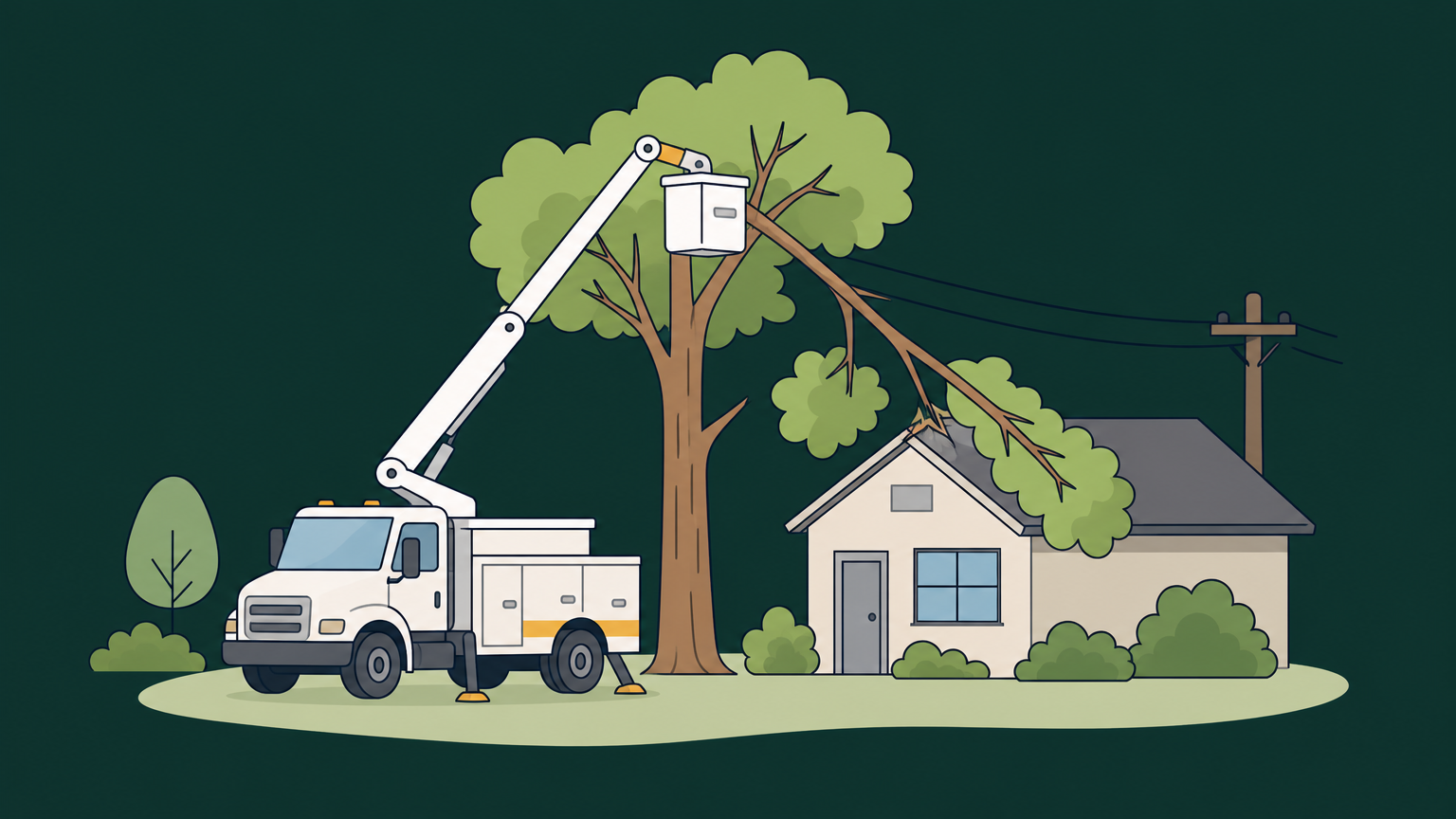
Equipment shapes the bill more than most people expect. A climber with a pole saw is cheap, while a bucket truck adds a large share of the cost . Hazards such as a limb touching your house or a power line change the method as well. If a branch is tangled in a line, call the utility first. A tree crew should not touch it.
Timing, season, and emergencies
Demand peaks in summer, and booking in winter can save as much as 20% . That timing also suits the trees. For most pruning in our area, late winter to early spring (February to March) is the best window for tree health, so the cheaper season and the healthier season usually line up.
After a major storm, prices spike because crews book up. If nothing threatens your home, waiting a week or more before requesting quotes generally brings prices back down. Emergency and after-hours work runs $150 to $250 per hour . If a limb is hanging over your house or blocking your driveway, don't wait. Our storm cleanup line runs 24/7, with an average response of 1.5 to 3 hours for active hazards.
Time, equipment, and risk set the price of a branch job, not the size of the branch alone.
How to get an accurate quote for branch removal
Send every company the same photos, measurements, and questions, then compare the written quotes line by line. Identical inputs make the differences between quotes meaningful.
Give estimators what they need
A good estimate starts with good information. Before you call, gather these four things:
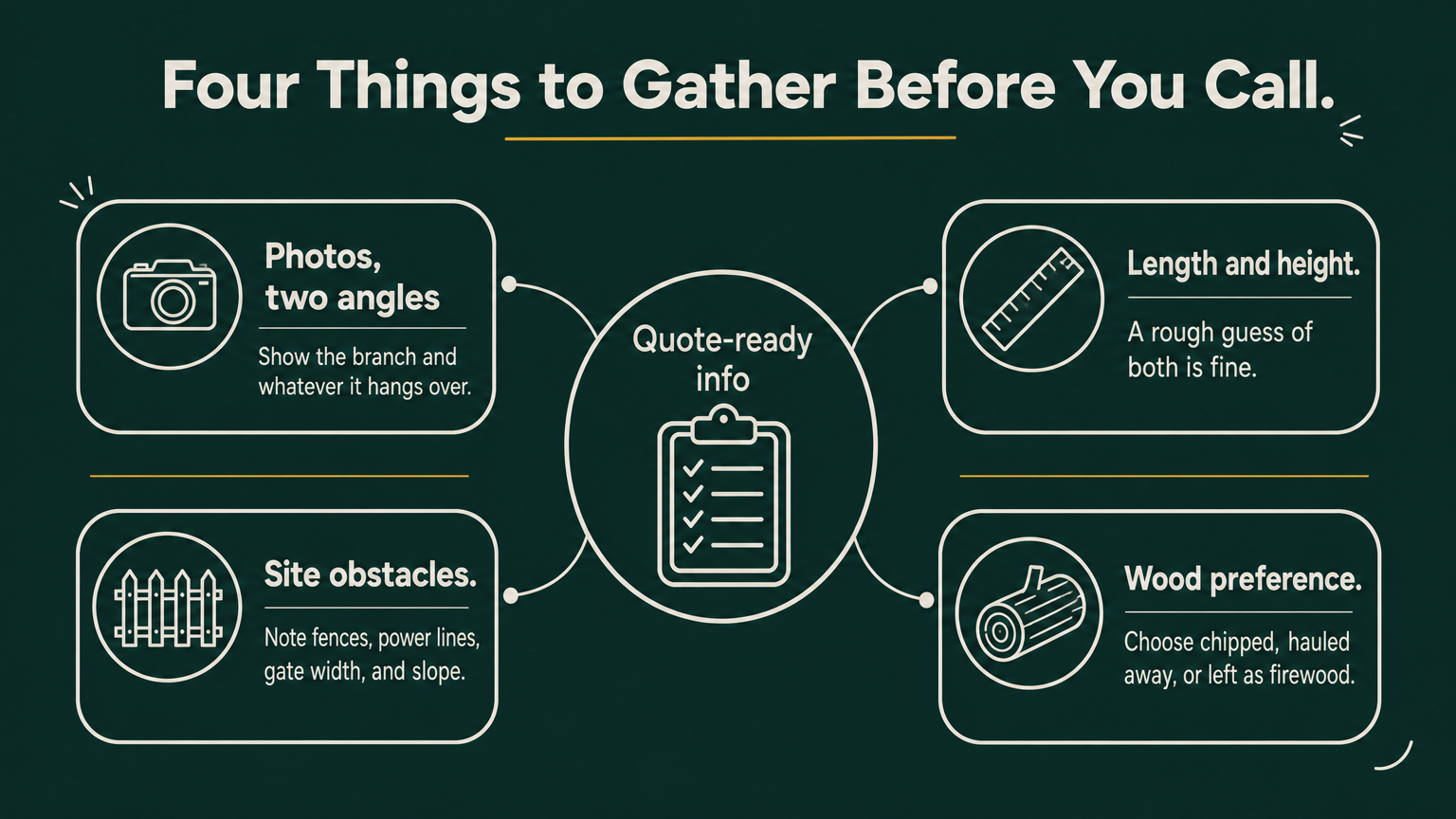
- Photos of the branch from two angles, including whatever it hangs over.
- A rough length and height off the ground. A good guess is fine.
- Obstacles such as fences, power lines, gate width, and slope.
- Your preference for the wood: chipped, hauled away, or left as firewood.
Then paste this into an email or contact form and fill in the brackets:
 Hi, I need a quote to remove one limb from a [tree type] in my backyard.
The limb is about [length] feet long and [height] feet off the ground,
and it hangs over [roof / fence / yard]. Photos are attached.
Please tell me: does the price include cutting, hauling, and cleanup?
Are you licensed and insured? When could you come out?
Compare quotes and spot red flags
Collect at least three written quotes and check what each one includes. We're licensed and insured, and any company you hire should show proof of both. A quote that is far below the others usually leaves something out, such as haul-away.
Watch for these red flags:
- A request to pay in full up front.
- Climbing with spikes, which leaves lasting wounds in the bark.
- Topping, which means cutting large branches back to stubs. It can kill a tree.
- No written scope, or vague wording about cleanup.
Photograph the tree before and after the work in case of a dispute.
The cheapest quote is rarely the lowest price once you add what it left out.
Hauling, fallen limbs, and when to remove the tree
Hauling is often the cheapest part of a branch job to handle yourself, and removing the whole tree is sometimes the cheaper long-term choice. Both questions come up once you see a quote.
Getting rid of a lot of branches
Haul-away costs $75 to $250 per job when it is billed separately, and many crews include it in the estimate. If you want to handle the debris yourself, you have a few routes:
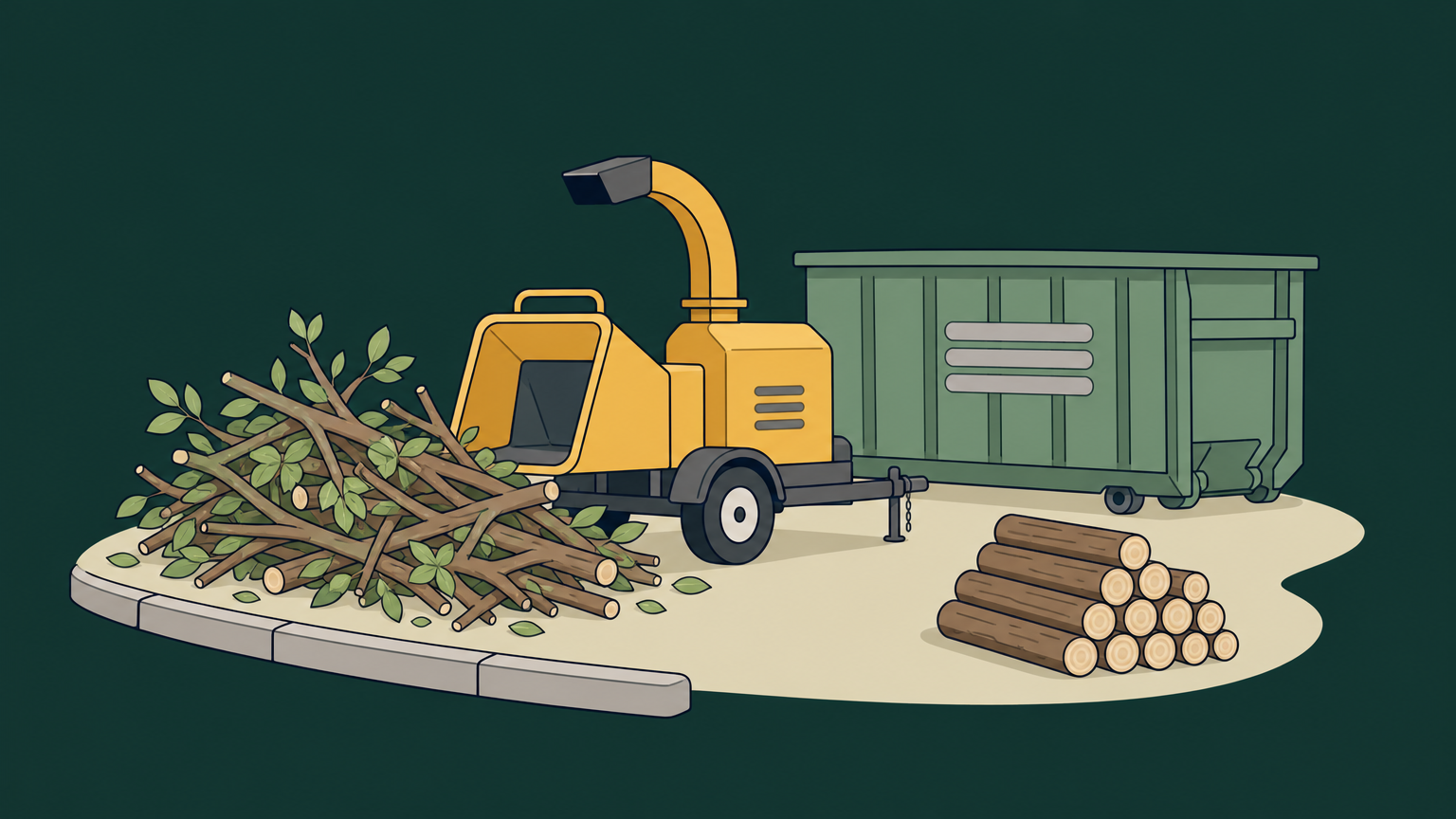
- Leave small branches at the curb for your local green waste pickup, where your town offers it.
- Take limbs to a city-approved dumping site.
- Rent a dumpster, which runs about $280 to $500 per week with disposal.
- Hire a crew with a chipper, which runs $100 to $150 per hour when chipping many branches at once.
Cutting the wood small while it is still green makes every one of those options easier. The crews we send also clean up branches, debris, and leftover material after the job.
When the whole tree is the better price
A 30-foot tree is mid-sized. Removal typically runs $400 to $1,200 nationally , depending on size, and access decides where in that range you land. NerdWallet puts the broader tree removal range at $200 to $2,000, with an average of $750.
Consider removal over repeated branch work when the tree is diseased or rotting, or when it needs most of its canopy cut. As a rule, never remove more than 25% of the living canopy in one season , because heavier cuts stress the tree. Paying for three rounds of branch work often costs more than one removal.
If a branch problem keeps coming back, price the whole tree before paying for a third round of cuts.
Insurance, permits, and ways to lower the bill
Homeowners insurance may help when a limb damages your home, but it rarely covers routine pruning. Your policy and deductible decide the outcome, so read both before you file anything.
Who pays when a limb falls
When a limb lands on your roof, insurance will typically pay some of the removal cost , subject to your deductible and policy limits. A limb that falls in the yard without damage is usually your own expense. For a neighbor's tree, most states hold the owner responsible only if they were negligent in caring for it. A tree on public property, such as a sidewalk strip, is generally the city's job.
Rules on protected, heritage, and street trees vary by city, so check with yours before cutting. We've provided permit assistance for 31 Vancouver properties between 2024 and 2026. Permit processing for removals takes 5 to 10 business days, so allow for that if your job involves a whole tree.
Ways to lower the price
You can cut the cost of a branch job without cutting corners:
- Bundle every branch you want gone into a single visit.
- Book in winter, when crews are less busy.
- Clear a path to the branch and move vehicles and patio furniture.
- Stack small debris near the street, thick ends facing the road, if you want to lower haul-away time.
- Compare three written quotes.
Skip anything that adds risk, such as cutting a large limb yourself from a ladder. A pro's fee is small next to the cost of an injury or a damaged roof.
The biggest savings come from timing and preparation, not from hiring the cheapest crew.
What to budget and who to call
Plan on $75 to $250 for a small or medium branch and $150 to $850 for a large limb, then adjust for height, access, and haul-away. Treat those national numbers as a sanity check and rely on written local quotes for the real figure. Winter booking, bundled cuts, and clear access are the surest ways to keep the total down.
If you have a branch to deal with in Vancouver, Portland, or nearby, send us your photos and we'll tell you what the job involves. You can request a free estimate from Alexa's Tree Service by phone or through the contact form.