Tree Removal & Trimming: 5 Types of Providers Compared
The best provider for tree removal & trimming is a licensed, insured local company that gives a written free estimate and cleans up after the job. If you want one crew for removal, trimming, stumps, and storm calls, pick a full-service company. For a single small cut, an independent crew can work. If you are not sure a tree is sick or just untidy, hire a certified arborist first.
Most people searching this are weighing quotes that differ by hundreds of dollars and reviews that all say five stars. You are trying to tell a careful crew from a risky one before anyone climbs your tree. That is hard to do from a phone screen.
This guide covers five types of providers in the Portland-Vancouver area, starting with Alexa's Tree Service, which has worked in Vancouver, WA, since 2006. Each type gets the same three checks: how it works, who it suits, and what it costs. After the list, you get a price breakdown with a worked example and a checklist for comparing quotes and reviews.
1. Alexa's Tree Service
Alexa's Tree Service is the pick when you want one licensed, insured local crew for removal, trimming, stumps, and storm calls.
How it works
Alexa's is a licensed and insured company that has operated since 2006. It serves Vancouver, WA, Portland, OR, Camas, Battle Ground, Ridgefield, Gresham, Beaverton, and Lake Oswego. You call (360) 723-6688 or use the online form, get a free estimate , and the crew clears branches and debris when the work is done.
- Tree removal for hazardous, diseased, or unwanted trees. Most residential jobs take 2 to 8 hours.
- Trimming and pruning that removes dead, diseased, or oversized branches.
- Stump grinding 6 to 12 inches below grade.
- Tree cabling to support weak or split trees so you can keep them.
- Storm cleanup, available 24/7, with a typical response of 1.5 to 3 hours for active hazards.
- Maintenance plans, plus separate commercial service lines.
Removals in Vancouver can need a permit. Alexa's gives permit guidance and has helped with 31 Vancouver properties between 2024 and 2026. Processing takes 5 to 10 business days , so ask about it before you pick a date.
One crew that handles removal, trimming, stumps, and storm calls saves you from coordinating three companies.
Who it suits
Homeowners with a hazardous, diseased, or storm-damaged tree get the most from a full-service crew. One company can assess the tree, remove it, grind the stump, and haul the debris. It also fits anyone who wants one phone number for every tree problem on the property.
Businesses are the second fit. Commercial removal is scheduled around business hours, and trimming that frees blocked signage and sightlines at retail centers and office parks happens early in the morning or after close. Alexa's has 180+ five-star Google reviews, but read a sample yourself and look for comments about clean, damage-free work.
What it costs
These are Alexa's published ranges. The top of each range reflects large, hard-to-reach, or hazardous trees , and every job starts with a free estimate.
| Service | Price | Notes |
|---|---|---|
| Tree removal | $300 to $2,000+ | Debris is hauled away |
| Tree trimming | $200 to $800+ | Best in February and March |
| Stump grinding | $120 to $380 per stump | Bundling with removal saves $45 to $75 |
| Tree cabling | $300 to $1,200 per tree | Installs in 2 to 4 hours |
2. Independent solo operators and small crews
Independent crews suit small, low-risk jobs where a lower bid matters most.
How it works
An independent operator is usually an owner who climbs, runs the saw, and drives the truck, with one or two helpers. You often get a quote by sending photos or after a short visit, and the person who quotes the job is the person who does it. Before you say yes, ask three things:
- Can you see proof of liability insurance and workers' compensation?
- Will the crew climb, or use a bucket truck or crane?
- Is cleanup and hauling included in the price?
A small crew is only a bargain when its insurance is real.
Who it suits
Small jobs fit best. Think of trimming a low ornamental tree, removing a small tree with open access , or cutting back branches over a shed.
Skip this type when a tree leans over your house, touches power lines, or needs a crane. Those jobs call for heavier equipment and more hands , and an injury or damage claim can land on your own insurance if the crew is underinsured.
What it costs
Quotes from small crews are often lower because overhead is lower. A bid far under the rest usually leaves something out, so compare what each one covers.
- Cleanup, chipping, and hauling
- Stump grinding, or a note that the stump stays
- Any permit work
- Proof of insurance
3. Certified arborist consultants
A certified arborist is the right first call when you do not yet know what the tree needs.
How it works
An ISA Certified Arborist holds a credential from the International Society of Arboriculture. Some work as independent consultants who inspect the tree and write a report, and some work inside tree companies. The visit covers the tree's health and structure .
You then get a written recommendation : prune, cable, treat, monitor, or remove. A consultant who does not sell the work has no reason to push removal.
If you are not sure the tree must come down, pay for an opinion before you pay for a removal.
Who it suits
Choose this type when a tree leans, shows cracks or fungus at the base, or drops large limbs for no clear reason. A second opinion also helps when two companies give you opposite advice.
It also helps when you need a neutral document for a neighbor dispute, an insurance claim, or a permit application. Some cities ask for an arborist's report with a removal permit, so check your city's rules before you book.
What it costs
Consultants typically charge for the visit or by the hour, so ask for the fee before they come. The fee is separate from any work that follows.
It pays for itself when it keeps you from removing a tree that could be saved. Alexa's cabling runs $300 to $1,200 per tree , which can cost less than a large removal and keeps the shade you already have.
4. Landscaping companies with tree crews
Landscaping companies work for ground-level pruning bundled with yard care, not for large removals.
How it works
Many landscaping and lawn companies add pruning and small removals to their regular visits. Light trimming is done by their own crew, while bigger removals are often subcontracted to a tree company. Ask who will actually be on your property.
Also ask who carries the insurance for tree work. A mowing crew's coverage may not extend to climbing and felling.
Ask one question first: who is physically cutting the tree, and are they insured for it?
Who it suits
This type works for hedges, shrubs, and ornamental trees you can reach from the ground. It makes the most sense when you already pay for yard maintenance and want everything on one invoice.
It is the wrong pick for tall trees, storm damage, or work near structures. Those jobs need a crew whose daily work is trees , with the rigging and experience that go with it.
What it costs
Light pruning often folds into the monthly maintenance price , which can be the cheapest route for small trees. Removals passed to a subcontractor may carry a markup .
Ask for the subcontractor's name and compare that bid with one from a direct tree company. If the gap is small, direct is usually simpler.
5. Online quote marketplaces
Online quote marketplaces help you collect several bids fast, as long as you verify each company yourself.
How it works
A marketplace collects your job details and photos, then sends them to several companies that contact you with quotes. Many show ratings and written reviews , which makes a first shortlist quick. The platform does not do the work, so check each company's insurance and license yourself.
Expect calls and texts from more than one provider. Ask each to send a written estimate by email so you can compare them side by side.
A star rating helps you shortlist, but it never replaces seeing the insurance certificate.
Who it suits
It fits you if you are new to the area and have no recommendations, or if you want three bids fast on a routine job. It also helps if you hate calling around.
It is a poor fit for an emergency. When a limb is through your roof, call a 24/7 storm crew directly , because waiting for lead responses costs hours you do not have.
What it costs
Platforms publish average prices by city, but averages mix small shrub jobs with crane removals. Treat them as a rough check, not a quote. Some platforms charge companies for leads, so ask whether the price you were given is the price you would get by calling the company directly.
A practical mix is two bids from a marketplace and one from a full-service company such as Alexa's. That gives you a realistic price floor and ceiling.
What tree removal and trimming cost near you
In the Portland-Vancouver area, tree removal and trimming runs from about $200 for a light trim to $2,000 or more for a large, hazardous removal.
What moves the price
Size and risk set most of the price. Tall trees take more time, more rigging, and sometimes a crane. The same tree costs more when the crew cannot get a truck close.
- Height and trunk diameter
- Access: fences, slopes, narrow side yards
- Distance to your house, wires, or neighbors
- Condition: dead or split trees are riskier to climb
- Haul-away, stump grinding, and permit work
A worked example
Say you remove one medium tree and grind its stump. For illustration, the removal quote is $900 and the stump is $250. Booked separately, that is $1,150. Bundled, you save $45 to $75, so the total lands between $1,075 and $1,105 .
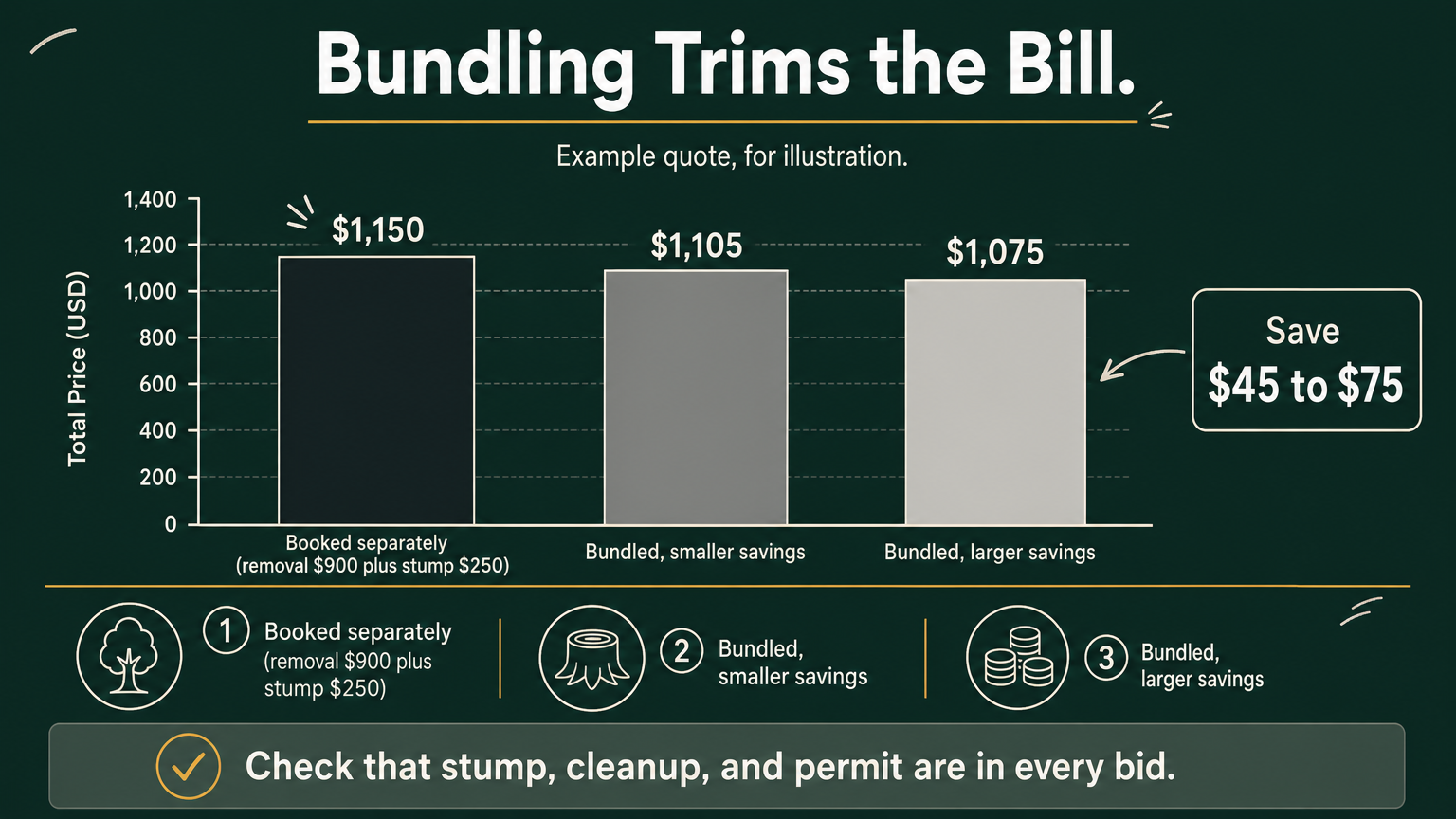
Use that math when you compare bids. If one company's removal price looks low, check whether the stump, cleanup, and permit are in it.
Trimming, removal, and timing
Trimming costs less per visit. Alexa's trimming runs $200 to $800+, against $300 to $2,000+ for removal. The ranges overlap, though. A large tree that needs heavy pruning every few years can cost more over time than one removal.
Schedule trimming from late winter to early spring , February to March, and never remove more than 25% of the living canopy in one season. Removal can happen year round. Free removal for seniors is uncommon. Ask your city or county, and ask any company you call whether it offers a discount.
The cheapest bid only counts if it covers the same work as the others.
How to compare quotes and reviews before you book
Compare providers on credentials first, reviews second, and price last.
Check credentials first
Ask for proof before you ask for a price. A crew that hesitates on paperwork is telling you something.
- Liability insurance certificate
- Workers' compensation coverage
- Any license your state or city requires
- A certified arborist on staff for risky or structural work
- A local address and a phone that someone answers
Read reviews for patterns
Look for recent reviews that mention punctuality, cleanup, how damage was handled, and whether the final price matched the quote. Three and four-star reviews often tell you more than the five-star ones.
Check how the company replies to complaints. Be wary of a pile of vague one-line reviews posted in a short window. Match the business name and phone number across sites to be sure the reviews belong to the same company.
Line up quotes side by side
Ask each company to put the same items in writing. When the numbers differ, the table below shows where the gap usually hides.
| Item to compare | Why it matters |
|---|---|
| Trees and cuts covered | Prevents disputes about scope |
| Cleanup and hauling | Chipping and hauling can add real cost |
| Stump grinding | Often left out of the base price |
| Permit work | Adds days and sometimes fees |
| Insurance proof | Protects you if something goes wrong |
| Payment terms | Large upfront cash demands are a warning sign |
Walk away from any crew that knocks on your door after a storm, pushes you to decide the same day, or proposes topping, which means cutting main trunks back to stubs.
A written, itemized quote is the best review you will ever get of a company.
Next steps for your tree job
The right choice depends on the job. Use a certified arborist when you need a diagnosis, an independent crew or landscaper for small ground-level work, and a marketplace to gather bids. When the tree is big, close to your house, or a storm hazard, hire a licensed and insured full-service crew.
Whichever you pick, verify insurance, read reviews for patterns, and get the scope in writing so every bid covers the same work. If you are in Vancouver, Portland, or nearby, you can request a free estimate from Alexa's Tree Service and use it as the benchmark for every other quote you collect.