
How to Hire Tree Removal and Trimming Pros in Vancouver, WA
The fastest way to get reliable, affordable tree removal trimming service is to follow four steps. Define the job and learn the price range, check permits and timing, shortlist licensed and insured local crews, and compare three written quotes line by line. Price matters, but the cheapest quote is rarely the lowest total once cleanup, stumps, and mistakes are counted.
The problem is that tree work is hard to judge from the ground. You get a number over the phone and have no idea whether it covers hauling, stump grinding, or the fence the crew might flatten. After a windstorm, door-to-door crews show up with low offers and no proof of insurance. Meanwhile, the good local companies in the Vancouver and Portland area can be booked for weeks.
This guide walks through each step in order. It draws on the work of Alexa's Tree Service, a licensed and insured crew serving Vancouver, WA and Portland, OR since 2006. You will get price ranges, a quote request you can copy, a comparison of three sample quotes, and a checklist for the day the crew arrives.
Know your job and your budget first
Before you call anyone, decide what you are asking for and what a fair price looks like. A clear scope and a realistic budget let you spot a lowball or an inflated quote in seconds.
Trimming, removal, or cabling
Trimming cuts back dead, diseased, or oversized branches so a tree stays healthy and balanced. Removal takes the whole tree down. It fits trees that are dead, diseased, leaning toward a structure, or in the wrong place. As a rule, no more than 25% of the living canopy should come off in one season. If your tree needs more than that to be safe, removal or a staged plan is the honest answer.
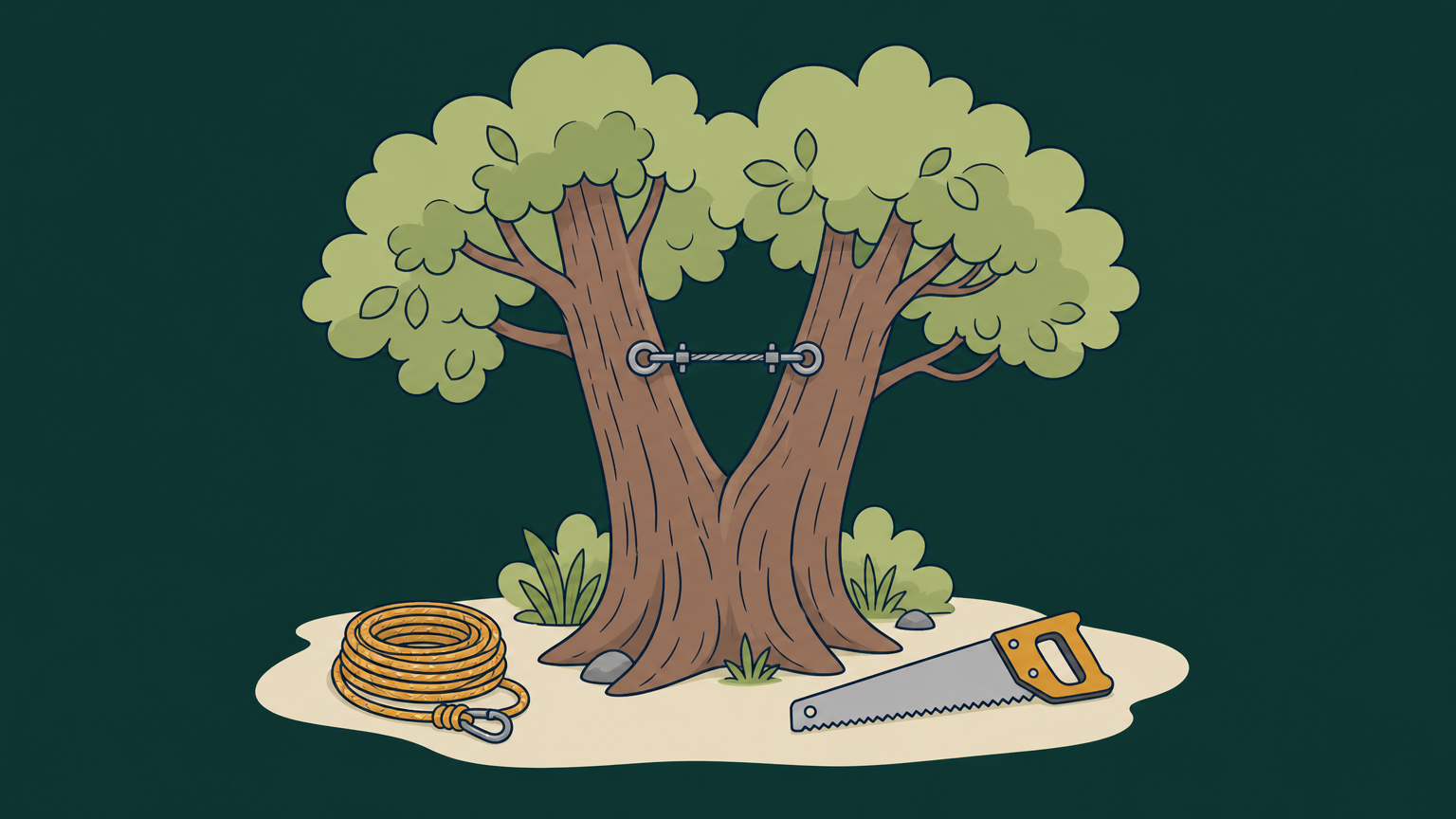
Cabling is the middle path. Steel or synthetic cables support a split trunk or a heavy limb, so a mature or cherished tree can stay standing. Ask for it when a tree is valuable to you and structurally weak, not healthy enough to ignore or too far gone to save.
Typical price ranges
These are the ranges Alexa's Tree Service uses for homes in the Vancouver area. Use them to sanity-check any quote you receive.
| Service | Typical range | Notes |
|---|---|---|
| Tree removal | $300–$2,000+ | Most residential jobs take 2–8 hours |
| Tree trimming | $200–$800+ | Best scheduled in February or March |
| Stump grinding | $120–$380 per stump | 30 minutes for small softwood, 2–3 hours for large hardwood |
| Tree cabling | $300–$1,200 per tree | Installation takes 2–4 hours |
What moves the price
- Height and trunk diameter
- Distance to your house, fence, or power lines
- Access, meaning whether a truck and chipper can reach the tree or the crew must climb and lower pieces by hand
- Tree condition, since dead or decayed wood is less predictable to cut
- Cleanup, meaning hauling everything away or leaving wood and chips on site
- Stump grinding, either included or left in the ground
Never trim near power lines yourself. Call your utility, and hire a crew that works around lines routinely.
Tree work is priced by risk and access, not just by the size of the tree.
Step 1. Check permits, rules, and timing
Check your local tree rules and pick your season before you request quotes. Both change what you can do and when, and a good crew will ask about them anyway.
Permits and property lines
Cities such as Vancouver and Portland have their own tree rules, and those rules can depend on trunk size, species, and location. Call your city or county before you book. Where a permit is needed, processing takes 5–10 business days , so build that wait into your schedule. Alexa's Tree Service handled permit assistance for 31 Vancouver properties between 2024 and 2026 , and a crew that does this regularly will tell you what to file.
A tree on the property line, or entirely on a neighbor's land, is not yours to cut alone. Talk to your neighbor first and get agreement in writing. Washington law can make you liable for significant damages if you cut trees you do not own, so ask an attorney if you disagree about ownership.
The best month to trim a tree
For most trees, late winter to early spring, February through March , is the best window. Trees are dormant, the structure is easy to see, and cuts heal as growth starts. Dead, split, or leaning trees are different. They are hazards, so do not wait for a season.
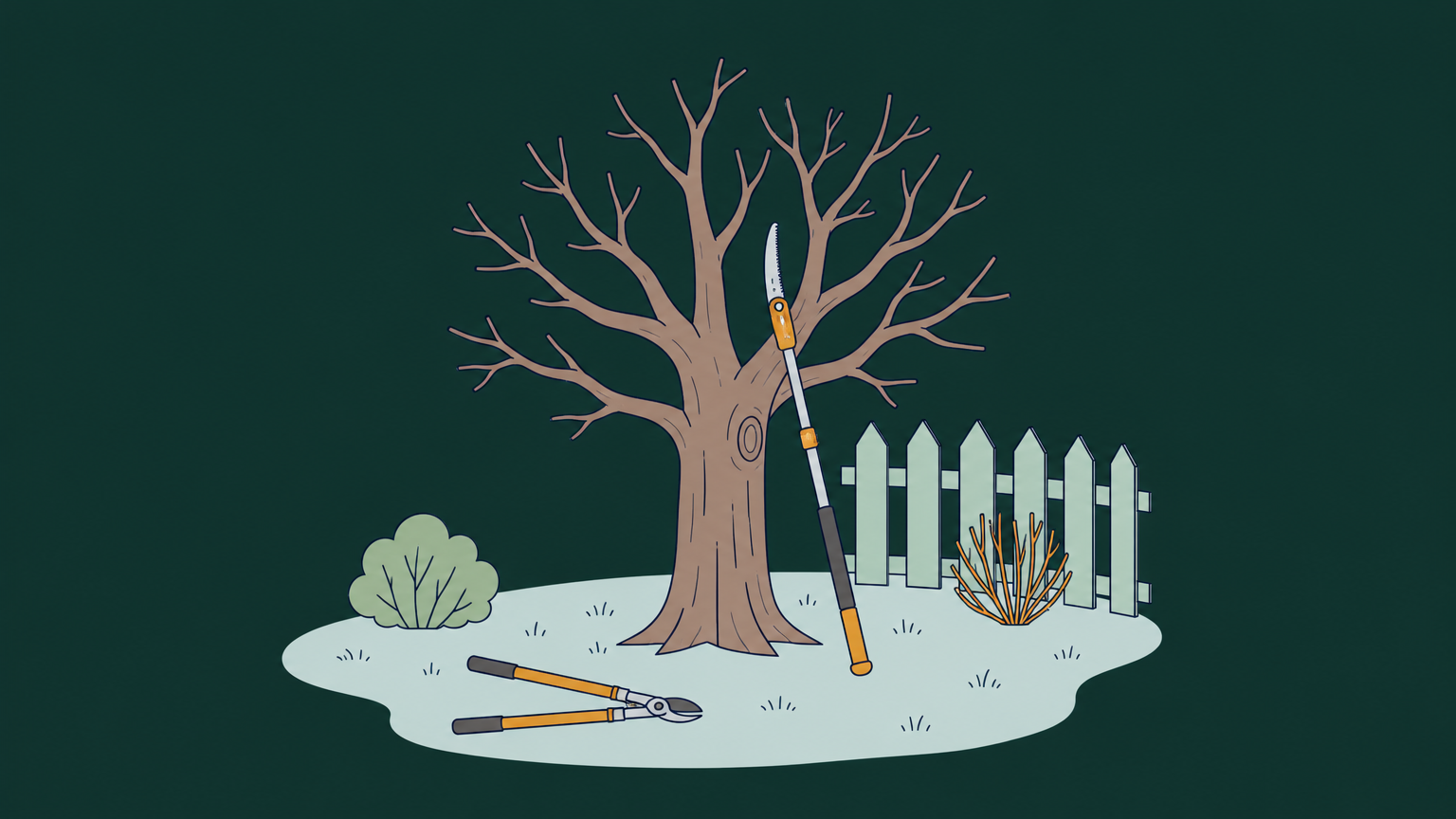
Storm damage cannot wait either. If a limb is on your roof or a trunk is across the driveway, call a service that offers 24/7 storm cleanup. Alexa's Tree Service does.
Trim in February or March, but remove a hazard tree the day you know it is one.
Step 2. Shortlist three local pros
Aim for three local companies that pass the basic checks below. Three is enough to see the market price without wasting weekends on estimates.
Verify license, insurance, and credentials
Ask each company for proof of liability insurance and workers' compensation . If an uninsured worker falls or a limb hits your house, you may carry the bill. Check the business license or contractor registration through your state's lookup for Washington or Oregon. Also ask whether an ISA Certified Arborist is on the crew or advising, since that credential from the International Society of Arboriculture shows trained judgment about tree health.
Read reviews for patterns
One glowing review means little. Look for patterns across recent reviews : on-time arrival, written quotes that matched the final bill, and cleanup. Search for words like "damage," "fence," "lawn," and "stump." A company with 180 or more five-star Google reviews, as Alexa's has, gives you plenty of detail to read. Check the company's own site too, and make sure the phone number and address match its listings.
Red flags to rule out fast
- A crew that knocks on your door after a storm and wants a deposit today
- No written quote, or a quote with only one total
- Cash-only payment or a request for full payment upfront
- A plan to "top" the tree, which means cutting main branches to stubs
- No proof of insurance when you ask for it
A shortlist is not about finding the best reviews; it is about removing the companies that put your property at risk.
Step 3. Request and compare written quotes
Ask all three companies for the same written quote, so the numbers are comparable. Free estimates are standard, so never pay to be quoted.
Send the same request to each company
Copy this into an email or contact form, and attach photos from two angles.
 Subject: Estimate request for tree removal and trimming at [address]
Hello,
I would like a written estimate for tree work at [address, city].
Trees: [number of trees, species if known, approximate height, trunk width]
Work wanted: [removal / trimming / stump grinding / cabling]
Access: [gate width, slope, power lines nearby, buildings or fences within 20 feet]
Available dates: [two or three windows]
Please itemize: labor per tree, debris haul-away, stump grinding, and any permit help.
Please also confirm your license, liability insurance, and workers' compensation coverage.
Thank you,
[Name, phone]
Compare line by line
Here is a worked example. You need one mid-size fir removed and its stump ground. The cheapest removal line is not the cheapest job.
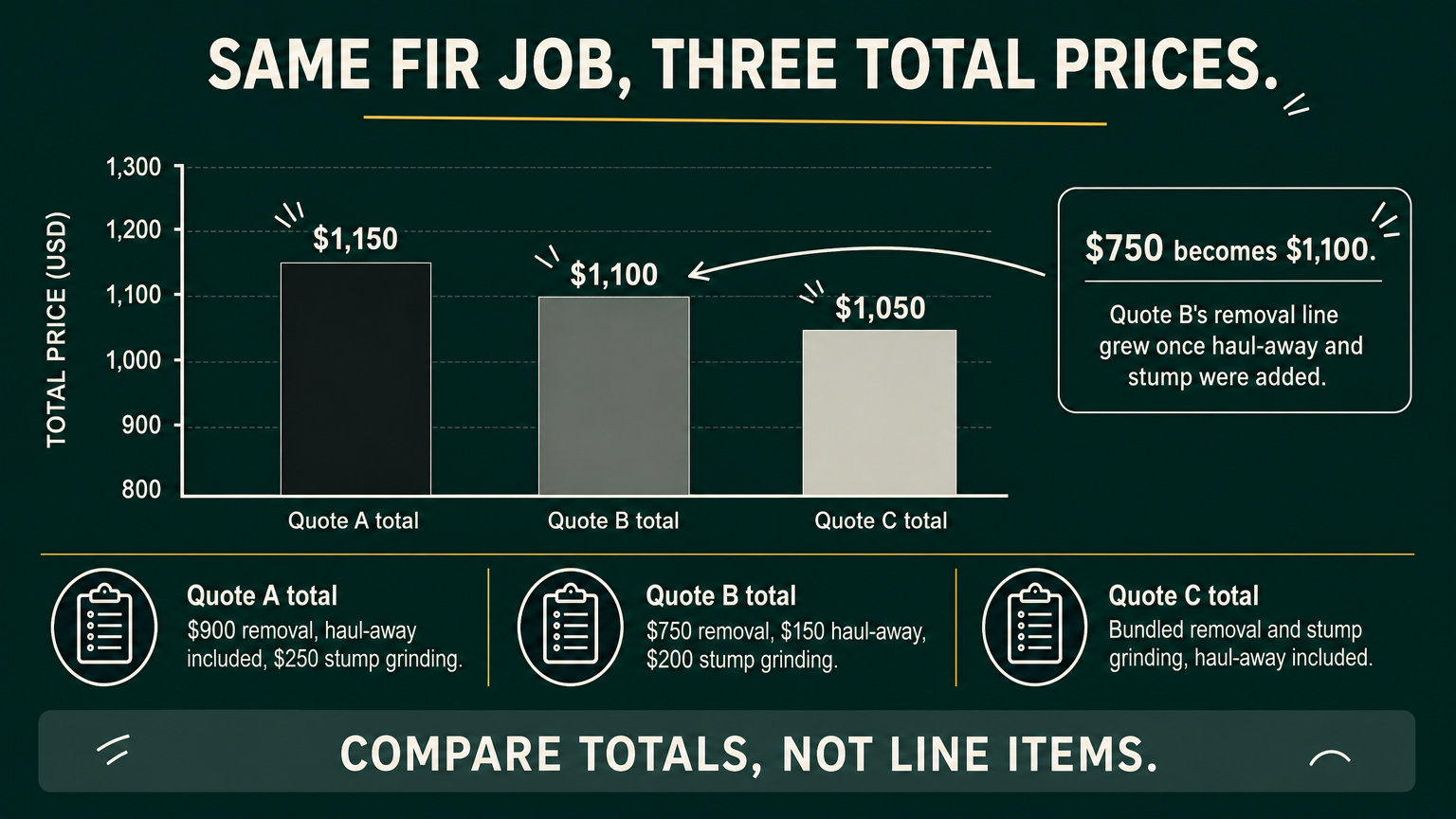
| Line item | Quote A | Quote B | Quote C |
|---|---|---|---|
| Fir removal | $900 | $750 | Bundled |
| Debris haul-away | Included | $150 | Included |
| Stump grinding | $250 | $200 | Bundled |
| Total | $1,150 | $1,100 | $1,050 |
Quote B looked cheapest at $750 until the haul-away and stump were added. Quote C wins on price, but only if its insurance checks out and it grinds to a usable depth. A crew that grinds 6–12 inches below grade , as Alexa's does, leaves ground you can plant or mow.
Lower the bill without cutting corners
Free tree removal is rare. Free estimates are common, and these steps lower the real price:
- Bundle stump grinding with removal. That saves $45–$75 compared with scheduling them separately.
- Keep the wood or chips if you can use them, and ask for the discount.
- Trim on schedule, so a small pruning job does not become a removal.
- Combine all your trees into one visit.
- Ask whether flexible dates change the price.
Compare totals, not line items, and ask what each quote leaves out.
Step 4. Sign, supervise, and inspect the work
Put the agreement in writing and inspect the result before you pay the final balance. This step is where the quote you negotiated becomes the job you actually get.
Before the crew starts
Make sure the signed estimate lists the trees, the work, the cleanup, the stump, the date, and the total. Skip any company that wants full payment before work starts. On the day, move cars, mark sprinklers and fragile plants, and keep kids and pets inside. Most residential removals take 2–8 hours , so expect a long morning or full day, not a few minutes.
After the job: a checklist
Walk the property with the crew lead before they leave:
- Branches, sawdust, and small debris are gone from the lawn, roof, and driveway
- Fences, gutters, and plants are undamaged
- Stumps are ground to the agreed depth
- Cuts on remaining trees are clean, with no stubs
- The final invoice matches the written quote
If you keep your trees, ask about a maintenance plan. Seasonal pruning and health checks catch problems early, and they keep the next tree removal trimming bill small. A cabled tree needs inspection roughly every 3–5 years if steel cable was used.
Pay the final balance only after you have walked the site and the invoice matches the quote.
Your next step for tree work
Hiring well comes down to four moves. Know the job and its price range, check permits and timing, shortlist insured local crews, and compare written totals before you sign. Do that, and you will avoid most of the surprises that make homeowners dread tree work.
If you are in Vancouver, Portland, or nearby, you can request a free estimate from Alexa's Tree Service and compare it against the others on your list. Send the photos and the quote request from Step 3, and you will get a straight answer on your trees.