
Cost of Fallen Tree Removal: Prices, Factors, and Insurance
The cost of fallen tree removal is what a tree service charges to cut up, haul off and clean up a tree that has already come down. Most jobs land between $150 and $2,500. A small tree in an open yard can cost $100 to $500, and a large tree resting on a roof can pass $4,500. National guides put the average near $600.
Where the tree landed matters more than how tall it was, which is why two neighbors can get quotes that differ by thousands. This article shows what drives the price, how to compare quotes, and when insurance pays.
Alexa's Tree Service has cleared storm-downed trees around Vancouver, WA and Portland since 2006, so you will also find local figures and a worked example below.
Why fallen tree removal prices vary so much
Fallen tree prices vary because crews charge for the wood they must move and the risk of reaching it, not for height alone. A downed tree is usually cheaper than the same tree standing, since the dangerous felling is already done. One national guide puts the saving at about half. That saving disappears when the trunk is under tension, tangled in other trees, or lying on something.
Size sets the baseline
Size sets the starting number because trunk diameter and length decide how many cuts, how much chipping and how many dump loads the job needs. The table below combines the ranges that national cost guides publish.
| Fallen tree | Typical price | What the price assumes |
|---|---|---|
| Small, under 30 ft | $100–$500 | Open yard, a few cuts, one haul |
| Medium, 30–60 ft | $300–$1,000 | Easy access for a chipper and truck |
| Large, 60+ ft | $800–$3,600+ | Heavy trunk, several loads |
| Resting on a roof or house | $2,200–$4,500+ | Careful rigging, sometimes a crane |
Across all sizes, national guides report an average near $600 and a typical range of $150 to $1,900 . A 40-foot or 50-foot tree on open ground sits in the medium row. A 100-foot giant belongs in the large row or above, especially if it is dense hardwood.
Where the tree landed and what it touches
A tree in an open yard is the cheapest case. Once it touches a fence, garage or house, expect 25% to 50% more , because the crew must cut in small sections to protect what is underneath. A tree on a roof may need a crane to lift pieces off the framing, and a crane day can add anywhere from $500 to $3,000.
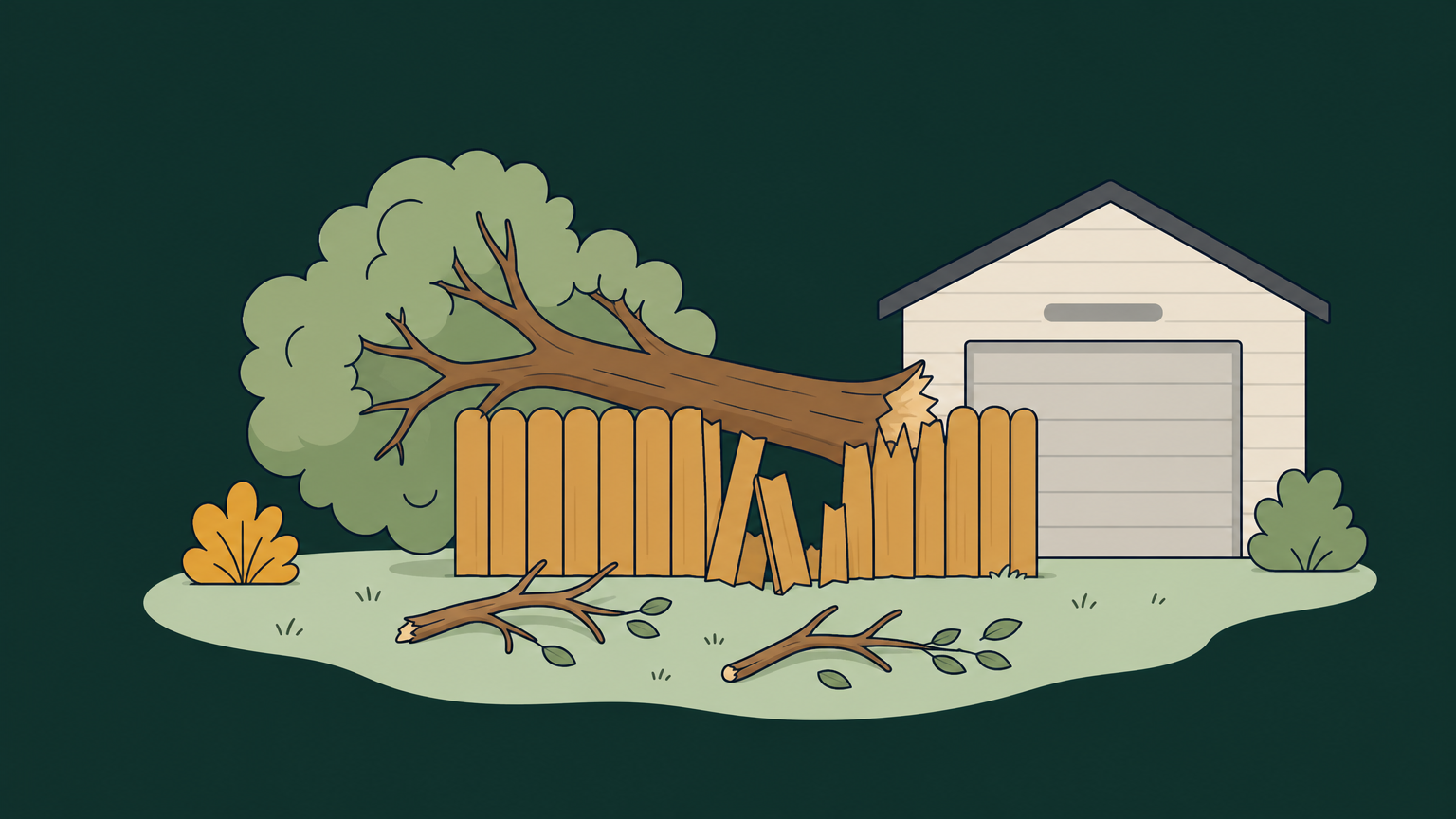
Power lines change the job completely. Treat every wire as live, stay well back, and call 911 and your electric utility. A tree company can price the work only after the lines are made safe.
A fallen tree costs the least in an open yard and the most when it rests on your house.
Access, timing, and wood type
Beyond size and landing spot, four smaller factors move the quote.
- Access: Logs behind a fence, on a slope or in a tight backyard get carried by hand, which adds crew hours.
- Timing: After-hours and holiday calls carry a premium. National guides cite 25% to 100%.
- Storm demand: After a major storm, prices rise across the area. If the tree is safe, waiting a week or two can bring better quotes.
- Wood and crew: Dense oak dulls saw chains and mud-packed roots slow the work. Some companies quote hourly, commonly $150 to $300 for a three-person crew.
How to get an accurate quote for a fallen tree
To get an accurate price, photograph the tree, make the area safe, and collect three written, itemized quotes from licensed and insured companies. Then compare what each quote includes, not only the total.
Steps to a fair quote
Do these in order, and you will have the information a crew needs to price the job. Never cut a trunk under tension, a tree on a roof, or anything near a power line yourself. Only small, stable pieces in a safe spot are reasonable DIY work.
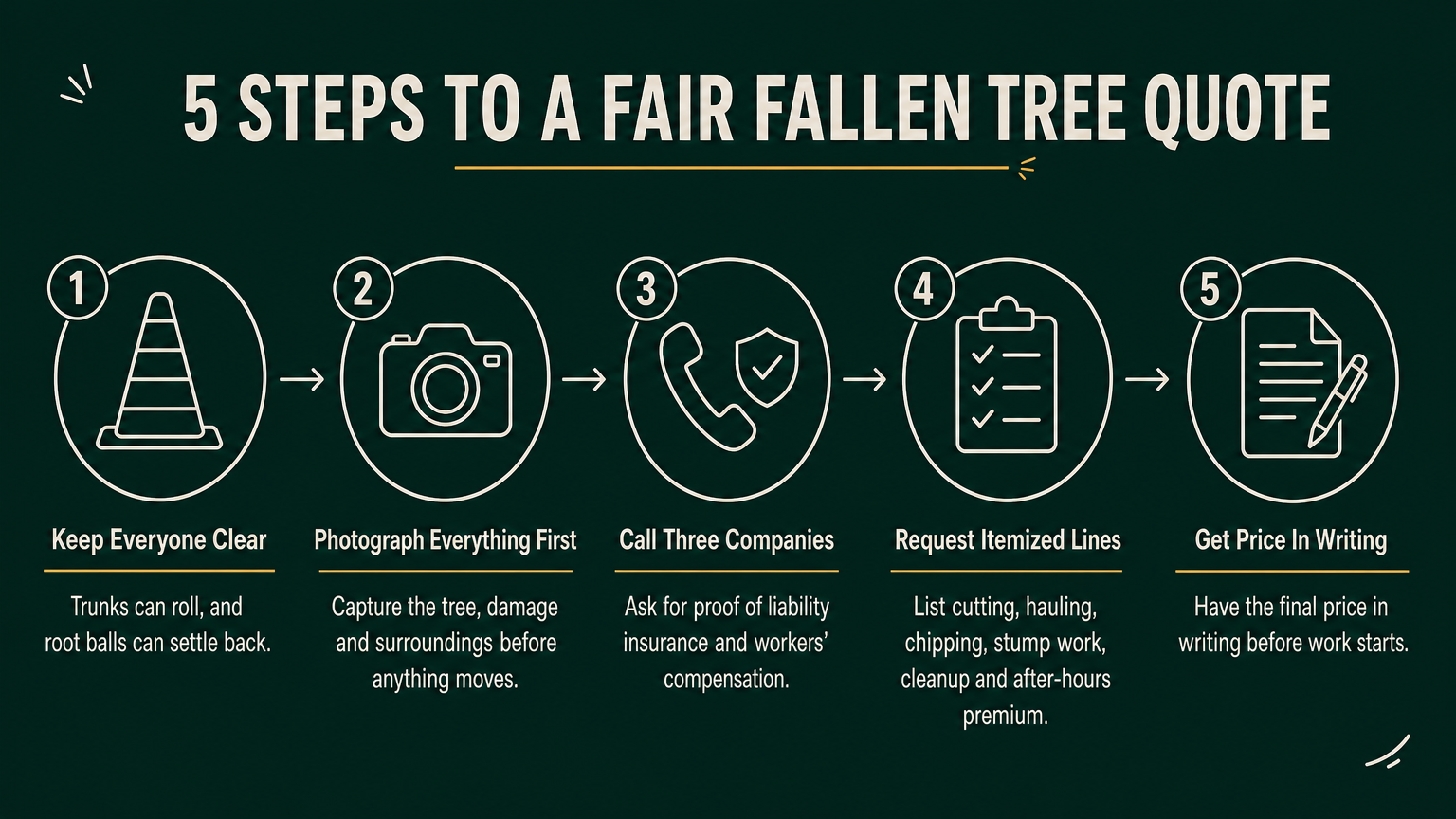
- Keep everyone clear of the tree. Trunks can roll, and a lifted root ball can settle back into its hole.
- Photograph the tree, the damage and the surroundings before anything moves. You need these for an insurance claim.
- Call at least three companies and ask for proof of liability insurance and workers' compensation . An ISA-certified arborist on the crew is a plus.
- Ask for itemized lines: cutting, hauling, chipping, stump work, cleanup, and any after-hours premium.
- Get the final price in writing before work starts.
What the quote should cover
A quote for cutting up and hauling the trunk often leaves out extras. Ask about each item below, because a low base price can hide them.
| Add-on | Typical cost |
|---|---|
| Stump grinding | $120–$500 per stump |
| Debris cleanup and chipping | $100–$300 |
| Clearing hanging limbs in a standing tree | $200–$450 |
| Lawn repair and grading | $100–$300 |
Ways to lower the bill
Start with timing. If the tree fell safely on open ground, schedule the work in normal business hours instead of paying a premium. Bundling a dying tree or a trim into the same visit also saves a second mobilization fee. If you want the logs as firewood, say so, since the crew may then skip hauling them.
Watch for red flags. Crews that knock on your door after a storm, ask for a large cash deposit, or refuse a written estimate are a risk. A very low price can mean no insurance , and you carry the liability if a log damages your home.
Compare what each quote includes, because the cheapest total often leaves out cleanup and stump work.
What fallen tree removal costs in Vancouver, WA
Around Vancouver, our storm cleanup work runs $450 to $3,200 , depending on urgency and complexity. A typical case is a fallen 40-foot maple blocking a driveway, which costs $890 to $1,400.
Local price ranges
These figures come from our own pricing for Clark County homes. Your final number depends on the on-site inspection.
| Job | Price |
|---|---|
| Storm cleanup, full range | $450–$3,200 |
| Fallen 40 ft maple blocking a driveway | $890–$1,400 |
| After-hours calls | 25% premium over standard rates |
| Stump grinding | $120–$380 per stump |
| Stump grinding, 24" and 48" stumps | $180 and $340 on average |
A worked example
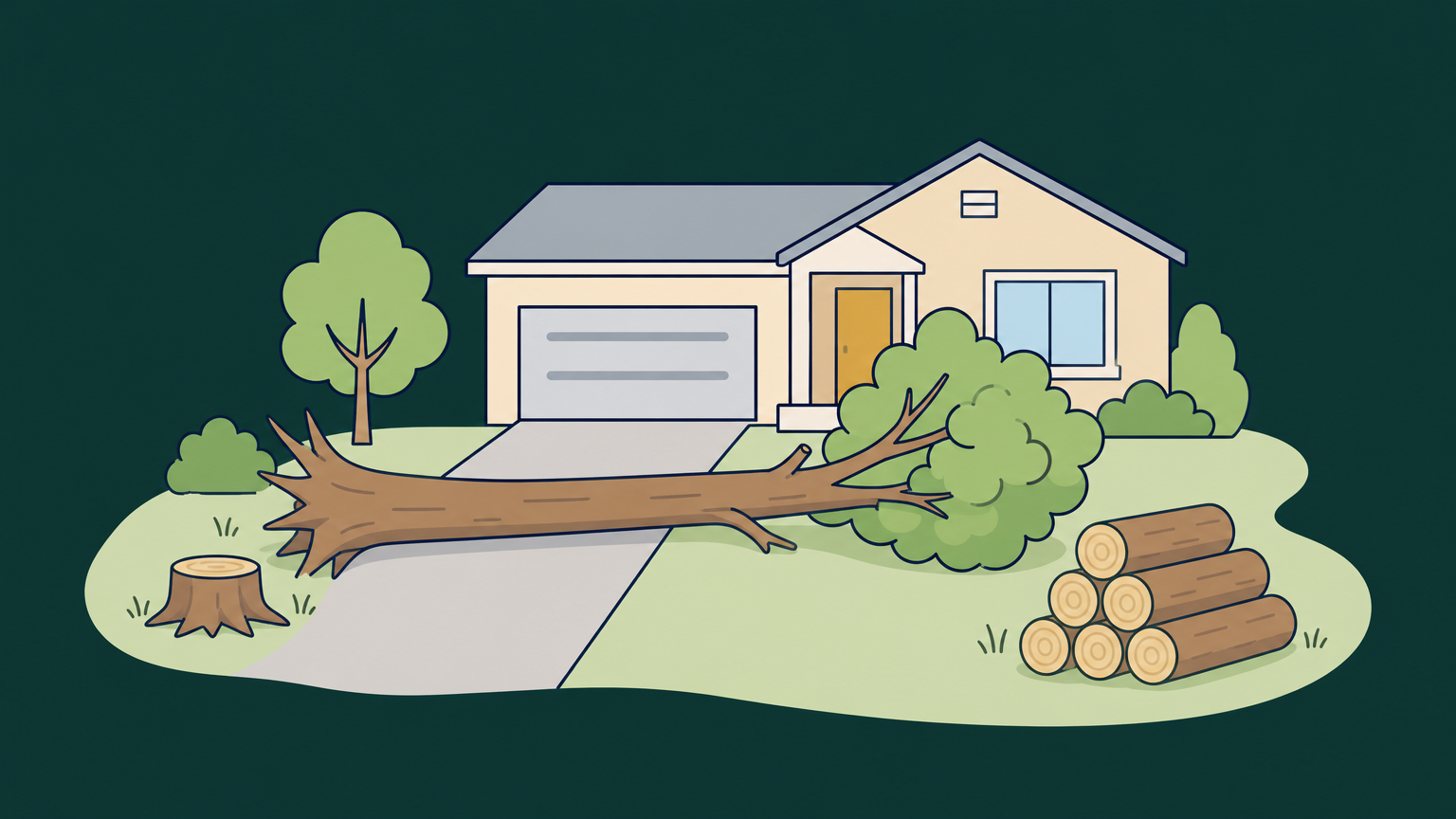
Say a 40-foot maple snaps in a windstorm and blocks your driveway. Booked for daytime, the removal costs $890 to $1,400 . Called out after hours, the 25% premium lifts that to about $1,110 to $1,750. If the trunk left a 24-inch stump and you want it ground, add about $180. The after-hours total comes to roughly $1,290 to $1,930 , assuming the premium applies only to the removal. If the same tree had landed on your roof, you would move to the roof row in the national table above.
Response times and permits
Our storm cleanup runs 24/7, including holidays and weekends. Average response for active hazards is 1.5 to 3 hours, and it stretches to 4 to 6 hours during peak storm demand. Two on-call crews cover Clark County.
Permit rules mostly target felling healthy standing trees, and some cities relax them for emergency hazards. For a large tree, or one on city property, check with your city first. We handle permit paperwork for large removals in Clark County.
For a typical driveway-blocking tree near Vancouver, plan on roughly $900 to $1,400 in daytime, and about a quarter more after hours.
Does insurance cover fallen tree removal?
Homeowners insurance often pays for fallen tree removal, but only when a covered event drops the tree on an insured structure or blocks access. Even then, the payout is capped.
When your policy pays and when it does not
Coverage depends on why the tree fell and where it landed.
| Situation | Usually covered? |
|---|---|
| Wind, ice or lightning drops a tree on your house, garage or fence | Yes, removal and repairs |
| Tree blocks your driveway or an access ramp | Often, check your policy |
| Healthy tree falls in your yard and hits nothing | Usually no |
| Dead, rotting or neglected tree falls | Often denied |
| Stump grinding | Usually no |
Limits and deductibles
Many policies cap debris removal at about $500 per tree and $1,000 per incident , though limits differ. Your deductible applies first. If a $1,200 removal falls under a $1,000 deductible and a $500 per-tree cap, the policy pays nothing for removal. A claim makes sense when the tree damaged the structure itself, since repairs are covered separately. Open the claim before you authorize extensive work, and keep your photos and written quotes.
Insurance pays for removal mainly when the tree damages something your policy covers, and the cap is often lower than the job.
Neighbor's tree and other help
If a neighbor's healthy tree falls in a storm, your own policy generally handles your side, while a tree with visible neglect may make the owner liable. State rules vary. Free tree removal for seniors is not a standard program, but some local agencies and nonprofits offer limited help. FEMA helps only after a federal disaster declaration.
Planning your budget for a downed tree
The cost of removing a fallen tree depends on size, where it landed, how easily a crew reaches it, and when you call. Expect a few hundred dollars for a small tree in an open yard, about $900 to $1,400 for a driveway-blocking tree near Vancouver, and several thousand once a roof or crane is involved. Photograph everything, stay clear of power lines, and compare itemized written quotes before you commit.
If a tree has come down on your property in Vancouver, Portland or the surrounding area, request a free estimate from Alexa's Tree Service and we will inspect it and give you a price.