
Tree Trimming Company Near Me: How to Hire in Vancouver, WA
Finding a tree trimming company near me that is reputable and fairly priced comes down to four moves: define the job, shortlist three licensed and insured companies, collect written free estimates, and compare scope before price. A typical residential trim in Vancouver, WA runs about $200 to $800, so a quote far outside that range deserves questions.
The hard part is the noise. A search returns lead-generation sites, directories with paid placement, and crews that knock on your door after a windstorm. Reviews are hard to read, and two quotes for "trimming" can describe completely different work. Hiring the wrong crew is not just a wasted payment. If an uninsured worker gets hurt on your property, or a dropped limb damages your roof, you may carry the cost.
This guide gives you a short primer on prices and timing, then four steps from first photo to final inspection. It draws on how we run estimates and jobs at Alexa's Tree Service, which has trimmed trees for homes and businesses in Vancouver, WA and the Portland area since 2006. You will get a copy-ready quote request, a vetting checklist, and a worked comparison of three quotes.
Before you start: what trimming costs and when to book
Trimming costs depend on the tree and the job, not on the calendar, and most trees do best when trimmed in late winter. Knowing both before you call keeps you from overpaying or booking at the wrong time.
What a trimming job costs
Most residential trims in Vancouver, WA cost between $200 and $800+ per job . The final number depends on tree height, access, and how much wood comes off . National averages for trimming sit around $270 to $450, which fits inside that range. Tall conifers, trees over roofs, and crowns that need roping out push you toward the top.
| Service | Typical price range | What moves the price |
|---|---|---|
| Tree trimming | $200–$800+ per job | Height, access, amount of canopy removed |
| Tree cabling | $300–$1,200 per tree | Tree size, number of cables, 2–4 hours of install time |
| Tree removal | $300–$2,000+ | Height, trunk diameter, proximity to structures, permits |
| Yard cleanup | From $150 | Debris volume, lot size, seasonal timing |
Four factors move a quote. Height decides whether a crew climbs or brings a lift. Access decides whether a chipper reaches the tree or branches get carried out by hand. Hazards such as roofs, fences and power lines slow the work. Scope covers how much canopy comes off and whether the crew hauls the debris.
Here is a worked example. You have a 35-foot maple that needs deadwood removed and clearance over the roof, plus a small ornamental that needs shaping. One company might quote $450 for the maple and $200 for the ornamental, so $650 for the visit. If another company quotes $1,100 for the same list, ask which line items explain the gap.
Judge a trimming quote by the scope of work it describes, not by the headline number.
Hourly rates come up often, but residential trimming is usually quoted as a flat price per job. Crew size and equipment matter more than clock time, so ask for a flat price per tree.
When to schedule trimming
Late winter to early spring, February through March , is the best window for most trees. Deciduous trees are dormant, cuts are easy to see without leaves, and new growth in spring helps the tree close its wounds. Many arborists avoid heavy pruning in fall, because wet weather helps fungal spores spread.
Some work cannot wait. Dead, cracked or hanging branches should come down any time of year, and so should limbs that threaten your roof or a walkway. Also set a ceiling on how much is removed. Never take more than 25% of the living canopy in one season , because stripping more stresses the tree and invites weak regrowth.
Trimming, pruning or removal
Companies use "trimming" and "pruning" almost interchangeably. Trimming usually means cutting back overgrown branches. Pruning means selective cuts for tree health or structure. What matters is that your written quote says which branches go and why.
If you are unsure whether a tree should be trimmed at all, ask for a second opinion. A leaning trunk, a crack in the main stem, or large dead sections point toward removal. A split or heavy limb on a tree you love may be a candidate for cabling instead.
Step 1. Define the job and gather details
You get better quotes when every company bids on the same clearly described job. Spend 20 minutes on your own property before you contact anyone.
Walk the yard and document every tree
Work through this list with your phone in hand:
- Number each tree and photograph it from two angles, showing the full canopy.
- Estimate heights. To measure one, compare your shadow to the tree's shadow: tree height equals the tree's shadow length times your height, divided by your shadow length.
- Note what sits below and beside each tree: roof, fence, septic area, driveway, neighbor's yard.
- Mark problem spots: dead limbs, branches rubbing the roof, growth blocking a view or a driveway.
- Write your goal for each tree: safety, clearance, health, or appearance.
A clear photo set often lets a company give you a ballpark before a visit. It also stops the common mix-up where one bidder prices only the front yard.
Spot the jobs that cannot wait
Call a company the same day for a hanging or cracked limb over a structure , a tree that shifted after a storm, or a fallen tree on your house or fence. For storm damage, you want a crew that answers around the clock. Alexa's Tree Service takes storm cleanup calls 24/7.
One exception. If a branch or tree touches a power line , stay back and call your utility first. A tree company should not work on trees in contact with lines until the utility has dealt with them.
Send a request that gets comparable quotes
Copy this template into an email, text, or contact form and fill in the brackets:
 Subject: Free tree trimming estimate request, [your ZIP code]

Hi, I'd like a free written estimate for tree trimming at [street address, city].

Trees: [number, species if known, approximate height]
Work wanted: [e.g., remove deadwood, raise canopy 8 ft over driveway, clear roofline]
Access: [gate width, backyard or front, driveway length]
Hazards: [power lines, roof, fence, septic area]
Photos: attached

Please include in the quote: cleanup and haul-away, proof of liability and
workers' compensation insurance, and your earliest available date.

Thanks, [name, phone number]
A clear request with photos is the cheapest way to get quotes you can actually compare.
Step 2. Build a shortlist of vetted companies
A shortlist of three to four verified companies beats a long list of unchecked ones. Your goal at this stage is to eliminate weak options quickly, using public information and a few direct questions.
Search close to home, then check the details
Start with a Google Maps search for a tree trimming company near you, and ask neighbors whose trees look well kept who did the work. Closer is better, but only up to a point. A nearby company knows local species like Douglas fir, bigleaf maple and western red cedar, and it understands how wet winters and dry summers affect them. It also knows city rules. Alexa's Tree Service, for example, works across Vancouver, Camas, Battle Ground, Ridgefield, Portland, Gresham, Beaverton and Lake Oswego.
Once a company looks promising, confirm it has a real local address and phone number on its own website. Anonymous listings with only a form are common among lead resellers.
Read reviews for patterns
Volume matters less than pattern. Look for recent reviews spread over years , not a burst of 50 in one month. Read the three-star and one-star reviews first. Check whether the owner answers calmly and specifically.
Then scan for repeated phrases in the positive reviews. Good signs are "showed up on time," "cleaned up everything," "quote matched the final bill," and "protected the lawn." Red flags are "price went up on the day," "left debris," and "damaged the fence."
Verify license, insurance and credentials
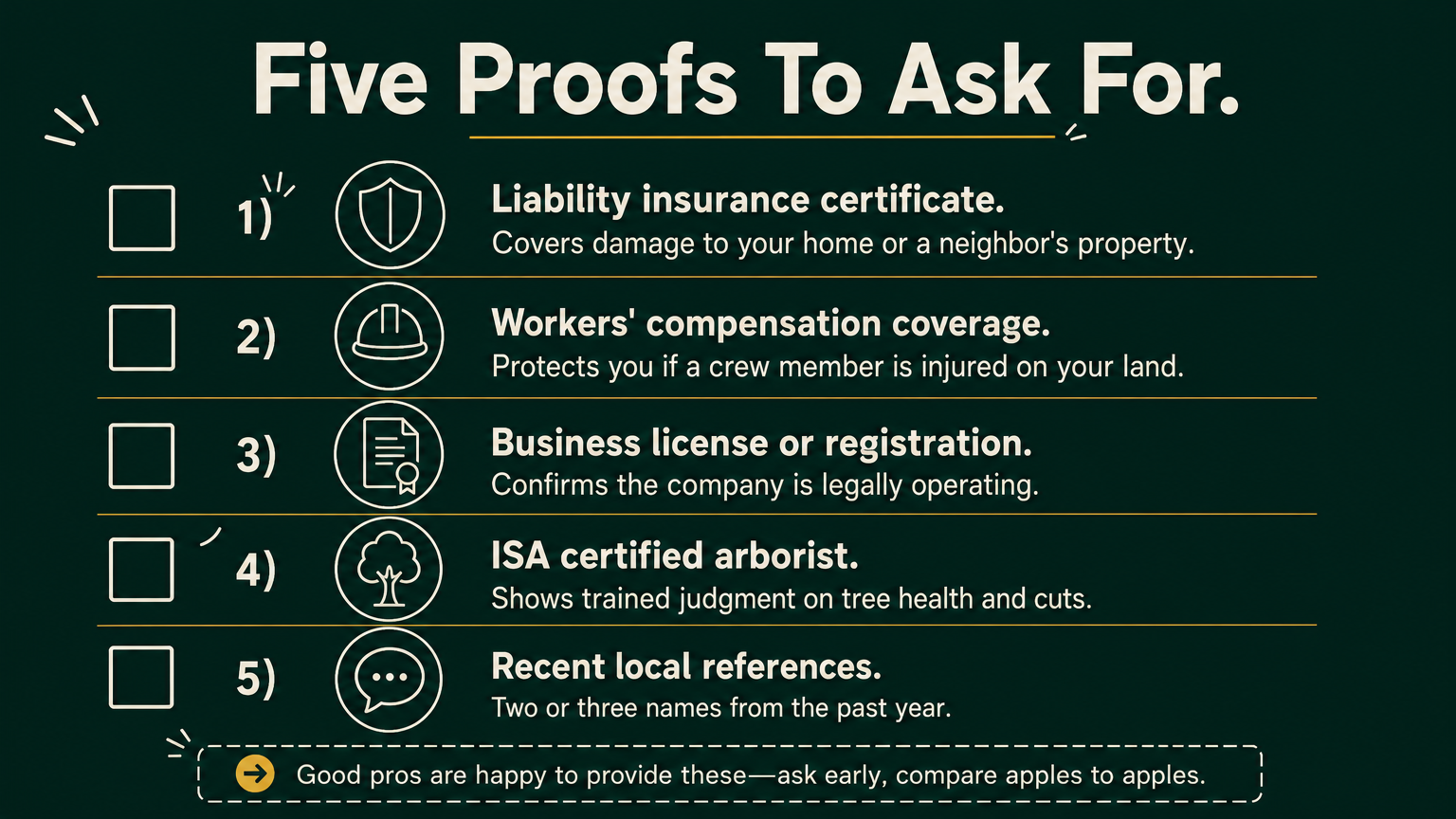
Ask every company on your shortlist for the items below before you accept an estimate.
| Ask for | Why it matters | A good answer |
|---|---|---|
| Liability insurance certificate | Covers damage to your home or neighbor's property | Certificate sent by the insurer or agent, current dates |
| Workers' compensation coverage | Protects you if a crew member is injured on your land | Yes, with proof |
| Business license or state registration | Confirms the company is legally operating | License number you can look up with your state |
| ISA Certified Arborist on staff | Shows trained judgment on tree health and cuts | Name of the certified person who will assess your trees |
| Recent local references | Lets you hear about cleanup and billing | Two or three names from the past year |
A licensed and insured company should hand these over without hesitation. Alexa's Tree Service is licensed and insured, and you should expect the same documents from anyone you hire. Drop a company from your list if it dodges the insurance question.
Be wary of these red flags :
- Door-to-door crews after a storm who want a deposit now
- Cash-only deals with no written quote
- A plan to "top" your tree, meaning cutting the main leaders to stubs
- Climbing spikes used on a tree you want to keep, because they wound live bark
- No named crew lead or company contact
Insurance proof is not paperwork. It decides who pays if something goes wrong.
Step 3. Get free estimates and compare quotes
Plan on three written estimates , and treat a free estimate as an interview for the company, not just a price check. Most reputable companies offer free estimates by phone or online form, and larger jobs get an on-site visit.
What a good written estimate includes
Do not accept a number scribbled on a business card. A solid estimate lists:
- Each tree by location or species
- The exact work per tree, such as "remove deadwood over 2 inches, raise crown 8 feet, no more than 25% canopy reduction"
- Whether cleanup, haul-away and wood or chips are included
- Total price, payment terms and any deposit
- Planned date and expected duration
- Insurance details
Stump grinding, permits and crane time are often separate lines, so ask directly whether they are included.
Compare quotes on equal terms
Line up the scope first and the price second. Here is a worked example for the same 35-foot maple:
| Company | Quoted price | Haul-away | Insurance proof | True cost |
|---|---|---|---|---|
| A | $380 | Extra $120 | Yes | $500 |
| B | $450 | Included | Yes | $450 |
| C | $290 | Extra | Not provided | Unknown, and unsafe to hire |
Company A looks cheaper than B until haul-away is added, which makes B the lowest real price. Company C's low number is a warning, not a bargain. Very low quotes often come from crews without insurance or ones that plan to cut corners on cleanup.
Ways to lower the bill without cutting corners
Several legitimate steps bring the price down. Bundle all your trees into one visit , because crews charge for setup and travel. Book for February or March , when schedules are lighter than after fall storms. Offer a flexible date , and ask whether wood chips can stay on site for mulch.
Be careful with offers of free tree cutting, including those aimed at seniors. Truly free work is rare. If you are on a fixed income, ask your city, county, or utility whether any assistance programs exist, and still insist on insured, licensed work from any contractor who helps.
The cheapest quote is rarely the lowest cost once cleanup, damage, and rework are counted.
Step 4. Book, supervise and inspect the work
Booking is not the end of your job. The last step protects your property and confirms you got what you paid for.
Confirm permits, timing and terms
Choose the company whose quote is clearest, not simply cheapest. Before you sign, confirm the date, crew size, and expected duration. A residential trim often takes a few hours, and most residential removals take 2 to 8 hours. Keep any deposit small, and plan to pay the balance after the work is done.
Ask about permits. Routine trimming of a normal yard tree usually does not need one, but removing larger trees can, and rules vary by city. In Vancouver, WA, permit processing takes 5 to 10 business days, and Alexa's Tree Service provided permit assistance for 31 Vancouver properties from 2024 to 2026. If a company says a permit is not your concern, check with your city yourself.
Be present on the day
Walk the property with the crew lead before work starts and point to each tree on your list. Confirm where branches will fall, where the truck will park, and which plants, fences and gutters need protection. You do not need to supervise every cut, but being reachable for questions prevents mistakes.
A professional crew works with ropes and controlled drops. It does not let heavy limbs crash onto your lawn or roof. If crew members start cutting something not on the quote, stop and call the office.
Inspect the finished work
Do a walkthrough before you pay the final balance. Use this checklist:
- Cuts sit just outside the branch collar, the slightly swollen ring where a branch meets its parent limb.
- No flush cuts, no long stubs, and no torn bark.
- The tree keeps its natural shape. No topping.
- No more than 25% of the living canopy was removed.
- Branches, sawdust and small twigs are cleared from lawn, driveway and roof.
Photograph the result and keep your invoice. If you have several mature trees, ask about a maintenance plan with seasonal pruning and health checks, so small problems get caught before they become emergencies.
The final walkthrough is your leverage, so inspect before you pay the balance.
Hire with a clear scope and proof
To find a good tree trimming company near you, define the job with photos, shortlist three companies, verify their insurance and license, and compare written estimates by scope, not by the lowest number. Schedule non-urgent trimming for late winter, keep canopy removal under 25% a season, and inspect the cuts and cleanup before you pay.
If you live in Vancouver, Portland or nearby communities and want a straight answer on your trees, request a free estimate from Alexa's Tree Service. You can also call (360) 723-6688, and we will tell you what the job needs and what it costs before any work starts.