
Tree Stump Removal Cost Calculator: How to Estimate Yours
To use a tree stump removal cost calculator well, measure each stump's diameter, match it to a size band, add a height tier for any tree still standing, then adjust for access, wood type and extras. In the Vancouver, WA and Portland area, Alexa's Tree Service prices stump grinding at $120 to $380 per stump and tree removal from $300 to $2,000 or more. Those two ranges are the backbone of the estimate you build below.
Most online calculators hand you one number and hide what is inside it. Stump work and tree removal are separate jobs with separate prices, and the final bill moves with things a web form never sees: roots, rocks, a fence the crew must work around, a tree leaning over a roof. When the quotes arrive later, they look wildly different and you can't tell which one is fair.
This guide gives you a calculator you can run with a tape measure and a pen. You will measure the stump and the tree, price the grinding, price the removal by height, add the extras, and total a low and a high figure. A worked example shows every sum, so you can check your own math before you call anyone.
What a stump and tree removal estimate covers
A stump and tree removal estimate covers up to four separate jobs: taking the tree down, dealing with the stump, clearing debris, and handling access or permit issues. Most crews price each as its own line, so the number you want is a sum of parts, not a single rate.
The four lines behind every price
Every estimate you build in this guide uses the same four lines:
- Tree removal: priced per tree, driven by height, trunk size and what the tree hangs over.
- Stump grinding or removal: priced per stump, driven by diameter, wood type and root spread.
- Debris and haul-away: branches, logs and wood chips. Some crews include it and others bill it separately.
- Access, permits and timing: tight yards, power lines, city permits and emergency calls.
Stump work is rarely included in a tree removal price. Most companies treat the two as separate services, so a quote for taking down a tree usually leaves the stump standing unless it says otherwise. Any cost of tree removal calculator that shows no stump line is only giving you half the answer.
Why a calculator gives a range, not a quote
A calculator works from what you type in, and a crew works from what it sees on site. Soil, root spread and lean change the job, and none of them show up in a form field. Rocky ground can dull grinder teeth, and a stump with large surface roots takes longer than one with a tidy flare.
That is why every figure in this guide is a low and a high. Treat the result as a budget range that tells you whether a quote is in the right area, not as a price to hold anyone to.
A calculator prices the tree you describe, and a crew prices the tree it sees.
Grinding versus full stump removal
Grinding cuts the stump down with a machine. At Alexa's, the grinder takes the stump 6 to 12 inches below grade , which clears trip hazards, pest habitat and obstacles to mowing. The roots stay in the ground and rot slowly. For a lawn or a garden bed, that is usually all you need.
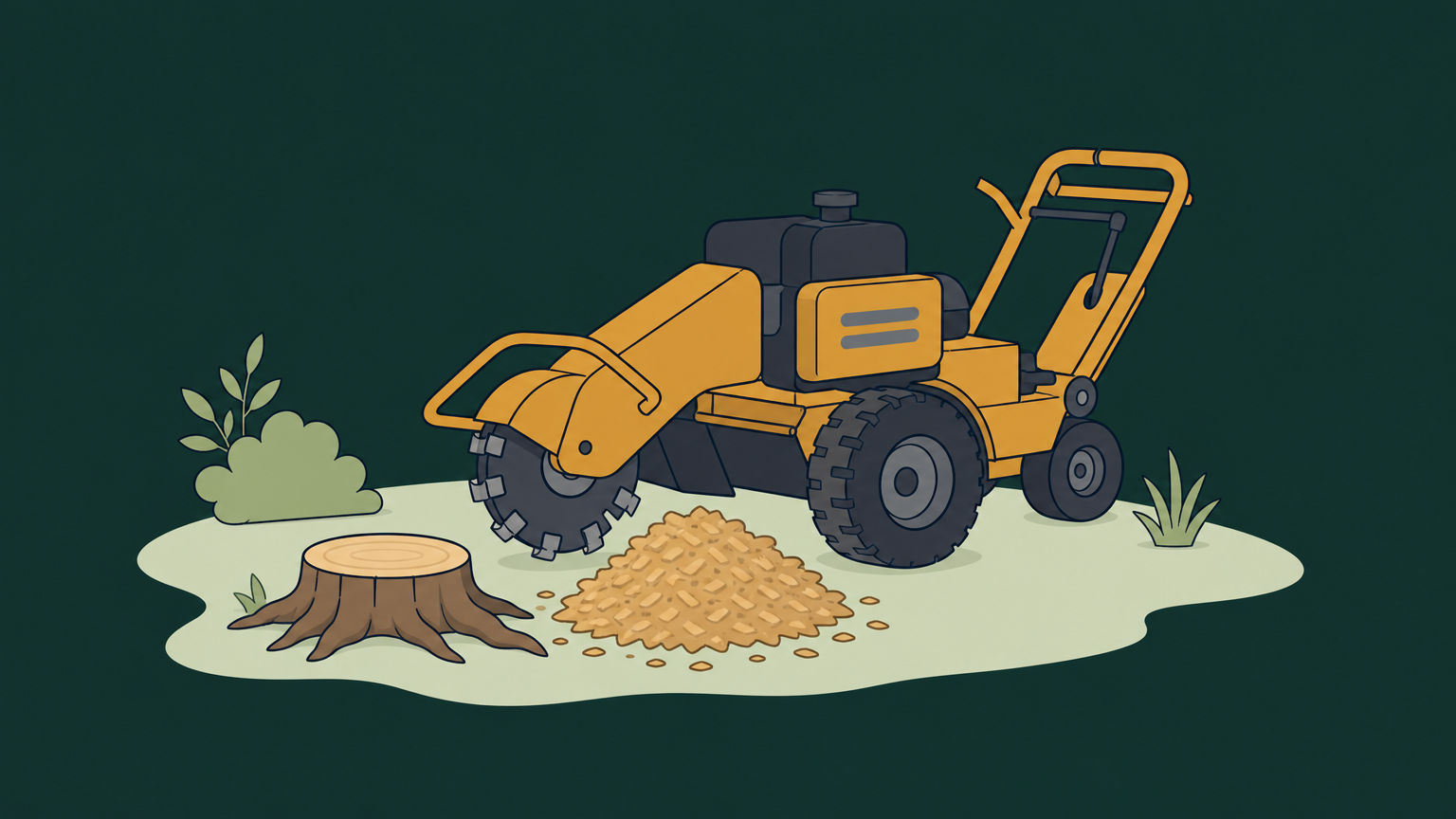
Full removal digs out the stump and its main roots with an excavator or by hand. Published city price tables put it at roughly double the grinding cost. Choose it only when you plan to pour a patio, build over the spot, or plant a new tree in the same place. The calculator below prices grinding, because that is what most yards need.
Step 1. Measure the stump, the tree and the site
Measure three things before you price anything: the stump's diameter at its widest point, the tree's height, and how a crew would reach the work. Ten minutes with a tape measure gives you better inputs than any photo upload.
Measure each stump across its widest point
Run the tape straight across the top of the stump, through the center, at its widest point. If the base flares out with roots, measure the flare , because that is the wood the grinder must remove. Round up to the next full inch.
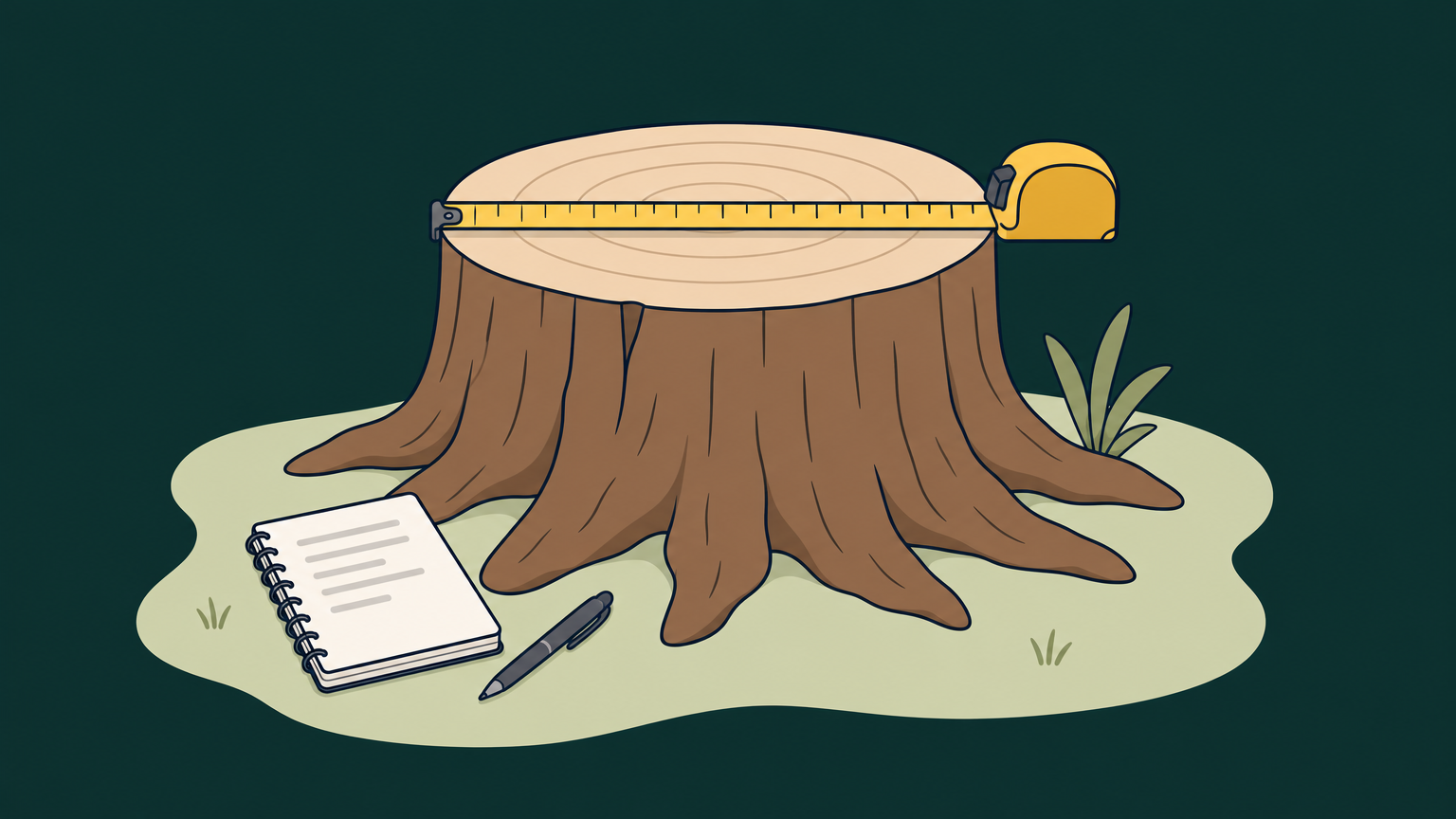
Also note the stump's height above ground and count how many stumps you have. Several stumps in one visit usually cost less per stump than the same stumps booked on different days. Write down whether the wood is a softwood such as pine or fir, or a hardwood such as oak or maple. Hardwood takes longer to grind.
Estimate the tree's height without climbing
Use the shadow method on a sunny day. Measure your own height and the length of your shadow, then measure the tree's shadow along the ground. Then use this formula:
tree height = tree shadow × (your height ÷ your shadow)
If you are 6 feet tall, your shadow is 4 feet and the tree's shadow is 28 feet, the tree is about 42 feet tall. You only need to land in the right height tier, so a few feet of error will not change your range much.
Note the access and photograph everything
Walk the route a crew would take from the street to the work. Note gates narrower than a few feet, fences, sprinkler heads, steep slopes, and anything under or beside the tree: a roof, a garage, a shed, power lines. Tight access is one of the biggest swings in a tree removal price. Then take photos of the trunk, the stump and the surroundings. Copy this worksheet and fill it in:
 Stump 1: diameter ___ in | height ___ in | softwood / hardwood
Stump 2: diameter ___ in | height ___ in | softwood / hardwood
Tree 1: height ___ ft | trunk diameter ___ in | leaning? yes / no
Over or near: roof / fence / power lines / open yard
Access: open gate / narrow gate / no vehicle access
Debris: haul away all / keep wood chips / keep firewood
Photos taken: trunk, stump, access route, what it hangs over
Measure the widest point of the stump and the height of the tree, and the rest of the estimate follows.
Step 2. Price the stump grinding
To price stump grinding, match each stump's diameter to a size band, move the figure up or down for wood type and ground conditions, and add the stumps together. Alexa's grinding price runs from $120 to $380 per stump, so every band below sits inside that range.
Match each stump to a size band
These planning bands are built to fit inside Alexa's range. They assume open access and ordinary soil. Use the low end for softwood and the high end for hardwood.
| Stump diameter | Time on site | Planning range per stump |
|---|---|---|
| Under 12 in. | About 30 minutes if softwood | $120 to $180 |
| 12 to 24 in. | Between the two | $180 to $280 |
| Over 24 in. | 2 to 3 hours if large hardwood | $280 to $380 |
Some companies quote by the diameter inch and add a minimum charge instead. Published guides report minimums of roughly $75 to $125 for grinding, so a single small stump rarely costs less than that. Ask which method a company uses so you can compare quotes on the same basis.
Adjust for wood, roots and ground
Start at the middle of your band, then move it. Each of these pushes the price in a predictable direction:
- Hardwood, such as oak or maple: toward the top of the band. Dense wood dulls teeth and takes longer.
- Softwood, such as pine or fir: toward the bottom of the band.
- Large surface roots or a wide flare: toward the top. There is more wood to cut.
- Rocky soil: toward the top. Rocks damage grinder teeth.
- Obstacles around the stump: fences, irrigation heads and patios add time. Mark sprinkler heads before the crew arrives.
Compare grinding with doing it yourself
Renting a stump grinder typically costs $190 to $360 per day, before fuel, safety gear and your own time. For one small stump, that is already more than a professional's $120 to $180. Doing it yourself starts to make sense only when you have a lot of stumps, and even then the machine is heavy and dangerous without training.
Chemical stump removers cost about $10 for the granules, but they need weeks or months to soften a stump and are a poor fit if you have children, pets or nearby plants. For a stump that blocks the mower or sits in a planned garden bed, a professional grinding visit is faster and has a predictable price.
For one or two stumps, hiring a pro costs about the same as renting the machine for a day.
Step 3. Price the tree removal by height
To price tree removal, find the tree's height tier, take the planning range for that tier, and add roughly one third if access is tight. Alexa's tree removal starts at about $300 and passes $2,000 for the largest trees. Use the cost of tree removal calculator table below for each standing tree.
Pick the height tier
Most tree crews price by the tree, not by the foot, because the work grows faster than height: more climbing, more rigging, a bigger drop zone and more wood to haul. Height tiers capture that. These planning bands fit inside Alexa's range:
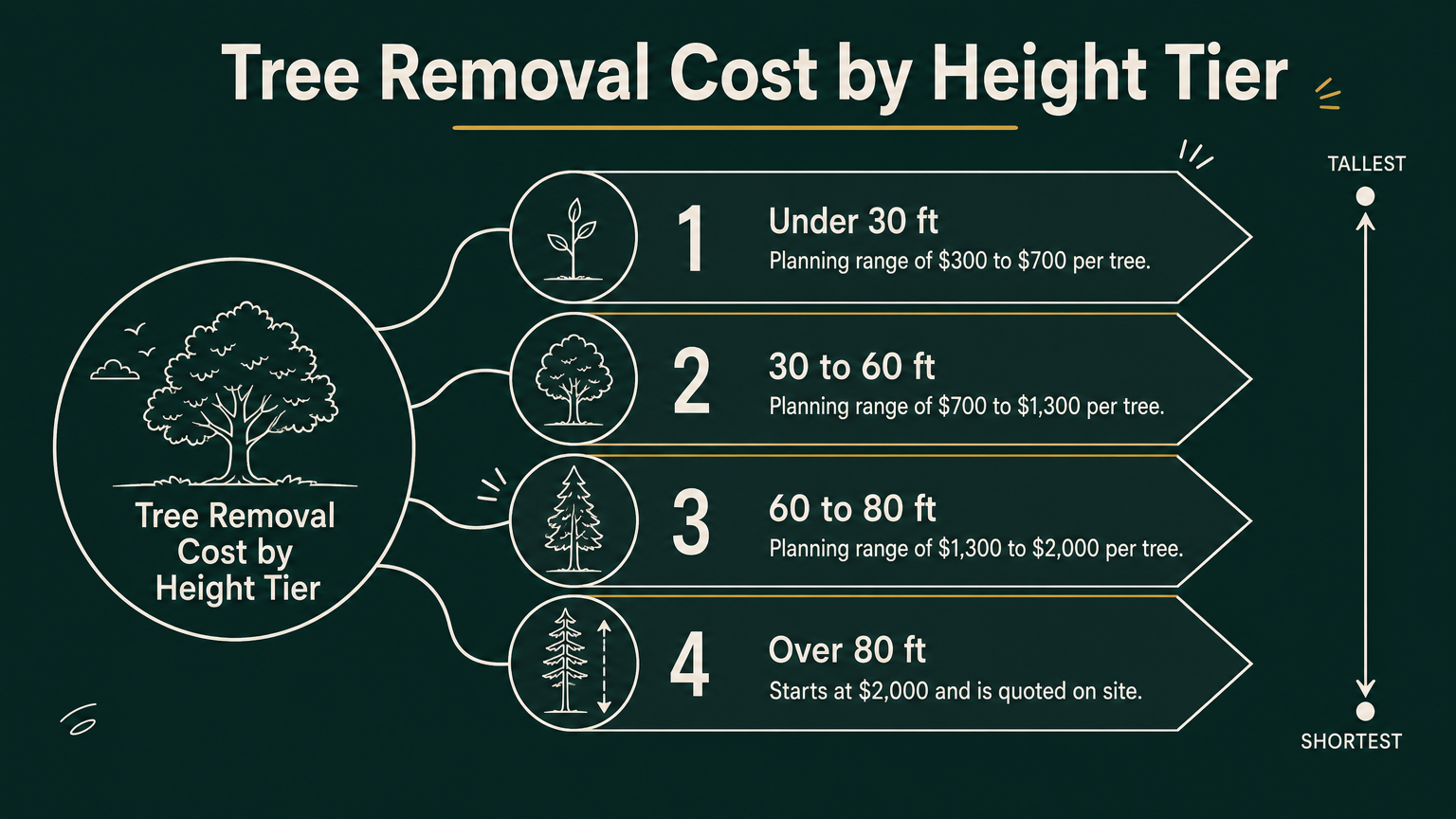
| Tree height | Planning range per tree | Rough cost per foot |
|---|---|---|
| Under 30 ft | $300 to $700 | $15 to $35 (at 20 ft) |
| 30 to 60 ft | $700 to $1,300 | $18 to $33 (at 40 ft) |
| 60 to 80 ft | $1,300 to $2,000 | $19 to $29 (at 70 ft) |
| Over 80 ft | $2,000 and up | Quoted on site |
If you are searching for tree removal cost per foot , treat the last column as a back-of-envelope check, not a billing method. It simply divides each band by a typical height. A quote far outside $15 to $35 per foot for an ordinary tree in open ground deserves a question about what the scope includes.
Small, large and pine trees
A small tree under 30 feet is usually a short job. Most residential removals take 2 to 8 hours , and a small tree in an open yard sits at the bottom of that range. Use the first row of the table and the low end of the band.
A large tree over 60 feet moves into the higher tiers because crews work in the air, lower sections with ropes and bring more equipment. For a pine tree , measure the height before you assume a bargain. Pines tend to grow tall and straight, so the height tier decides the price, though their softwood stumps grind at the lower end of the Step 2 band.
Fallen trees and storm damage
A fallen tree is priced like the standing tree it used to be, minus the climbing if it lies in open ground. If it lies across a roof, fence or driveway, the crew must cut it in controlled pieces to avoid more damage, and the price moves toward the top of the tier. Emergency and after-hours calls are quoted on site, because the work is urgent and the conditions are unpredictable.
If a tree is on a structure or blocking your only exit, call a crew right away rather than building a budget first. Alexa's offers storm cleanup around the clock. If the tree damaged your house, check your homeowner's policy too, since some policies cover removal when a structure is hit.
Height sets the tier, and access decides where in the tier you land.
Step 4. Add branches, debris and other extras
Extras are the lines a basic calculator leaves out: debris haul-away, branch cleanup, minimum charges, permits and scheduling. Add them after the stump and tree lines, because they change the total as much as a size band does.
Debris, chips and branch removal
Debris haul-away is the line to confirm first. Alexa's tree removal includes a crew that hauls away debris, but many companies list it separately. Wood chips from grinding are a separate question: you can keep them as mulch, or ask the crew to take them.
For branch removal , such as storm-broken limbs or a pile left from trimming, crews usually quote a flat job price or bill by crew time. Count the piles, note the largest limb diameter and photograph them. A tree debris removal cost calculator is only as accurate as that count.
| Extra | How it is usually priced | What to do |
|---|---|---|
| Debris haul-away with a removal | Included at Alexa's, separate line elsewhere | Ask if it is in the quote |
| Grinding chips haul-away | Some companies charge by diameter inch, a published guide shows $1.50 to $4 | Keep the chips as mulch to save |
| Branch or limb cleanup | Flat job price or crew time | Count piles and photograph them |
| Tight access | Add roughly one third to the removal line | Clear the route to the work |
| Minimum charge | Often $75 to $125 for grinding in published guides | Bundle stumps in one visit |
| Bundling grinding with removal | Saves $45 to $75 at Alexa's | Book both on the same visit |
Permits, timing and ways to lower the total
In Vancouver, WA, some tree removals need a permit, depending on the tree and the property. Ask the city before you schedule. Alexa's gives permit assistance guidance, and processing takes 5 to 10 business days , so the permit adds time more than cost. Start early so it does not hold up the crew.
Several habits lower the total without cutting corners:
- Bundle every stump and tree into one visit.
- Schedule planned work in calm weather so you avoid emergency calls.
- Clear the route by moving planters, toys and loose items, and opening a gate.
- Rake back mulch so surface roots are visible.
- Keep the chips instead of paying for haul-away.
The cheapest estimate is the one where everything is bundled, cleared and scheduled ahead.
Step 5. Total the range and check it with a quote
To total your range, add the low figures and the high figures from each line separately, subtract any bundling saving, and keep both numbers. The gap between them is your honest uncertainty until a crew sees the site.
Run the numbers for a typical yard
Here is a typical case. You have one 40-foot tree behind a fence, so access is tight, and two stumps: a 26-inch stump from that tree and an older 14-inch stump. Using the bands above:
| Line | Low | High |
|---|---|---|
| 40 ft tree, 30 to 60 ft tier | $700 | $1,300 |
| Tight access, plus one third | $233 | $433 |
| 26 in. stump, large band | $280 | $380 |
| 14 in. stump, medium band | $180 | $280 |
| Debris haul-away with removal | $0 | $0 |
| Bundling saving, midpoint of $45 to $75 | -$60 | -$60 |
| Total | $1,333 | $2,333 |
The midpoint is about $1,800. If you are setting a budget, plan near the high figure. If the quotes you get land inside $1,333 to $2,333 and list the same scope, you are in a normal range.
Check your range against a real quote
Send photos and your worksheet to the companies you are considering, and ask each for a written quote with the same lines: tree, each stump, debris and any permit work. Free estimates let you compare without paying for the comparison. A quote that is far above your range may include extras, such as root removal or haul-away. A quote far below it may leave out the stump or the cleanup.
Before you accept one, ask these questions:
- Does the price include the stump, or only the tree?
- How deep will the grinder go, and who handles the chips?
- Is debris haul-away included?
- Is the company licensed and insured?
- Who handles the permit, if one is needed?
A good quote lists the tree, each stump and the cleanup as separate lines, so you can compare it to your range.
Getting from a range to a real price
You now have a method that works for any yard: measure each stump and the tree, match them to a band, adjust for wood, access and extras, and total a low and a high figure. The worked example shows how a tree and two stumps turn into a range of about $1,300 to $2,300. Your numbers will differ, but the steps do not.
The estimate is a starting point, not a promise. A crew on site sees the roots, the soil and the lean, and can turn your range into a fixed price. If you are in Vancouver, Portland or nearby, you can request a free estimate from Alexa's Tree Service and bring your worksheet and photos. That gives you a quote to compare against the number you just built.