
Tree Service Removal Cost: What You'll Pay in 2026
You've got a tree that needs to come down, and the first question is always the same: what's this going to cost? Tree service removal cost varies more than most homeowners expect, and getting a number in your head before you call anyone helps you spot a fair quote from an inflated one.
In the Vancouver and Portland area, most homeowners pay somewhere between a few hundred dollars for a small backyard tree and several thousand for a large hazardous tree near a structure or power line. Tree removal prices hinge on height, trunk diameter, location, and how much cleanup and stump work you want included. Straight answers on those factors are what turn a rough guess into a real budget.
We've spent over 15 years pricing and removing trees across Clark County and the greater Portland metro, so this breakdown reflects what jobs actually cost here, not national averages that don't match Pacific Northwest labor and access conditions. Below, we'll walk through rates for tree removal by size and complexity, what pushes prices up, and how to compare quotes without getting burned.
Why tree removal costs vary so much
Ask five tree companies to quote the same job and you'll get five different numbers, sometimes a difference of a thousand dollars or more. That spread isn't random. Tree removal cost depends on a stack of variables that compound on each other: a 60-foot tree next to a garage costs far more to remove than the same tree standing alone in an open field. Understanding what determines the price of a tree removal lets you ask better questions when a crew shows up to bid your job.
Tree height and size
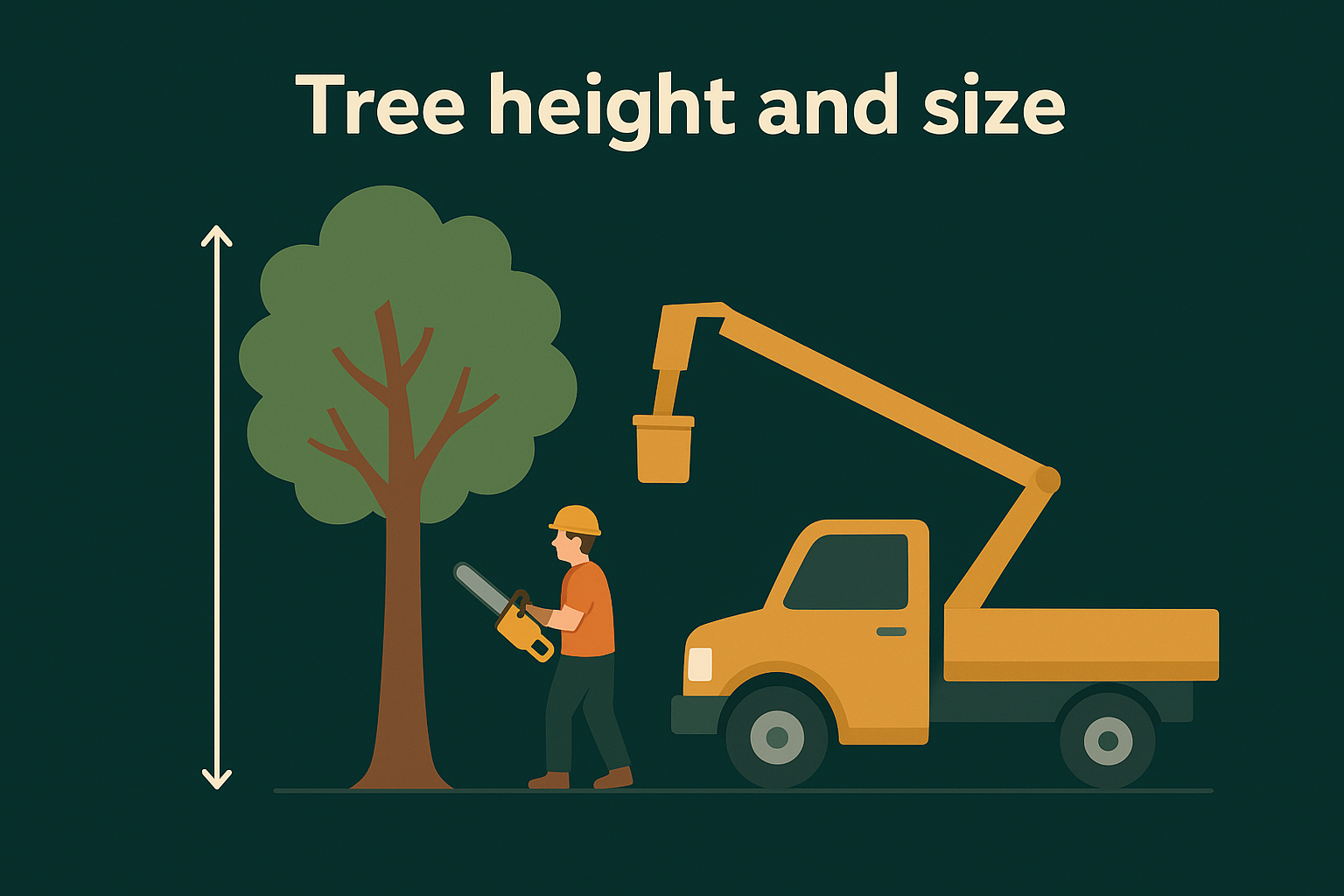
Height is the first thing any estimator looks at, because it determines rigging, equipment, and time on site. A 20-foot ornamental tree might take an experienced crew 45 minutes to fell and haul away. A 90-foot Douglas fir, common across Clark County properties, can take a full crew most of a day, especially if it has to come down in sections rather than one clean drop.
| Tree Height | Typical Complexity | Rough Price Range |
|---|---|---|
| Under 30 ft | Low, often single-crew job | $200 - $600 |
| 30 - 60 ft | Moderate, may need rigging | $600 - $1,500 |
| 60 - 80 ft | High, sectional removal likely | $1,200 - $2,500 |
| Over 80 ft | Very high, near structures or lines | $2,500 - $5,000+ |
These ranges shift based on everything else in this section, so treat them as a starting point, not a quote.
Trunk diameter and wood density
Beyond height, trunk diameter matters just as much. A wide-trunked maple with a 40-inch base takes longer to cut through and produces far more wood and debris than a slender pine of the same height. Denser hardwoods like oak also dull chainsaw chains faster and slow the whole job down compared to softer conifers common in Pacific Northwest yards.
The single biggest driver of your final bill isn't the tree's height, it's how hard the crew has to work to get it safely on the ground and off your property.
Location and access
Getting equipment to the tree changes the math entirely. Crews with clear driveway access can bring in a bucket truck or crane, cutting labor time significantly. Trees tucked behind fences, over septic systems, or wedged between a house and a property line usually mean climbing and manual rigging instead, which takes longer and costs more in labor. Overhead power lines add another layer of complexity and often require coordination with the utility company before any cutting starts.
Condition and hazard level
Healthy trees are more predictable to remove than dead, diseased, or storm-damaged ones. Rotted wood can shift unpredictably mid-cut, brittle limbs can snap without warning, and a tree already leaning toward a structure demands slower, more careful rigging to control the drop. Hazardous removals, the kind we get called for after windstorms roll through Vancouver and Portland, almost always run higher than a straightforward, healthy tree removal because the safety margin has to be wider.
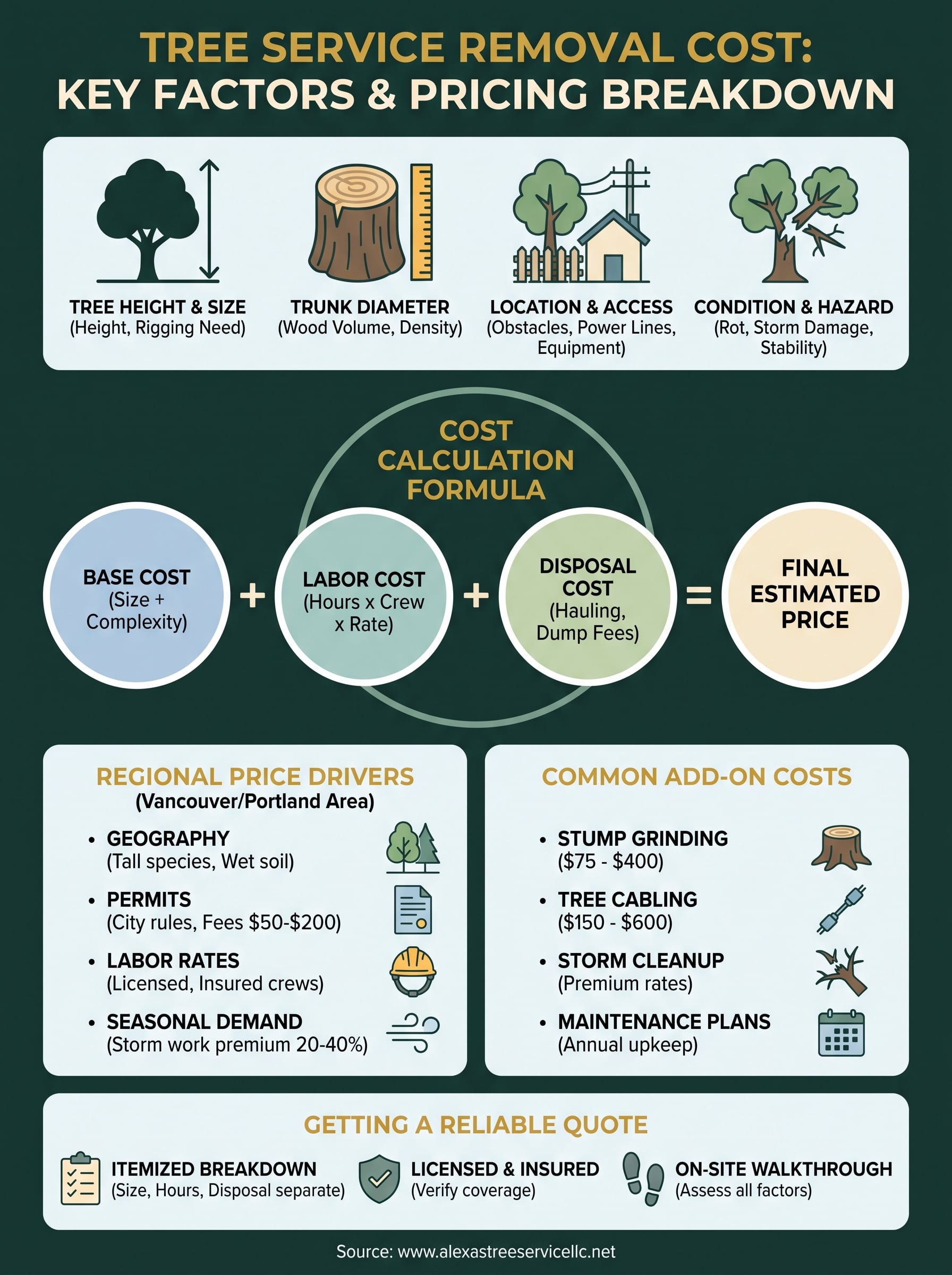
Grouped together, these four factors, height, trunk size, access, and condition, explain almost every dollar of variation you'll see between quotes. A company that walks your property and asks about all four before naming a price is doing it right. One that quotes a flat number over the phone without seeing the tree usually isn't accounting for something that will surface as an added fee later.
How to estimate your tree removal cost by size and hours
Most tree companies price a job by combining a base rate for size with an hourly labor estimate for the crew and equipment involved. Understanding this math lets you build your own rough estimate before a crew ever sets foot on your property, and it gives you a way to sanity-check any quote you receive.
Budget-minded homeowners often ask how many labor hours a typical job takes. A small tree under 30 feet with easy access usually runs one to two hours for a two-person crew. A mid-size tree in the 30 to 60 foot range, especially one requiring rigging around a fence or shed, can eat up three to five hours. Anything over 60 feet, or a job requiring sectional cutting near a structure, often stretches into a full day, six to eight hours or more, once you factor in setup, cutting, and hauling debris.
Crew size and equipment needs shift the math further. A job that only needs a chainsaw and a couple of climbers costs less per hour than one requiring a bucket truck, crane, or extra ground crew to manage traffic and debris. Here's a simple way to frame it:
- Base cost = size category (small, medium, large) plus complexity multiplier for access and hazard
- Labor cost = estimated hours x crew size x hourly rate
- Disposal cost = hauling and dump fees, often bundled but sometimes billed separately
Add those three together and you land close to what most companies quote for tree removal prices in this region.
If a quote skips straight to a flat number without mentioning hours, crew size, or disposal, ask what's included before you sign anything.
Getting a written breakdown matters more than most homeowners realize. Two quotes for the same tree can look identical on the surface but differ by hundreds of dollars once you see whether stump grinding, debris hauling, or permit paperwork is baked in. Homeowners comparing bids should always ask for the size, hours, and disposal costs itemized separately rather than lumped into one number, since that's the only way to compare apples to apples across companies.
What drives pricing in Vancouver and Portland
Local geography and city rules add a layer of cost that a national pricing guide can't capture. Douglas fir and big leaf maple dominate yards across Clark County and Multnomah County, and both grow tall enough that most removals here fall into the higher end of the size chart above. Add in a rainy season that saturates root systems from October through April, and you get more storm-weakened trees needing emergency work than you'd find in a drier climate.
City permit rules push the price further. Vancouver, WA requires a permit for removing certain trees within city limits, particularly heritage trees or anything in the public right-of-way, and navigating that paperwork takes time a homeowner rarely has when a tree is already leaning. Portland's Urban Forestry code is even stricter, especially for street trees planted between the sidewalk and curb, which is why certified arborist work in Portland often includes permit handling. A company that handles permit assistance as part of the job saves you a trip to city hall, but that service gets factored into the quote.
| City | Permit Trigger | Typical Added Cost |
|---|---|---|
| Vancouver, WA | Heritage trees, right-of-way removals | $50 - $150 permit fee |
| Portland, OR | Street trees, trees over set diameter | $75 - $200 permit fee |
Skipping the permit step to save money almost always costs more later, once the city fines land on your desk.
Labor rates matter too. Crews that carry a license and full insurance in the Vancouver-Portland metro charge more per hour than the national average, largely because cost of living here runs higher and qualified climbers are in short supply. Rates for tree removal from a properly insured company will read higher on paper than a cash-only crew working out of a pickup truck, but that gap covers workers' comp, liability coverage, and cleanup that actually meets city standards.
Seasonal demand shifts pricing as well. Fall and winter windstorms flood local companies with emergency calls, and 24/7 storm cleanup work often carries a premium over a scheduled removal booked in July. Homeowners who plan trims and removals during the slower summer months typically land better pricing than those calling mid-storm.
Extra services that add to your tree removal bill
A base tree removal quote rarely covers everything you actually need done. Most homeowners end up adding at least one extra service once the tree is down, and knowing these costs upfront keeps the final invoice from surprising you.
Stump grinding
Grinding down what's left after removal is the most common add-on we quote. Stump grinding typically runs $75 to $400 depending on stump diameter and root spread, and it's rarely included in a base removal price unless you ask for it as a package. Leaving a stump behind might save money short-term, but it invites pests, trip hazards, and regrowth shoots that cost more to deal with later.
Tree cabling and support
Sometimes the goal isn't removal at all, it's saving a tree that's structurally weak. Tree cabling in Vancouver, WA installs steel support systems in the canopy to prevent a split trunk or heavy limb from breaking during a windstorm, and it typically costs $150 to $600 depending on tree size and how many support points the crew installs. This service makes sense for a mature, otherwise healthy tree that just needs reinforcement rather than a chainsaw.
Storm cleanup and emergency work
Emergency calls after a windstorm carry different pricing than a scheduled removal. Post-storm cleanup work often includes hauling downed limbs, clearing driveways, and sometimes emergency bracing before a full removal can even be scheduled. Because crews respond on short notice, often middle-of-the-night calls during a Pacific Northwest windstorm, expect a premium of 20 to 40 percent over standard daytime rates.
Emergency storm work costs more for a reason: crews are mobilizing fast, often in dangerous conditions, to protect your property before things get worse.
Ongoing maintenance plans
Homeowners who want to avoid emergency calls altogether often sign up for a year-round property upkeep plan covering seasonal pruning, health checks, and early identification of disease or structural weakness. These plans typically bundle two to three visits a year at a lower combined rate than paying for each service separately, and they catch problems while trimming still solves them, before a full removal becomes the only option.
| Extra Service | Typical Cost Range |
|---|---|
| Stump grinding | $75 - $400 |
| Tree cabling | $150 - $600 |
| Storm cleanup (per call) | 20-40% premium over standard rate |
| Maintenance plan (annual) | Varies by property size and visit count |
Getting a reliable quote for your project
Pricing a tree removal isn't guesswork once you know what to look for. Tree service removal cost comes down to height, trunk diameter, access, condition, and whichever extras you tack on, whether that's stump grinding, cabling, or a maintenance plan. A trustworthy company walks your property, explains each factor, and hands you an itemized quote rather than a flat number pulled out of thin air.
Quotes that skip the details usually hide costs that surface later as change orders. You deserve a crew that answers questions upfront, carries proper insurance, and stands behind clean, damage-free work in your yard, not one that disappears after cashing your check.
If you're ready to compare a real number against everything you've read here, schedule your free on-site tree estimate and get a written breakdown built for your property, not a national average.